


Three months ago, a construction company's CFO called me in a panic. They'd just received a Department of Labor audit notice covering their entire West Coast operation — 280 employees spread across California, Oregon, and Washington, with about half working hybrid schedules between job sites and remote planning work. Their timekeeping system? A patchwork of mobile apps, Excel sheets, and paper timecards that nobody had properly mapped to each state's specific requirements.
The audit exposed $247,000 in potential penalties. Not because they weren't tracking time — they had mountains of data. The problem was their system couldn't prove compliance across different jurisdictions, work types, and employee classifications. Every state had different rules for meal breaks, overtime calculations, and record retention. Their hybrid workers triggered compliance requirements they didn't even know existed.
This happens because timekeeping systems weren't designed for modern work reality: employees crossing state lines, switching between remote and on-site work, and triggering different regulatory frameworks based on where they open their laptop on any given Tuesday.
The jurisdiction trap that catches businesses off guard
Most businesses discover cross-jurisdiction timekeeping issues the expensive way. You hire someone in Texas who occasionally works from their vacation home in Colorado. Your California team has employees who moved to Nevada but kept their jobs. That New York consultant spends three months in Florida every winter.
Each scenario creates a compliance nightmare that standard timekeeping systems can't handle. California requires meal breaks documented differently than Oregon. New York's spread-of-hours rules don't exist in Texas. Some states count travel time as hours worked, others don't. Your single timekeeping policy suddenly needs to morph based on geography, and your technology stack probably can't keep up.
Overtime calculations break first. An employee works 35 hours from their home in Portland and 10 hours from a client site in San Francisco. Which state's overtime rules apply? Both? Neither? Your payroll team manually researches labor law while trying to process timesheets, creating a bottleneck that gets worse every pay period.
Record-keeping hits the second failure point. Different states require different retention periods, different levels of detail, and different audit trails. A timekeeping system that's perfectly compliant in one state might be missing critical data for another. By the time you realize this, you're already non-compliant and scrambling to reconstruct records that should have been captured differently from day one.
Building the three-layer compliance framework
Policy alone won't save you. Technology without proper configuration is useless. Auditing without the right foundation catches problems too late.
Accurate time tracking made effortless.
GoTimio empowers your team to log, monitor, and manage work hours seamlessly.
- Real-time time tracking
- Automated timesheet approvals
- Payroll and billing integration
No credit card required
Layer 1: Policy Architecture Your policies need to acknowledge geographic reality. Instead of one timekeeping policy, you need a master framework with jurisdiction-specific addendums. The master policy covers universal requirements — everyone must log time daily, everyone must document breaks, everyone must submit weekly. The addendums handle the local variations.
A marketing agency structured it like this: Their master policy required all employees to log time through their central system with location tags. California employees had an addendum requiring two separate meal break confirmations. New York employees had an addendum covering spread-of-hours documentation. Remote employees had an addendum requiring weekly location certification.
Layer 2: Technology Configuration Most timekeeping software can handle multiple locations, but few are properly configured for true hybrid compliance. The technology layer needs three core capabilities that rarely come standard.
Dynamic rule application based on real-time location. Not just where the employee is hired, but where they're actually working each day. This means GPS verification, IP tracking, or manual location certification — preferably all three with logic to handle conflicts.
Automated policy enforcement that changes with location. If someone works from California on Monday and Arizona on Tuesday, the system needs to prompt for different break confirmations, calculate overtime differently, and flag different compliance risks.
Defensible audit trails that capture not just time entries but the compliance context. Which rules were applied? Why? What version of the policy was active? What notifications were sent? This metadata becomes critical during audits.
A logistics company solved this by implementing location-aware time tracking that automatically switched rule sets based on GPS data. Drivers crossing state lines triggered different meal break requirements without any manual intervention. The system maintained separate audit trails for each jurisdiction, making compliance reporting straightforward instead of nightmarish.
Automate jurisdiction addendums so rules apply without manual toggles when an employee's location changes.
Here's a quick workflow showing how the three layers interact to apply rules, enforce policies, and capture audit evidence.
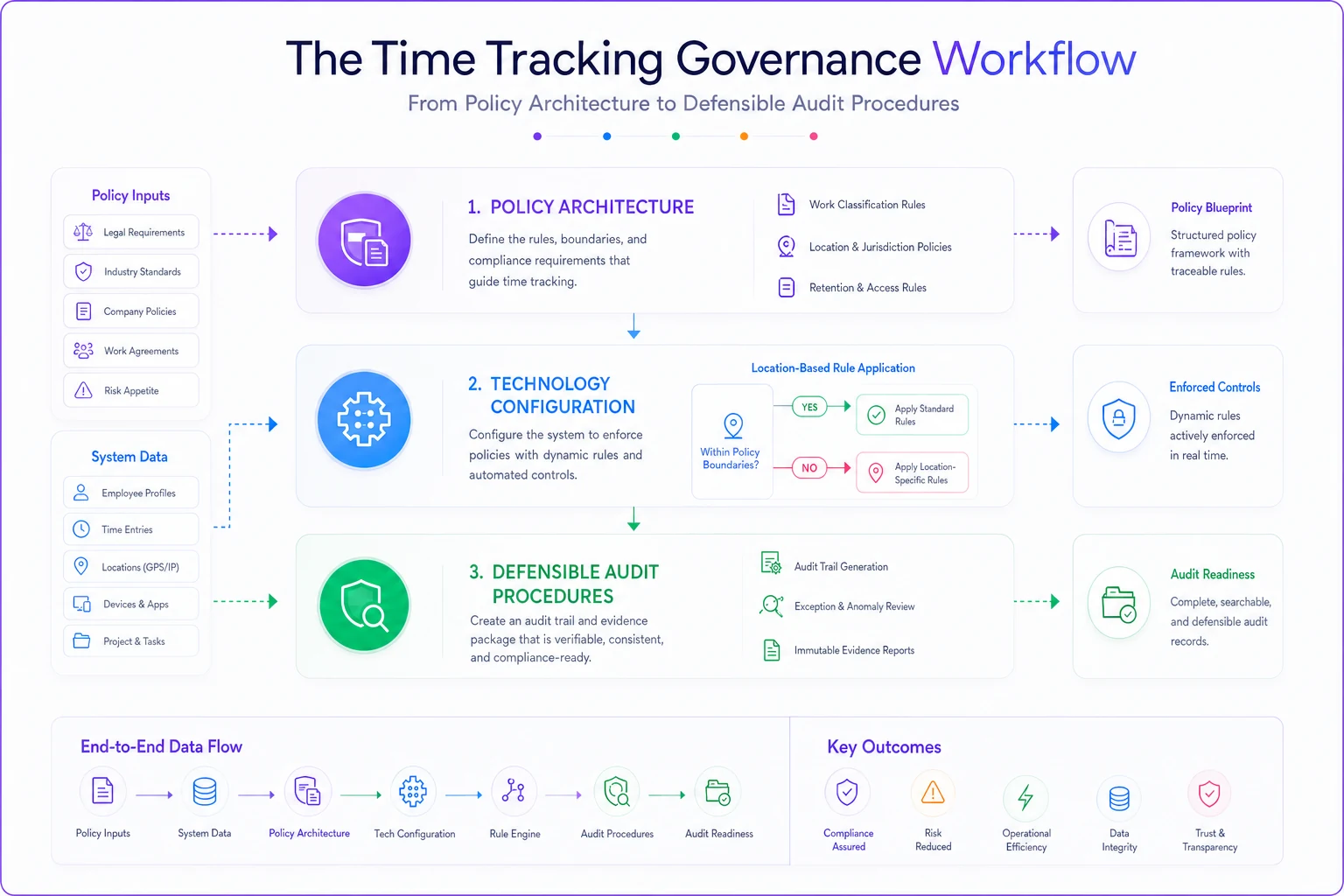
This diagram highlights where decisions happen and what data needs to be captured for audits.
Layer 3: Audit Procedures The audit layer is where most businesses realize their first two layers have massive gaps. You need two types of audits running continuously: operational audits that catch problems before they compound, and compliance audits that ensure you're ready for external scrutiny.
Operational audits should run weekly and focus on exceptions. Which employees logged time from unexpected locations? Who triggered multiple jurisdiction rules in one pay period? Where are the gaps between policy requirements and actual data capture?
Compliance audits need to simulate external reviews. Can you produce six months of meal break records for California employees? Can you prove overtime was calculated correctly for employees who worked across state lines? Can you show your policies were updated when regulations changed?
The escalation pathway that fixes problems before they become violations
When compliance issues surface — and they always do — you need an escalation pathway that fixes problems before they become violations. Most businesses have some version of "manager reviews timesheets," but that's not an escalation pathway, it's a rubber stamp.
Real escalation pathways have triggers, owners, and deadlines. A missing meal break triggers an immediate manager notification with a 24-hour response requirement. Three missing meal breaks trigger an HR review with documented coaching. Pattern violations trigger a compliance review with potential system changes.
Level 1: Automated Corrections (Same Day)
-
System detects missing meal break
-
Automated reminder sent to employee
-
Manager notified if not resolved within 2 hours
-
Entry locked after business day ends
Level 2: Manager Intervention (Next Day)
-
Manager reviews all flagged entries
-
Direct contact with employee required
-
Correction must include explanation
-
Pattern tracking initiated
Level 3: HR Review (Weekly)
-
All corrections reviewed for patterns
-
Policy gaps identified
-
Training needs assessed
-
System modifications proposed
Level 4: Compliance Review (Monthly)
-
Cross-jurisdiction issues analyzed
-
Regulatory changes incorporated
-
Audit trail integrity verified
-
Executive reporting prepared
A software company implemented this framework and saw compliance issues drop by 80% in four months. Not because employees suddenly became more compliant, but because problems got caught and fixed at Level 1 instead of festering until audit time.
Cross-jurisdiction checklist for immediate implementation
Stop waiting for perfect policies or complete system overhauls. These checks will catch your biggest compliance gaps now:
Daily Location Verification
-
[ ] Employees confirm work location at clock-in
-
[ ] System captures GPS or IP location
-
[ ] Conflicts between reported and detected location flagged
-
[ ] Remote work properly categorized vs on-site
Meal Break Compliance by State
-
[ ] California
30-minute meal before 5th hour documented
-
[ ] New York
Spread-of-hours tracked for 10+ hour days
-
[ ] Colorado
30-minute meal for 5+ hour shifts recorded
-
[ ] Oregon
Meal break waivers documented and retained
Overtime Calculation Variations
-
[ ] Daily overtime (California, Alaska, Nevada) calculated separately
-
[ ] Weekly overtime properly offset by daily OT already paid
-
[ ] Weighted average rate calculated for multiple pay rates
-
[ ] Travel time included/excluded based on state rules
Record Retention Requirements
| Jurisdiction | Retention |
|---|---|
| Federal | 3 years for payroll records |
| California | 4 years for personnel records |
| New York | 6 years for payroll records |
| System | configured for longest applicable period |
Multi-State Worker Tracking
-
[ ] Employees working in multiple states identified
-
[ ] Primary work location established and documented
-
[ ] Temporary work location changes tracked
-
[ ] Tax implications flagged for payroll
Use these checks to find the biggest gaps fast and prioritize fixes.
When manual workarounds stop working
You know you've hit the breaking point when your payroll team spends more time researching compliance than processing time entries. When every new hire in a different state triggers a week-long policy review. When your audit preparation takes longer than the audit itself.
The transformation usually happens in stages. First, businesses centralize their timekeeping data, eliminating the spreadsheet chaos. Then they add location intelligence, so the system knows where work is happening. Finally, they implement dynamic rule engines that automatically apply the right compliance requirements based on real-time factors.
Modern AI-powered operational platforms handle this by building jurisdiction intelligence directly into the timekeeping workflow. When an employee clocks in, the system knows their location, applies the correct rules, enforces the right policies, and maintains jurisdiction-specific audit trails. It's not just time tracking with extra features — it's a compliance system that happens to track time.
The shift happens when you stop treating timekeeping as data collection and start treating it as risk management. Every time entry is a potential compliance event. Every policy exception is a future audit finding. Every missing record is a penalty waiting to happen.
The compound effect of systematic compliance
When your timekeeping system actually handles cross-jurisdiction complexity, other operational improvements become possible.
Payroll processing time drops dramatically when you're not manually researching every edge case. HR spends less time firefighting and more time on strategic work. Managers trust the system instead of second-guessing every timesheet. Employees know exactly what's expected regardless of where they're working.
A professional services firm tracked their improvement after implementing this three-layer framework. Before: 23 hours per week spent on timekeeping compliance across their 150-person team. After: 4 hours per week, mostly reviewing exception reports. That's 988 hours per year redirected from compliance firefighting to revenue-generating work.
But the bigger win was confidence. They could hire in any state without a three-week compliance research project. They could let employees work remotely without wondering what regulations they were violating. They could face audits without panic, knowing their records would hold up to scrutiny.
Making the framework stick
The difference between businesses that maintain compliance and those that constantly scramble comes down to system thinking. You can't bolt compliance onto a broken timekeeping process. You can't automate your way out of unclear policies. You can't audit your way to good data if the foundation is shaky.
Start with the reality of how your employees actually work. Map their movements, understand their patterns, identify where jurisdiction lines blur. Build policies that acknowledge this reality instead of pretending everyone works from a single location. Configure technology that enforces these policies automatically, not through constant manual intervention.
Most importantly, treat compliance as an operational capability, not a legal burden. Every business operating across state lines needs this capability. The question is whether you build it intentionally or accidentally discover you don't have it during an audit.
The construction company? They rebuilt their entire timekeeping system using this framework. Six months later, they passed a follow-up audit with zero findings. Not because they hired compliance experts or bought expensive software, but because they built a system that made compliance the path of least resistance. When good compliance becomes easier than non-compliance, the rest takes care of itself.
Ready to optimize your workforce time management?
Join 2,000+ companies using GoTimio to improve timesheet accuracy, reduce payroll errors, and boost team productivity.