


You discover an employee logged 45 hours last week, but their keycard shows they left early three days straight. Now you're stuck between two terrible options: ignore potential fraud or risk destroying team morale with heavy-handed accusations.
Most managers handle timesheet fraud detection completely wrong. They either go full CSI mode—installing surveillance software, conducting surprise audits, announcing "crackdowns"—or they ignore red flags until the problem explodes into a $15,000 payroll discrepancy that finance discovers during year-end reconciliation.
Timesheet fraud rarely starts as malicious theft. It usually begins with someone padding 15 minutes here and there during a tough week. Then it becomes habit. Then normalized. Eventually you've got multiple employees adding phantom hours because "everyone does it."
Aggressive fraud detection often punishes honest employees more than fraudsters. Your top performer who occasionally forgets to clock out gets flagged by the same system as someone deliberately stealing time. The resulting investigation demoralizes good employees while sophisticated time thieves learn to game whatever detection method you implement.
Why standard fraud detection creates more problems than it solves
Traditional timesheet monitoring relies on pattern matching that generates mountains of false positives. Your system flags Sarah for irregular punch times, but she's actually your most reliable employee who covers different shifts when needed. Meanwhile, the actual fraudster maintains perfectly consistent 9-to-5 entries while leaving at 3 PM daily.
The investigation process typically destroys trust even when no fraud exists. Picture running a 50-person manufacturing operation where you announce mandatory timesheet audits after discovering discrepancies. Suddenly every legitimate correction—someone forgot to clock back from lunch, logged wrong project code, fixed yesterday's mistake—looks suspicious. Productivity drops as employees spend time documenting every minute instead of working.
Public fraud investigations create adversarial dynamics that poison workplace culture. Once employees know you're actively hunting for timesheet fraud, they start covering for each other, warning about audits, and viewing management as the enemy. The social cost often exceeds whatever money you might recover from catching fraudsters.
Building anomaly detection that catches fraud without false alarms
Effective fraud detection starts with baseline behavioral patterns, not rigid rules. Instead of flagging anyone who clocks in outside normal hours, you track individual patterns over time. When someone suddenly shifts from consistent 8:30 AM arrivals to erratic morning times, that's worth investigating—but only after considering legitimate explanations.
Accurate time tracking made effortless.
GoTimio empowers your team to log, monitor, and manage work hours seamlessly.
- Real-time time tracking
- Automated timesheet approvals
- Payroll and billing integration
No credit card required
Here's an anomaly scoring framework that reduces false positives:
| Anomaly Type | Low Risk (1-2 points) | Medium Risk (3-4 points) | High Risk (5+ points) |
|---|---|---|---|
| Time variance | 15-30 min from baseline | 30-60 min shifts | 60+ min changes |
| Pattern breaks | 1-2 per month | Weekly inconsistencies | Daily variations |
| Buddy punching indicators | Occasional overlap | Frequent near-misses | Impossible sequences |
| Project allocation | Minor discrepancies | Regular mismatches | Systematic patterns |
| Documentation gaps | Occasional missing notes | Frequent omissions | Deliberate avoidance |
Combine multiple weak signals rather than relying on single strong indicators. Someone occasionally arriving late isn't fraud. Someone arriving late, with no project notes, whose badge shows different times, and whose output doesn't match logged hours—that warrants investigation.
Behavioral baselines need regular recalibration. Seasonal patterns, project cycles, and personal circumstances all affect legitimate time patterns. A warehouse worker's hours during inventory season look nothing like their regular schedule. Without context, your detection system generates useless noise.
Progressive spot audits that feel routine, not punitive
Random spot checks work better than announced investigations, but only when positioned as routine quality control rather than fraud hunting. The messaging matters enormously. "We're auditing timesheets for fraud" triggers defensive reactions. "We're reviewing time allocation accuracy for project costing" feels administrative.
Start with soft verification that doesn't feel like interrogation:
Week 1-2: Documentation review
-
Compare timesheet entries against project deliverables
-
Check badge/keycard data for general alignment
-
Review expense reports for timing consistency
Week 3-4: Indirect observation
-
Note arrival/departure patterns during normal operations
-
Compare claimed overtime against actual output
-
Cross-reference with customer interaction logs or support tickets
Week 5-6: Gentle verification
-
"Hey, I noticed you logged Project X on Tuesday but the client says the meeting was Wednesday. Mind checking?"
-
"Facilities mentioned the lights were off in your section after 4 PM yesterday but you've got hours until 6. Everything okay?"
Maintain plausible deniability about fraud suspicions during initial investigations. Most discrepancies have innocent explanations. Jumping straight to accusations destroys relationships unnecessarily.
When patterns strongly suggest fraud, shift to targeted verification:
Targeted audit indicators:
-
Three or more anomaly patterns converging
-
Discrepancies exceeding $500 monthly
-
Multiple employees reporting concerns
-
Customer complaints about availability despite logged hours
Even targeted audits should feel procedural rather than personal. Frame them as "ensuring accurate project costing" or "validating overtime budget allocations." This preserves dignity while gathering evidence.
Here's a simple visual of the progressive spot-audit workflow to help teams understand the process.
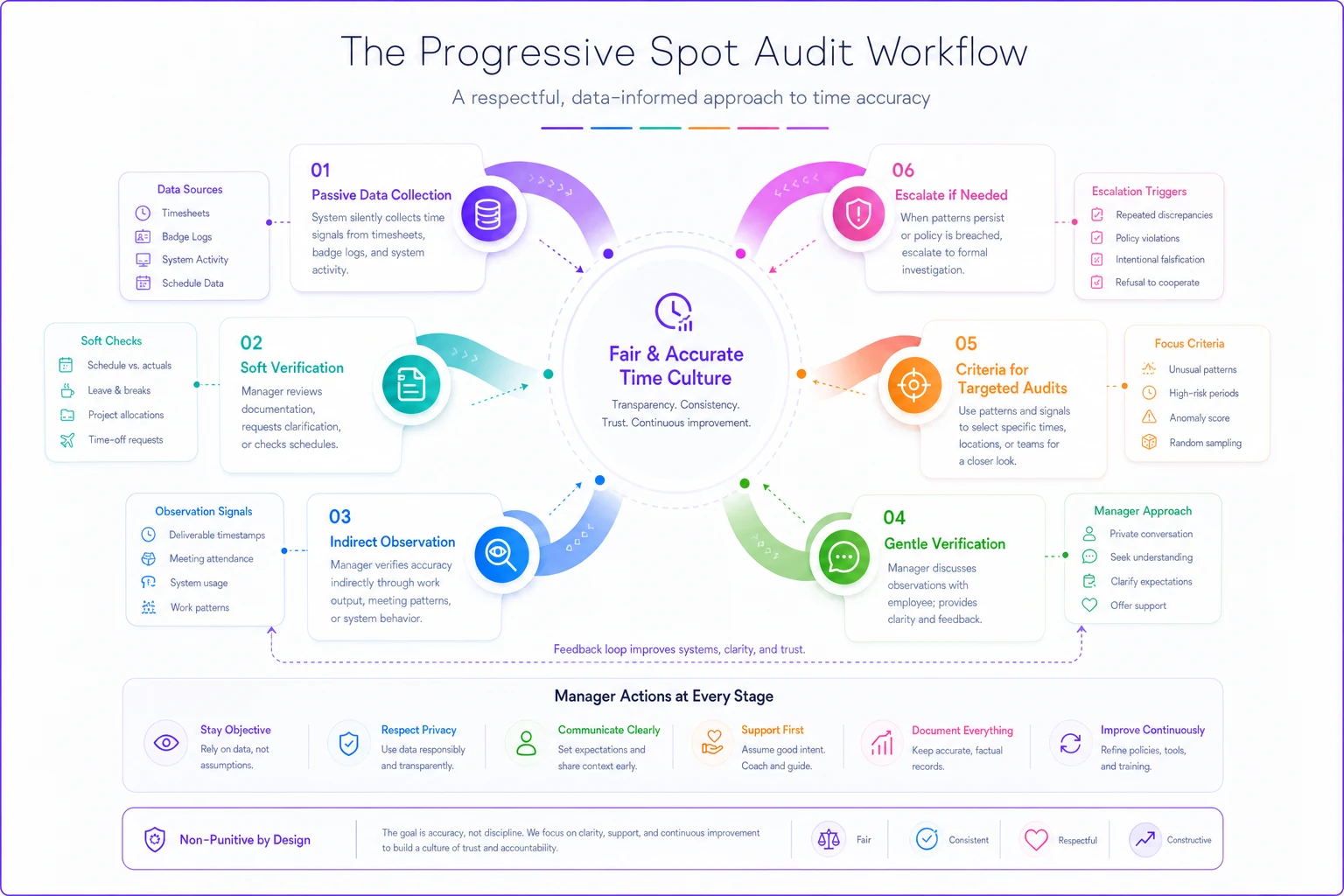
Position spot checks as routine quality reviews to avoid signaling suspicion.
Most discrepancies have innocent explanations. Jumping straight to accusations destroys relationships unnecessarily.
Communication scripts that preserve dignity during investigations
Initial inquiry (no accusation):
> "Hi [Name], I'm reviewing last week's timesheets for the quarterly labor report and noticed a few entries I wanted to clarify. Do you have five minutes to help me understand your hours for Tuesday and Thursday?"
Clarification request (soft challenge):
> "I'm seeing 8 hours logged for the Morrison project on Wednesday, but the client mentioned you wrapped up Tuesday evening. Could you walk me through what you worked on Wednesday? Sometimes project codes get mixed up in our system."
Discrepancy discussion (firmer):
> "I need your help resolving something. Your timesheet shows you here until 6 PM yesterday, but the security log has you badging out at 4:15 PM. What am I missing? Sometimes the system glitches, so I want to understand what happened."
Always provide an "out" that preserves dignity. Even when you're certain fraud occurred, leaving room for explanation prevents defensive lockdown. Employees who made honest mistakes will clarify immediately. Fraudsters typically offer elaborate, inconsistent explanations.
For conversations with suspected fraudsters, document everything but avoid confrontational language:
Investigation meeting opener:
> "I've been reviewing our time tracking accuracy across the department and found some patterns in your timesheets I need to understand. This isn't a disciplinary meeting—I'm trying to ensure our records are correct and understand if there are system issues we need to address."
Evidence presentation (non-accusatory):
> "Here's what I'm seeing: Over the past six weeks, your logged hours total 247, but project deliverables and system logs suggest closer to 210-220 hours of actual work. Help me understand this gap. Are there tasks I'm not seeing? Issues with how you're tracking time?"
Each script positions the manager as solving a puzzle rather than prosecuting a crime. This approach:
-
Reduces defensive reactions
-
Encourages honest disclosure
-
Maintains professional relationships if no fraud occurred
-
Provides clear documentation if termination becomes necessary
Always provide an "out" that preserves dignity. Even when you're certain fraud occurred, leaving room for explanation prevents defensive lockdown. Employees who made honest mistakes will clarify immediately. Fraudsters typically offer elaborate, inconsistent explanations.
Progressive discipline that starts gentle
When fraud is confirmed, your response should escalate gradually unless the violation is egregious. Immediate termination for minor first offenses creates fear-based cultures where nobody reports problems.
Level 1: Coaching conversation (first minor offense)
-
Verbal warning with written follow-up email
-
Clarify time tracking expectations
-
Implement weekly timesheet review for 30 days
-
No formal disciplinary record if behavior corrects
Sample follow-up email:
> "As discussed, I've noticed some inconsistencies in your recent timesheets. Going forward, please ensure all time entries match actual hours worked. I'll review your timesheets weekly for the next month to help ensure accuracy. Let me know if you need clarification on our time tracking policies."
Level 2: Written warning (repeated issues or moderate fraud)
-
Formal documentation in personnel file
-
Specific examples of violations
-
Clear consequences for continued fraud
-
Required signature acknowledging understanding
Level 3: Final warning with restitution
-
Calculate fraudulent wages received
-
Offer repayment plan or immediate termination choice
-
Mandatory daily check-ins
-
Any future violation triggers termination
Level 4: Termination with potential legal action
-
Immediate termination for cause
-
Documentation package for unemployment challenge
-
Consideration of criminal charges for amounts over $1,000
-
Recovery of fraudulent wages through legal channels
The progression speed depends on severity. Padding 30 minutes occasionally might warrant coaching. Claiming 20 hours of phantom overtime jumps straight to final warning or termination. Document the rationale for skipping steps when warranted.
System design that prevents fraud without creating surveillance culture
Manual timesheet fraud detection wastes enormous operational energy while missing sophisticated fraud. You need systematic detection that runs quietly in the background, flagging only significant anomalies for human review.
Modern operational software can correlate multiple data streams automatically:
-
Badge/keycard entry and exit times
-
Computer login/logout patterns
-
Project management task updates
-
Customer interaction timestamps
-
Email and communication activity
-
GPS data for mobile employees
The trick is implementing these tools without creating Big Brother paranoia. Position them as operational efficiency improvements, not surveillance. "We're integrating time tracking with project management to reduce your admin work" lands better than "We're monitoring your every move."
Smart anomaly detection reduces false positives through context awareness. The system learns that Jennifer always works late Thursdays for the Asia-Pacific client calls. It knows warehouse staff hours spike during receiving days. These patterns become baseline normal, not fraud indicators.
AI-powered analysis can identify subtle fraud patterns humans miss:
-
Employees who always clock in exactly at 9
00:00
-
Suspicious clustering of overtime requests
-
Time entries that correlate with sports events or holidays
-
Groups of employees with synchronized suspicious patterns
But the technology should augment human judgment, not replace it. When the system flags anomalies, managers investigate with the scripts and progressive approach outlined above. This combination of automated detection and respectful human intervention maintains both fiscal responsibility and team trust.
Recovery strategies when fraud damages team morale
Discovering timesheet fraud creates ripple effects beyond the perpetrator. Other employees wonder if they're suspected, worry about increased scrutiny, and lose faith in colleagues. Recovery requires deliberate trust rebuilding.
After resolving fraud cases, address the team without revealing specific details:
> "I want to address some recent changes in our time tracking procedures. We've identified and resolved some discrepancies in our timesheets. Going forward, we're implementing better systems to ensure accuracy and fairness for everyone. These changes aren't about mistrust—they're about protecting honest employees and ensuring everyone's paid correctly for their actual work."
Focus on protecting good employees rather than catching bad ones. Emphasize how accurate time tracking ensures:
-
Proper project budgeting
-
Fair overtime distribution
-
Accurate performance evaluations
-
Correct client billing
Consider amnesty periods for minor past violations:
> "Starting Monday, we're implementing new time tracking procedures. If anyone has concerns about past timesheet accuracy, please see me privately this week. We're focused on moving forward correctly, not investigating history."
This approach often surfaces additional fraud while showing reasonable leadership. Employees who made minor mistakes appreciate the chance to come clean without severe consequences.
Preventing timesheet fraud through operational design
The best fraud detection is fraud prevention. When your operational structure makes fraud difficult and unrewarding, you spend less time investigating and more time running your business.
Structural prevention methods:
-
Require project notes for any overtime claims
-
Implement buddy system for critical time periods
-
Rotate approval responsibilities monthly
-
Cross-train employees to notice anomalies naturally
-
Create transparency around labor costs and budgets
Cultural prevention runs deeper. When employees understand how labor costs affect bonuses, profit sharing, or job security, peer pressure reduces fraud. Nobody wants to be the person whose timesheet padding cost everyone their quarterly bonus.
Regular calibration sessions help. Bring teams together quarterly to discuss:
-
What counts as working time versus break time
-
How to handle email/calls outside normal hours
-
Project allocation when multitasking
-
Travel time policies
-
Work-from-home hour tracking
These discussions surface confusion before it becomes fraud. That employee who's been counting their commute as work time might genuinely misunderstand policy rather than deliberately stealing.
Building sustainable trust while maintaining vigilance
The perfect timesheet fraud detection workflow balances trust and verification without tipping into either extreme. You're not running a prison where every minute requires documentation. You're also not running a charity where people self-report hours on the honor system.
Sustainable detection operates mostly invisibly. Employees know systems exist to ensure accuracy but don't feel constantly watched. When issues arise, they're handled professionally without drama. The message becomes "we verify because we're responsible" rather than "we monitor because we don't trust you."
This balance requires consistent application. You can't ignore fraud from senior employees while hammering junior staff for minor violations. You can't be lenient during busy seasons then strict during slow periods.
Most importantly, separate timesheet accuracy from performance evaluation. An excellent employee who pads their timesheet has two separate issues: they do great work, and they're committing fraud. Address both realities without conflating them. This nuance helps maintain professional relationships even during difficult conversations.
Timesheet fraud often signals broader operational problems. Employees padding hours might be responding to:
-
Unrealistic productivity expectations
-
Informal pressure to appear busy
-
Confusion about policies
-
Financial stress from low wages
-
Toxic cultural dynamics
Addressing root causes prevents more fraud than any detection system. When employees feel fairly compensated, clearly understand expectations, and trust management, timesheet fraud becomes rare. Your detection workflow then handles exceptions rather than constant violations.
The goal isn't catching every instance of fraud—it's creating an environment where fraud feels both unnecessary and risky. When achieved, you'll spend less time reviewing timesheets and more time growing your business. The detection workflow becomes insurance rather than daily operations, protecting against edge cases while your team focuses on real work.
The goal isn't catching every instance of fraud—it's creating an environment where fraud feels both unnecessary and risky. When achieved, you'll spend less time reviewing timesheets and more time growing your business. The detection workflow becomes insurance rather than daily operations, protecting against edge cases while your team focuses on real work.
Ready to optimize your workforce time management?
Join 2,000+ companies using GoTimio to improve timesheet accuracy, reduce payroll errors, and boost team productivity.