


Three weeks ago, a marketing agency owner showed me their billing process. They'd just lost a $42,000 client after a dispute over tracked hours that should've been caught before the invoice went out. The client pointed to 67 hours logged against tasks that weren't in the original scope. Another 34 hours were categorized wrong. The agency couldn't defend the charges because they'd never mapped time entries back to the actual contract.
This stuff happens all the time. Your team tracks time. Project managers review timesheets weekly. Accounting generates invoices from those approved hours. But somehow, when that invoice hits your client's inbox, there's suddenly a mismatch between what you billed and what they expected.
The problem isn't the time tracking. There's this gap between time entry and invoice generation where nobody actually reconciles tracked hours against contracted deliverables, rate categories, and scope boundaries. Most businesses treat this as an accounting task when it's really operational.
Why billing reconciliation breaks down before it starts
The typical billing workflow looks clean on paper. Time gets tracked, managers approve it, accounting bills it. But watch what actually happens during a billing cycle.
Your team members log time against project codes they think are right. They pick task categories based on what seems logical. Project managers approve timesheets by checking if the total hours seem reasonable, not whether each entry maps correctly to billable categories. By the time accounting generates the invoice, they're working with data that's been corrupted at multiple points.
A construction company I worked with discovered this when their field teams logged everything as "general labor" because the time tracking system made it easier than selecting specific trade categories. When invoices went out showing 340 hours of general labor at $85/hour for what was actually specialized electrical work that should've been billed at $145/hour, they'd already lost roughly $20,000 in unbilled revenue that month alone.
Real reconciliation needs to happen at three checkpoints before any invoice gets generated.
Checkpoint 1: Time-to-contract mapping
Before you generate an invoice, every logged hour needs to trace back to something specific in your client agreement. This isn't about matching project codes. It's validating that the work performed actually falls within contracted scope.
Accurate time tracking made effortless.
GoTimio empowers your team to log, monitor, and manage work hours seamlessly.
- Real-time time tracking
- Automated timesheet approvals
- Payroll and billing integration
No credit card required
-
Which contract line item authorizes this work
-
Whether it falls under base scope or requires change order documentation
-
If the logged category matches the contracted billing category
Most teams skip this because it feels redundant. Project managers already approved these hours, right? But project managers approve based on whether work got done, not whether it's billable under current contract terms.
An engineering firm learned this after a client refused to pay $18,000 in CAD drafting hours. The project manager had approved the time because the drafting work was necessary. But the contract specifically excluded CAD work from base scope. Those hours needed a signed change order before they became billable.
Create a mapping table for each project. Left column shows time entry categories from your tracking system. Right column shows corresponding contract line items. Middle column flags anything needing special documentation. Takes maybe 20 minutes per project but prevents hours of dispute resolution later.
Start mapping the largest accounts first—small fixes there save the most time and reduce major disputes.
Create a mapping table for each project. Left column shows time entry categories from your tracking system. Right column shows corresponding contract line items. Middle column flags anything needing special documentation. Takes maybe 20 minutes per project but prevents hours of dispute resolution later.
The category mismatch trap
Your internal time categories don't match your client's purchase order categories. Your team tracks time using operational categories that make sense for project management. But clients approve invoices based on their procurement categories.
A software development agency had developers logging time as "backend development," "frontend development," and "database optimization." Made sense internally. But their client's purchase order only had categories for "Technical Development" and "Quality Assurance." When the invoice showed work categories that didn't exist in the client's system, their automated invoice processing rejected it immediately.
The fix requires a translation layer. Build a category mapping matrix that converts your internal tracking categories to client-approved billing categories:
| Internal Category | Client Billing Category | Hourly Rate | Requires Approval |
|---|---|---|---|
| Frontend Dev | Technical Development | $165 | No |
| Backend Dev | Technical Development | $165 | No |
| Database Work | Technical Services | $185 | Yes - over 10 hrs |
| Code Review | Quality Assurance | $145 | No |
| Architecture Planning | Technical Services | $185 | Yes - all hours |
This mapping happens before invoice generation, not during client disputes. Every organization has different procurement categories. Some clients want everything broken down by technical specialty. Others want it rolled up into broad service categories. Know their system before you bill.
Rate validation and blended rate reconciliation
Multiple billing rates create reconciliation headaches. Senior staff, junior staff, overtime, weekend rates, rush charges — each multiplies the chance for disputes. Rate discrepancies often hide inside correct-looking totals.
A consulting firm almost lost a major client over this. Their invoice showed 180 hours at a blended rate of $195/hour. Mathematically correct. But the client had specifically negotiated that senior consultants would be capped at 40% of total hours. The actual breakdown was 65% senior hours, violating contract terms even though the total amount was accurate.
Your billing reconciliation checklist needs explicit rate validation:
-
Pull all hours by resource level
-
Calculate the percentage mix of senior vs junior resources
-
Verify against any contractual caps or minimums
-
Check for unauthorized overtime or rush charges
-
Confirm special rates were properly documented
A digital marketing agency started doing this after realizing they'd been under-billing by about $7,000 monthly. Junior designers were doing senior-level work but getting logged at junior rates because nobody updated the rate tables after promotions.
Documentation requirements for unusual entries
Some time entries need extra documentation before they become billable. Travel time, research hours, internal meetings about the project, rework caused by client changes — these all trigger different documentation requirements depending on your contract.
The rule: if a time entry could raise questions, document the justification before the invoice goes out. Not in response to client queries. Before they even see it.
An architecture firm built this into their process after a dispute over site visit travel time. They'd billed 18 hours of travel for multiple site visits. The client argued travel was included in the base fee. The contract was ambiguous. But because the firm had documented each trip's purpose and obtained email approval before the travel occurred, they kept the charges.
Create a flag system for entries that need documentation:
-
Green flags
Standard billable work, no documentation needed
-
Yellow flags
Billable but needs explanation (client-caused rework, scope creep within tolerance)
-
Red flags
Requires written approval before billing (out-of-scope work, travel, overtime)
Your billing reconciliation process reviews every yellow and red flag before invoice generation. This isn't about creating paperwork. It's about having answers ready before questions arise.
Building your pre-billing reconciliation workflow
A functional billing reconciliation process follows a specific sequence. Not a general review, but structured validation that catches mismatches before they become disputes.
Week before billing cycle closes: Review all flagged entries from the current period. Get missing documentation now, while people still remember why they logged those hours.
Three days before invoice generation:
-
Export all time entries for the billing period
-
Run the category mapping validation
-
Check rate mixing against contract limits
-
Flag any entries missing required documentation
-
Calculate preliminary totals by client billing category
Quick visual of the pre-billing workflow below.
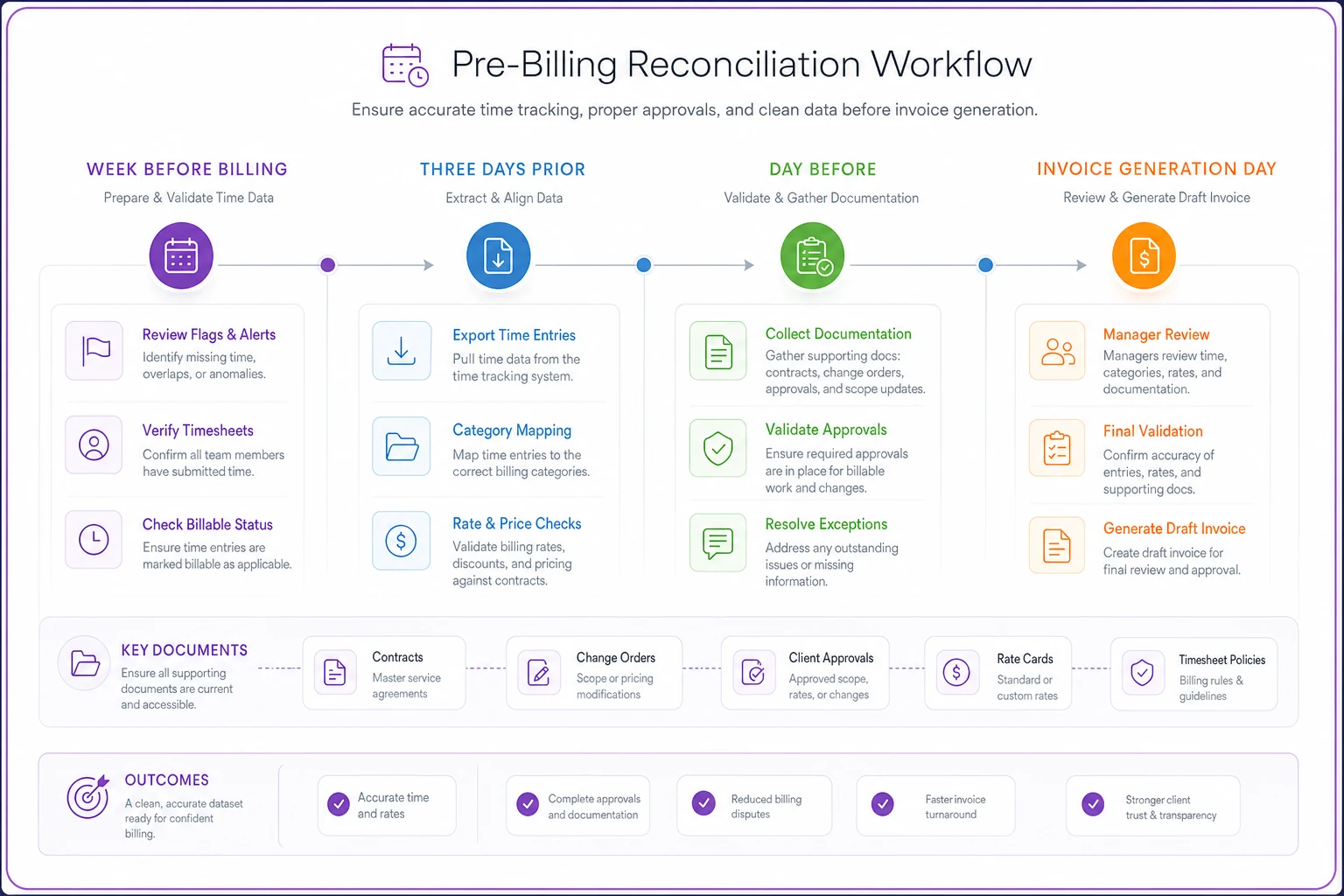
Day before invoice generation: Meet with project managers to review any anomalies. You're specifically validating:
-
Hours that don't map to contracted deliverables
-
Categories that exceed budgeted allocations
-
Rates that don't match the current rate card
-
Any entries requiring special client approval
Invoice generation day: Generate draft invoices with full backup documentation attached. Every hour on that invoice should trace back to a contract line item, have the correct category and rate, and include any required supporting documentation.
The dispute response framework
Even with perfect reconciliation, disputes happen. But when you've done proper pre-billing reconciliation, disputes become clarification conversations instead of payment battles.
Your dispute response template should include:
-
The original contract section authorizing the work
-
The category mapping showing how internal categories translate to billing
-
Approval documentation for any flagged items
-
A detailed activity log for questioned hours
A landscaping company reduced payment delays by 75% after implementing this framework. Previously, they'd scramble to justify charges after receiving disputes. Now they attach a reconciliation summary to every invoice showing exactly how hours map to contracted services.
When disputes arise, you're not defending fuzzy time entries. You're pointing to specific contract terms and documented approvals. The conversation shifts from "prove these hours are valid" to "here's the authorization for this work."
Operational software and billing reconciliation
Manual reconciliation works for small project volumes, but it doesn't scale. Once you're managing multiple projects with different rate structures and billing categories, spreadsheet reconciliation becomes a full-time job.
AI-powered operational software changes this equation. Instead of manually mapping every time entry to contract terms, the system maintains those relationships automatically. When someone logs time, the platform immediately validates it against the project's billing rules. Mismatched categories get flagged in real-time, not during invoice review.
The automation handles the tedious parts — rate validation, category mapping, documentation tracking. Your team focuses on exceptions and client relationships. A PR agency using this approach cut their billing reconciliation time from 14 hours to about 90 minutes per cycle while actually catching more discrepancies.
But the real value isn't time savings. It's the audit trail. Every hour has a complete history showing who logged it, who approved it, which contract term authorizes it, and what documentation supports it. Disputes that used to take days of research now get resolved in minutes.
Preventing future mismatches
The best billing reconciliation happens before time gets logged. Train your team on proper categorization. Update rate cards immediately when contracts change. Flag scope creep the moment it happens, not during billing.
Involve clients in the process earlier. Send preliminary hours reports mid-month. Let them question entries while there's still time to clarify, not after receiving a final invoice. An IT consulting firm started doing this and saw payment delays drop from an average of 47 days to 23 days.
Your billing reconciliation checklist becomes a competitive advantage. While competitors struggle with payment delays and client disputes, you're getting paid on time because your invoices are defensible from the moment they're generated. That's the difference between tracking time and actually getting paid for it.
Ready to optimize your workforce time management?
Join 2,000+ companies using GoTimio to improve timesheet accuracy, reduce payroll errors, and boost team productivity.