



Three months ago, a construction company in California got slammed with an $847,000 settlement because their 15-minute rounding system consistently shaved 7 minutes off workers' morning clock-ins. The owner thought rounding was standard practice — turns out California's neutral rounding requirement meant his system was technically wage theft.
This wasn't some aggressive labor violation. The company had used the same time clock rounding policy for twelve years without issues. Their payroll software defaulted to quarter-hour rounding, supervisors approved timecards weekly, nobody complained. Until a former project manager filed a class action covering 280 employees over four years.
The expensive lesson: rounding rules that seem reasonable can create massive compliance exposure when they systematically favor the employer, even by accident.
Why standard rounding creates systematic bias
Most businesses adopt rounding without understanding the math behind compliance risk. You set up quarter-hour rounding thinking it simplifies payroll, but the actual clock-in patterns create predictable losses for employees.
Think about morning arrivals. Workers showing up at 7:53 AM get rounded to 8:00 AM — losing 7 minutes. But how many employees arrive at 8:07 AM and gain 7 minutes from rounding down? Almost none, because showing up late triggers different consequences.
The pattern repeats at lunch. Employees returning from break at 12:52 PM lose 8 minutes when rounded to 1:00 PM. Those returning at 1:08 PM and gaining from rounding? Rare, because that's visibly late from lunch.
These aren't random rounding errors that balance out. They're systematic biases created by workplace behavior patterns. Early arrivals get penalized, late returns get caught by supervisors, and the rounding system quietly favors the employer by 15-40 minutes per employee per week.
One retail chain discovered their 5-minute rounding policy cost employees an average of 23 minutes weekly. Across 450 employees, that represented $312,000 in annual underpayment. They only found out during a Department of Labor audit triggered by an unrelated complaint.
Jurisdiction compliance requirements by state
Different states treat rounding violations with wildly different severity levels. What passes in Texas might bankrupt you in California.
Accurate time tracking made effortless.
GoTimio empowers your team to log, monitor, and manage work hours seamlessly.
- Real-time time tracking
- Automated timesheet approvals
- Payroll and billing integration
No credit card required
California: The strictest enforcement
California requires absolute neutrality in rounding. Your system must benefit employees as often as it benefits the employer, measured across all employees over time. The state uses statistical analysis during audits — if your rounding shows even a 51/49 split favoring the employer, you're non-compliant.
California also stacks penalties. Rounding violations trigger:
-
Unpaid wage claims
-
Waiting time penalties (up to 30 days of wages per employee)
-
PAGA penalties ($100-$200 per pay period per employee)
-
Interest and attorney fees
A seemingly minor rounding bias affecting 50 employees over two years easily becomes a $400,000+ liability.
New York: De minimis exceptions with limits
New York allows de minimis rounding (insignificant amounts) but caps it strictly. Rounding can't exceed 10 minutes per day total, and employers must track cumulative impact. If an employee loses 15 minutes on Monday and gains 5 minutes on Tuesday, you still owe 10 minutes — the state doesn't consider them to offset.
The state also prohibits rounding on meal breaks. Clock out at 11:58 AM for lunch? That's 11:58 AM, not noon. This catches companies using standard timekeeping systems that apply universal rounding rules.
Federal FLSA: Neutral in practice standard
The Fair Labor Standards Act allows rounding if it "averages out" over time. But federal courts increasingly scrutinize whether rounding actually stays neutral. Recent cases show courts examining:
-
Statistical bias across all employees
-
Patterns in specific departments
-
Whether policy enforcement creates bias
-
If technology makes rounding unnecessary
The federal standard sounds permissive but enforcement has tightened significantly. Courts now expect employers to prove neutrality with data, not just policy language.
Grace period traps across different time tracking scenarios
Grace periods — allowing employees to clock in slightly early or late without penalty — create their own compliance maze. What seems like employee-friendly flexibility often becomes a wage violation.
The 7-minute window problem
Many systems use a 7-minute grace period with 15-minute rounding. Clock in at 7:53 AM or later rounds to 8:00 AM. This feels generous until you realize employees working 7:53 AM to 5:07 PM (9 hours 14 minutes) get paid for 9 hours. Those 14 minutes vanish daily.
A warehouse implemented this exact policy. Over 18 months, their 85 warehouse workers lost an average of 52 minutes weekly. The Department of Labor calculated $267,000 in back wages, plus matching liquidated damages.
Shift differential complications
Grace periods interact dangerously with shift differentials. A hospital allowed 10-minute grace periods but paid night differential only for scheduled hours. Nurses arriving at 10:52 PM for an 11:00 PM shift worked 8 minutes of night shift time at day rates.
The hospital argued the grace period was voluntary flexibility. The court disagreed — if employees perform night shift work, they earn night shift rates regardless of grace periods. Settlement: $1.4 million covering 3 years of shifts.
Automatic meal deductions
The worst compliance trap combines grace periods with automatic meal deductions. System deducts 30 minutes for lunch, but employees clock back 5 minutes early within the grace period. They work those 5 minutes but don't get paid because the system shows them "on lunch."
A restaurant chain discovered their POS system created exactly this problem. Servers frequently returned early from break to handle rushes, clocking in within the 6-minute grace period. The system treated them as still on break. Average loss: 18 minutes per shift. Total liability across 23 locations: $2.1 million.
Decision table for safe rounding thresholds
Here's a practical framework for setting defensible rounding policies based on jurisdiction and operational reality:
| State/Jurisdiction | Maximum Safe Rounding | Grace Period Limit | Meal Break Rounding | Audit Frequency | Statistical Test Required |
|---|---|---|---|---|---|
| California | None recommended* | 0 minutes | Prohibited | Quarterly | Yes - must prove neutrality |
| New York | 6 minutes | 5 minutes | Prohibited | Semi-annual | Yes - track cumulative impact |
| Washington | 10 minutes | 5 minutes | Prohibited | Semi-annual | Yes - department level analysis |
| Massachusetts | 15 minutes | 7 minutes | Allowed if neutral | Annual | No - but recommended |
| Texas | 15 minutes | 10 minutes | Allowed | Annual | No |
| Federal Only | 15 minutes | 10 minutes | Allowed if neutral | Annual | Becoming expected |
*California technically allows neutral rounding but proving neutrality is so difficult that elimination is safer
Applying the decision table
Start with your highest-risk jurisdiction. Operating in multiple states? Default to the strictest standard or implement location-specific policies.
-
California locations
No rounding, exact time tracking
-
Texas locations
15-minute rounding with quarterly neutrality audits
-
Remote employees
Follow their state's requirements
-
Travel between offices
Track under California rules
This seems complex but it's far simpler than defending multi-state wage claims.
A simple flow helps operationalize the decision table before you implement or change policies.
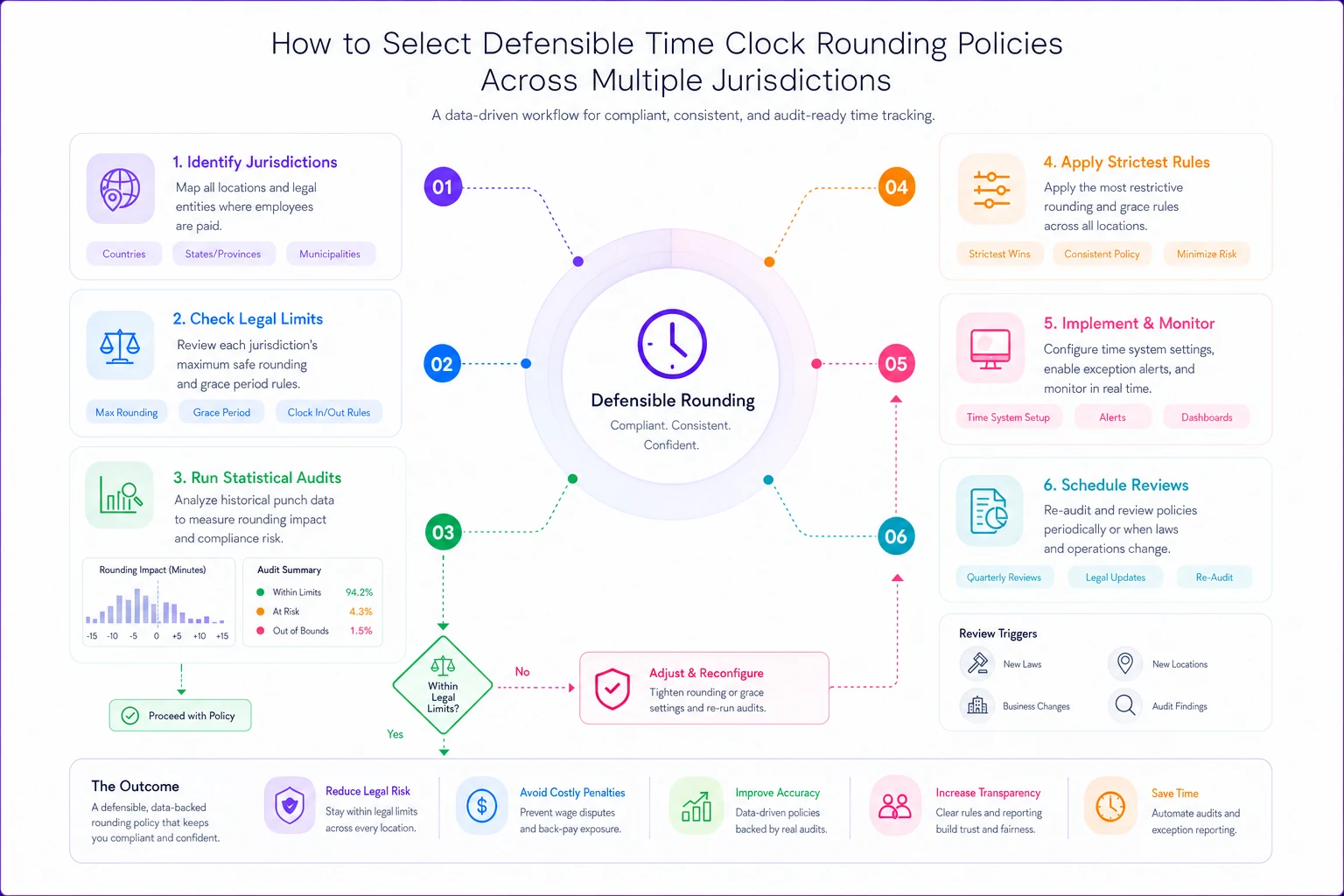
Use this workflow as a checklist when rolling out changes.
Worked examples across common scenarios
Example 1: Retail chain with 5-minute rounding
Setup: 120 stores, 3,400 employees, 5-minute rounding intervals, 3-minute grace period
Daily pattern:
-
Opening shift arrives 6
57 AM, rounds to 7:00 AM (loses 3 minutes)
-
Lunch return at 12
58 PM, rounds to 1:00 PM (loses 2 minutes)
-
Closing shift leaves 9
02 PM, rounds to 9:00 PM (loses 2 minutes)
Weekly impact per employee: 35 minutes lost
Annual underpayment: 3,400 employees × 30.3 hours × $11/hour = $1,133,220
Fix implemented:
-
Eliminated rounding entirely
-
Used actual clock times for payroll
-
Saved $78,000 in payroll processing they thought rounding saved
Avoided seven-figure liability
Example 2: Healthcare facility with 15-minute rounding
Setup: 450-bed hospital, 2,100 clinical staff, 15-minute rounding, 7-minute grace period
Compliance issues discovered:
-
Night shift differential not applied to grace period time
-
Rounding during shift changes created coverage gaps
-
Break relief staff consistently lost time
Statistical analysis showed:
-
Day shift
neutral rounding (49.8% employee favorable)
-
Night shift
64% employer favorable
-
Weekend shifts
71% employer favorable
Resolution:
-
Kept rounding for administrative staff only
-
Exact time tracking for clinical roles
-
Programmed automatic exception reports for >5 minute cumulative daily rounding
Paid $340,000 in back wages for 18 months of night/weekend shifts
Example 3: Manufacturing with complex shift patterns
Setup: Food processing plant, 800 employees, 3 shifts, 6-minute rounding
The problem emerged from shift patterns:
-
First shift
6:00 AM - 2:00 PM
-
Second shift
2:00 PM - 10:00 PM
-
Third shift
10:00 PM - 6:00 AM
Rounding worked fine for scheduled shifts. But overtime created issues. Workers staying late from first shift into second shift hours got double-rounded. Clock out at 2:03 PM became 2:00 PM (losing 3 minutes), then overtime calculation started at 2:06 PM instead of 2:00 PM (losing 6 more minutes).
Real example from audit:
-
Regular time
6:00 AM to 2:00 PM = 8 hours paid
-
Overtime
2:48 PM rounded to 2:45 PM = 0.75 hours paid
-
Actual time
8.8 hours
-
Paid time
8.75 hours
-
Lost
3 minutes regular + 3 minutes overtime rate
Across 800 employees working frequent overtime, this represented $450,000 in annual underpayment.
Building your defensible rounding policy
After analyzing hundreds of wage audits, clear patterns emerge about which policies survive scrutiny versus which trigger expensive settlements.
Policies that fail audits
The riskiest approach is implementing rounding without monitoring its actual impact. Companies assume rounding stays neutral because their policy says it should. But operational reality creates bias through morning arrival patterns, break return behavior, shift change dynamics, supervisor enforcement inconsistencies, and technology limitations.
One distribution center learned this expensively. Their employee handbook stated "neutral rounding policy" but they never tracked whether rounding actually stayed neutral. A DOL audit revealed employees lost an average of 41 minutes weekly. The company argued their written policy proved good faith. The investigator responded that good faith requires monitoring, not just policy language.
Minimum viable compliance approach
If you must use rounding, here's the bare minimum for defensible compliance:
-
Quarterly rounding audits
Pull 90 days of time data, calculate rounding impact per employee, identify anyone losing >15 minutes weekly. Statistical bias >52% toward employer triggers immediate policy review.
-
Exception reporting
Configure alerts when single-day rounding exceeds 10 minutes or weekly rounding exceeds 30 minutes for any employee. Investigate patterns, not just individual instances.
-
Grace period documentation
If allowing grace periods, track separately from rounding. Employees working during grace periods must be paid for that time, regardless of rounding rules.
-
Jurisdiction-specific overrides
Maintain a compliance matrix by location. California employees get exact time tracking while Texas employees might use 15-minute rounding. Your system must handle both simultaneously.
-
Retroactive correction protocol
When audits reveal bias, correct backwards at least two years or to the last clean audit. Include interest calculations based on jurisdiction requirements.
Run your first quarterly rounding audit before changing operational rules to see the baseline bias.
The safer alternative: eliminate rounding entirely
Modern time tracking makes rounding unnecessary. The operational "benefits" that justified rounding in paper timesheet days no longer exist. Processing exact time costs the same as rounded time in any decent payroll system.
Companies eliminating rounding report unexpected benefits. Increased employee trust in payroll accuracy, reduced timecard disputes requiring investigation, eliminated compliance audit anxiety, simplified multistate operations, cleaner integration with project costing systems.
The math is straightforward. Rounding might save a few hours of payroll processing monthly. But one wage audit costs more than decades of those savings. A manufacturing client spent $180,000 defending a rounding audit they ultimately won. They eliminated rounding anyway because the defense cost more than 20 years of supposed efficiency gains.
Technology considerations for compliant time tracking
The software you choose directly impacts compliance risk. Legacy systems built around rounding create problems even when you try to eliminate rounding.
Problems with traditional time clocks
Older time clock systems force rounding at the point of capture. Employee badges in at 7:52:47 AM but the system records 7:45 AM or 8:00 AM immediately. You can't audit the actual punch time later because it was never stored.
These systems also struggle with jurisdiction differences. Setting up different rounding rules for different locations requires complex workarounds or entirely separate systems. One restaurant group maintained three different time clock systems to handle state-specific requirements until they finally modernized.
Modern operational software advantages
Current AI-powered operational software captures exact timestamps then applies rules at the calculation layer. The raw time data stays intact for audit purposes while payroll sees processed numbers based on your policies.
This architecture enables retroactive policy adjustments without data loss, A/B testing different rounding impacts before implementation, automatic bias detection and alerting, jurisdiction-specific rule engines, and detailed audit trails for compliance defense.
More importantly, AI automation can identify patterns humans miss. When morning arrivals consistently trigger rounding losses, the system suggests schedule adjustments. If certain departments show statistical bias, you get alerted before auditors find it.
The real value comes from preventing problems rather than just tracking them. Modern platforms analyze time patterns and recommend policy adjustments that maintain operational efficiency while eliminating compliance risk. Instead of choosing between simple payroll processing and wage compliance, you get both.
Making the rounding decision for your organization
The choice about time clock rounding policy ultimately depends on your specific operational reality and risk tolerance. But clear patterns indicate what works versus what creates expensive problems.
If you operate in California, New York, or Washington, eliminate rounding entirely. The compliance risk far outweighs any operational benefit. One audit defense costs more than years of supposed efficiency gains from rounding.
For single-state operations in less restrictive jurisdictions, rounding might remain viable with proper monitoring. But implement quarterly audits, track statistical bias, and maintain correction protocols. The moment rounding shows >52% employer bias, you're accumulating liability.
Multistate operations should strongly consider exact time tracking everywhere. Managing different policies by location adds complexity that undermines whatever simplicity rounding supposedly provides. Using the strictest standard everywhere is operationally simpler and legally safer.
The construction company from the beginning learned this lesson at tremendous cost. They now use exact time tracking, automated compliance monitoring, and quarterly audits even though Texas doesn't require it. Their owner told me the settlement was the best thing that happened — it forced them to modernize operations they'd been patching with outdated policies for over a decade.
Your time clock rounding policy isn't just about payroll processing. It's about choosing between hidden accumulating liability and transparent operational efficiency. In an era where technology makes exact time tracking simple, rounding becomes an unnecessary risk that smart operators eliminate rather than manage.
Ready to optimize your workforce time management?
Join 2,000+ companies using GoTimio to improve timesheet accuracy, reduce payroll errors, and boost team productivity.