

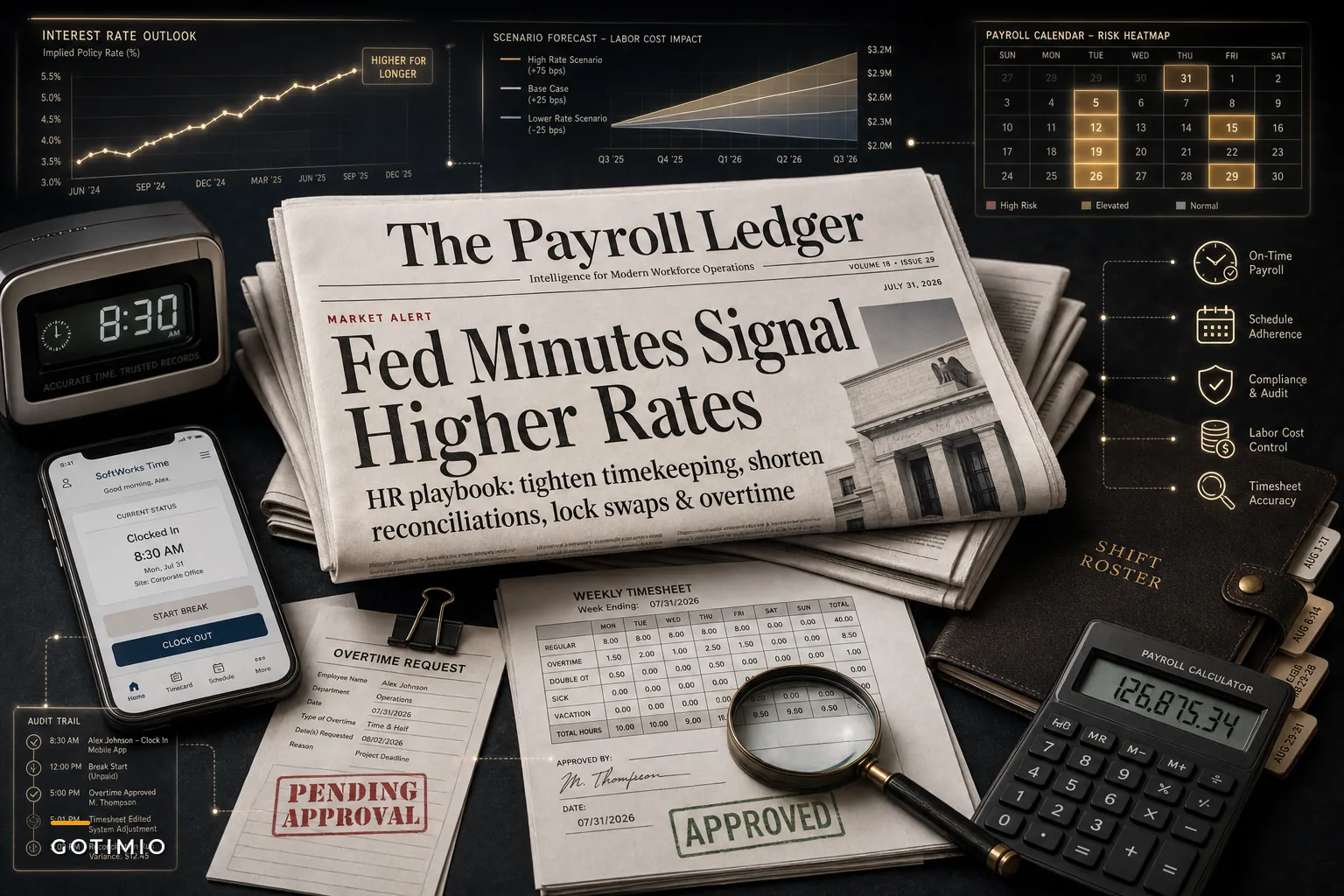

The July FOMC minutes quietly changed a lot of budget conversations. Officials signaled that if inflation doesn't cool, another round of tightening is on the table — pushing markets toward a higher-for-longer rate path. CNBC's coverage put it plainly: Fed officials saw the need for a rate hike if inflation doesn't cool, and the official minutes leaned harder on persistent price pressure than most people expected.
For HR and finance, this isn't a macro story. It's a cash-flow story. When borrowing gets more expensive and credit tightens, the first place leadership looks to protect margin is labor — because it's usually the biggest controllable line and the fastest to adjust. That means overtime scrutiny, hiring pauses, and a lot more pressure on payroll numbers being right the first time.
So rather than talking more about the Fed, what actually matters here is what lands on your desk when the CFO decides labor needs to get tighter — and where most teams lose control of the number before they even realize it.
The real exposure isn't overtime — it's forecast drift
Everyone assumes labor cost controls start with cutting overtime. Overtime is visible, easy to point at, and feels like a lever. But overtime is rarely where the money quietly leaks. The bigger problem is that most teams can't produce a payroll forecast that survives contact with the actual pay run.
The pattern is consistent. Finance builds a labor forecast off headcount and standard hours. The pay period closes and actuals come in 3–6% higher, and nobody can fully explain why. It's not fraud. It's an accumulation of small things: a handful of missed punches corrected upward, a few shift swaps that pushed people into overtime brackets, some PTO that overlapped with worked hours, and rounding that always seems to go in the employee's favor.
Under normal conditions, a 3% forecast miss is annoying. Under tighter conditions, that same 3% is the difference between hitting your labor budget and getting a very uncomfortable meeting invite. The Fed news didn't create this gap — it just removed the slack that used to absorb it.
The insight most teams miss: you can't control a labor number you can't predict. Cost control and forecast accuracy are the same problem. If your actuals swing unpredictably from your forecast, no amount of overtime policy will save you, because you're managing the number after it's already spent.
Where the labor number actually leaks
Before you tighten anything, you need to know which leaks matter. Not all of them are worth the friction of a new control. Here's how the common ones stack up in real operations.
Accurate time tracking made effortless.
GoTimio empowers your team to log, monitor, and manage work hours seamlessly.
- Real-time time tracking
- Automated timesheet approvals
- Payroll and billing integration
No credit card required
| Leak source | Typical impact | How visible is it? | Worth tightening now? |
|---|---|---|---|
| Uncontrolled overtime | High per incident | Very visible | Yes — but it's the obvious one |
| Retroactive punch corrections | Moderate, adds up | Low | Yes — quietly expensive |
| Shift swaps crossing OT thresholds | Moderate | Very low | Yes — often ignored |
| PTO overlapping worked time | Low–moderate | Low | Yes |
| Rounding bias | Low but constant | Nearly invisible | Depends on jurisdiction |
| Late timesheet approvals | Indirect (forecast noise) | Moderate | Yes |
The two most underrated rows are retroactive corrections and swaps that cross overtime thresholds. Both are nearly invisible in standard reports, and both scale with staffing volatility — which is exactly what tighter conditions produce. When schedules get unstable, the number of "small adjustments" per pay period climbs, and each one nudges your forecast further from reality.
That connection between schedule instability and payroll noise is worth understanding in detail, because it's the mechanism behind most forecast misses. We broke it down in this governance framework for shift tiers, swap approvals and payroll impact scoring — if you only fix one thing this quarter, understanding how a single swap ripples into overtime and forecast drift is the highest-leverage place to start.
A tighter operating model that doesn't require layoffs
The instinct under budget pressure is to cut. But the faster win is usually tightening the process around the hours you already pay for. A cleaner process gives you a defensible number and buys you room before anyone has to touch headcount.
-
Shorten your reconciliation SLA. If your team currently reconciles time three days after period-end, move exceptions to same-day. The longer a discrepancy sits, the harder it is to resolve accurately — and the more it corrupts your next forecast.
-
Gate overtime at the approval point, not the report. Approving overtime after it's worked is theater. The control has to sit before the shift, or before the swap that pushes someone over the threshold.
-
Freeze retroactive edits above a threshold. Small corrections, fine. Any retroactive change above a set number of hours should require a second approval and a documented reason. This alone kills a surprising amount of forecast drift.
-
Run scenario forecasts, not a single forecast. Build at least two: current staffing, and a hiring-freeze version where you can't backfill departures. Model that now so you're not scrambling when a role goes unfilled for two months.
-
Score every schedule change for payroll impact before it's approved. A swap that looks neutral on a roster can be expensive on payroll. Surface that cost at the decision point.
A simple visual shows where each control fits in the tightening sequence.
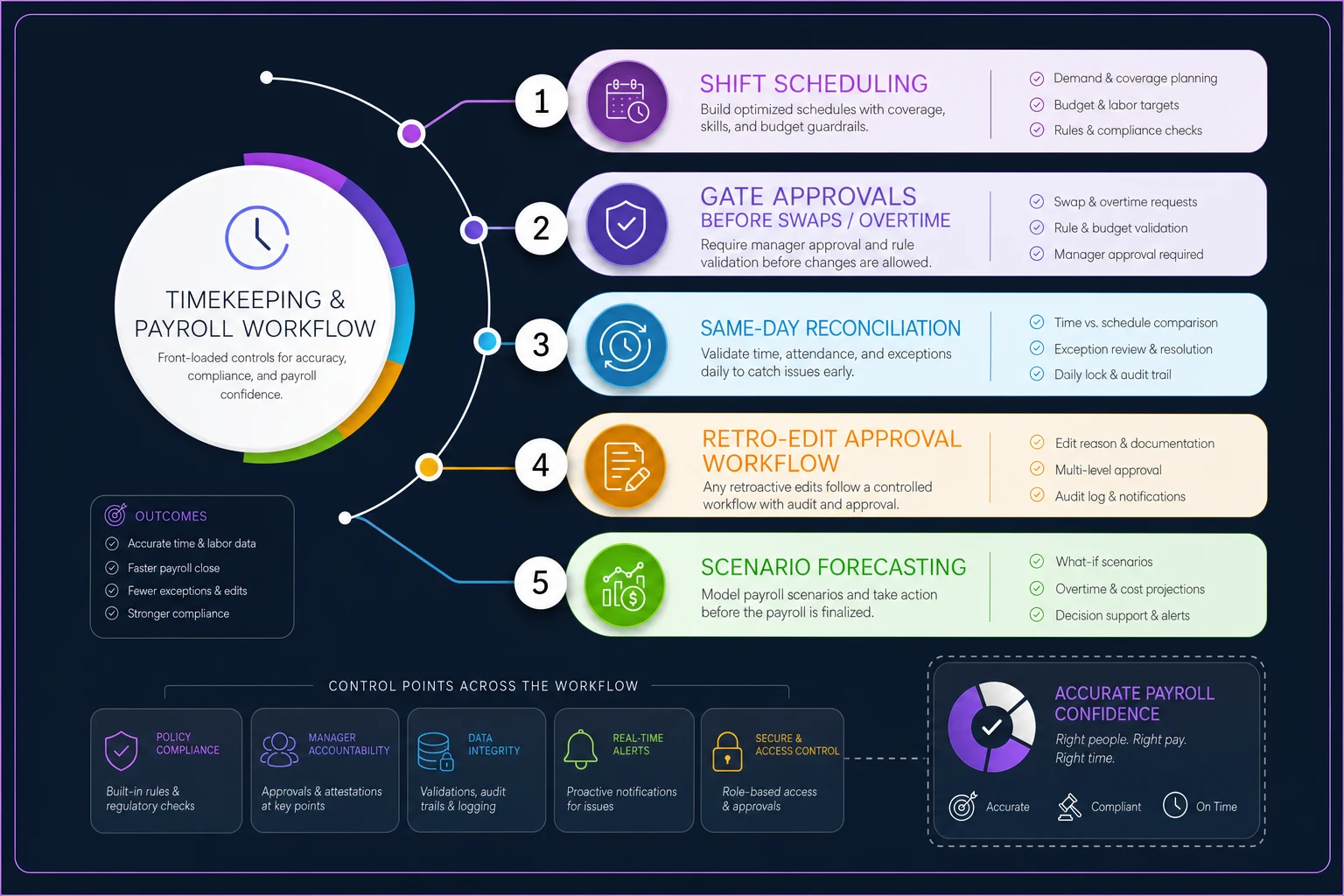
All five of these share the same logic: move the control earlier. Most payroll pain comes from catching problems after the money is already committed.
The first-pass accuracy problem nobody budgets for
There's a hidden tax in most timekeeping operations — the cost of fixing entries that should have been right the first time. Every correction consumes supervisor time, delays approvals, and injects noise into your forecast. Under tighter conditions, this gets more expensive because you have less staff time to burn on cleanup and less tolerance for a wrong number.
First-pass accuracy problems tend to cluster around a few predictable spots: mobile punches that don't sync, shift boundaries crossing midnight, employees forgetting to clock out, and swaps that were verbally agreed but never entered. None of these are dramatic on their own. Together they can generate dozens of corrections per pay period in a mid-sized team.
-
What percentage of time entries get edited after submission? (If it's above roughly 10%, you have a capture problem, not an employee problem.)
-
How many of those edits push hours up versus down?
-
Which locations, shifts, or roles generate the most corrections?
-
How long, on average, does a correction sit before approval?
-
How many corrections happen after the payroll cutoff — meaning they hit a later period?
The last one is quietly the worst. Corrections that miss the cutoff smear your labor cost across two periods, which makes both forecasts wrong and both harder to defend.
When to tighten hard — and when it backfires
Not every team should slam every control on at once. Aggressive tightening has real costs.
When aggressive tightening makes sense:
-
Your labor line is a large share of controllable spend and finance has flagged it
-
You're already seeing forecast misses of 3%+ per period
-
Staffing is volatile — departures, swaps, seasonal swings
-
You have supervisors who can actually enforce approval gates
When it's a bad idea:
-
Your teams already run lean and morale is fragile — piling on approval friction can push good people out, which costs far more than the overtime you saved
-
Your capture process is broken at the source; adding controls on top of bad data just creates more corrections
-
You don't have the reporting to tell whether the controls are working
If you can't yet measure your edit rate, OT approval leakage, or forecast variance, don't start with hard controls. Start with visibility. Tightening what you can't measure just moves the leak somewhere you can't see it.
A real scenario
A regional facilities-services company — around 180 hourly staff across a dozen sites — kept missing its labor forecast by roughly 4–5% every period. Leadership assumed it was overtime and started denying OT requests, which annoyed supervisors and barely moved the number.
When they actually broke down the variance, overtime was only part of it. The bigger drivers were retroactive punch corrections and swaps between sites that quietly pushed hours across overtime thresholds. Around 12% of entries were being edited after submission, and most edits pushed hours up.
They didn't cut a single position. They moved reconciliation to same-day for exceptions, required a second approval on any retroactive edit over two hours, and started scoring cross-site swaps for payroll impact before approving them. Within a couple of pay periods, forecast variance dropped to under 2% and supervisor cleanup time fell noticeably. The overtime "problem" mostly solved itself once the swap and correction leaks were closed.
The point isn't the exact numbers — they were aiming at the wrong lever entirely. The visible cost was overtime. That's not where the money was actually going.
Where the right systems quietly help
Most of what's described here is process and discipline. But there's a practical limit to how much of this you can enforce manually, especially when staffing gets volatile and correction volume climbs.
This is where operational software with solid automation earns its keep — not by replacing judgment, but by pushing the tedious controls upstream so they actually happen. The useful pieces are unglamorous: approval gates that trigger before a swap crosses an overtime threshold, automated exception flagging so supervisors see the twelve entries that matter instead of scrolling through 400, retroactive-edit rules enforced by configuration instead of memory, and clean audit trails so every adjusted hour is defensible when finance asks.
Automating exception flags to surface only the highest-impact entries can cut supervisor review time dramatically while preserving first-pass accuracy.
When correction volume is low, you can do most of this by hand. When conditions tighten and volatility rises, that's when manual enforcement starts breaking down and automation keeps first-pass accuracy from collapsing under the extra load. The goal is simple: make the accurate number the default number, so your forecast and your actuals stop drifting apart.
Bringing it together
The Fed's signal about a higher-for-longer path is just the trigger that moves labor budgets from "monitored" to "actively defended." The teams that handle this well won't be the ones that cut fastest. They'll be the ones whose payroll number is boring — predictable, explainable, and close to forecast every period.
That predictability comes from moving controls earlier: gating overtime and swaps before they happen, killing retroactive drift, and shortening the gap between a worked hour and a reconciled one. The pressure from tighter conditions is real, but it mostly exposes gaps that were already there. Closing them is well within reach, and you rarely need layoffs to do it.
The Fed's signal about a higher-for-longer path is just the trigger that moves labor budgets from "monitored" to "actively defended." The teams that handle this well won't be the ones that cut fastest. They'll be the ones whose payroll number is boring — predictable, explainable, and close to forecast every period.
That predictability comes from moving controls earlier: gating overtime and swaps before they happen, killing retroactive drift, and shortening the gap between a worked hour and a reconciled one. The pressure from tighter conditions is real, but it mostly exposes gaps that were already there. Closing them is well within reach, and you rarely need layoffs to do it.
Ready to optimize your workforce time management?
Join 2,000+ companies using GoTimio to improve timesheet accuracy, reduce payroll errors, and boost team productivity.