

A restaurant manager shows me her scheduling spreadsheet. Twenty-three employees, four shift types, and what looks like reasonable coverage for next week. Then she opens her text thread — seventeen swap requests in three days. Half already happened without approval. The other half are waiting on responses that won't arrive before the shifts start.
This isn't bad employees or lazy management. It's what happens when there's no actual scheduling governance in place. The damage shows up weeks later — payroll errors, surprise overtime, and eventually people quitting because their checks keep coming out wrong.
The hidden architecture of schedule stability
Most businesses treat scheduling like a weekly chore — fill the slots, post it, move on. But it actually operates across three layers that almost no one properly connects:
The shift tier structure defines which positions can work which shifts. Sounds obvious until your closing supervisor ends up covering a morning cashier shift, triggering differential pay nobody budgeted for — or someone without the right certifications is left alone during a critical operation.
The swap approval matrix determines who can approve what changes and when. Without one, every swap either gets auto-approved (chaos) or waits for the owner to weigh in (bottleneck). Neither approach works once you're past roughly fifteen employees.
Payroll impact scoring tracks how each schedule change affects labor costs. Most businesses only find out they've blown their labor budget after payroll runs. By then the response usually makes things worse — cut hours to compensate, employees get frustrated with erratic schedules, good people leave.
These three components should work together as a unified scheduling governance framework. Instead they tend to exist as disconnected pieces, if they exist at all.
Why traditional scheduling breaks at scale
A retail chain with eight locations learned this the hard way. Each store manager handled scheduling differently. Store A allowed unlimited swaps. Store B required 48-hour notice. Store C had informal "swap buddies" who covered each other constantly and off the books.
Accurate time tracking made effortless.
GoTimio empowers your team to log, monitor, and manage work hours seamlessly.
- Real-time time tracking
- Automated timesheet approvals
- Payroll and billing integration
No credit card required
Payroll dealt with the aftermath — around $11,000 in unplanned overtime across all stores in one quarter, plus another $4,500 in shift differential payments nobody had approved. But the real cost came from turnover. Exit interviews flagged inconsistent paychecks as the number two reason people left, right behind lack of advancement.
It compounds fast. A healthcare staffing agency managing 200+ CNAs across fifteen facilities found their swap approval process averaged 3.2 days. By the time approval came through, the shift had already passed. Nurses either worked unauthorized shifts (compliance risk) or didn't show up at all (coverage crisis).
Scheduling flexibility without governance turns into operational instability, then payroll chaos, then a retention problem. The pattern repeats across industries.
Building a tiered shift governance model
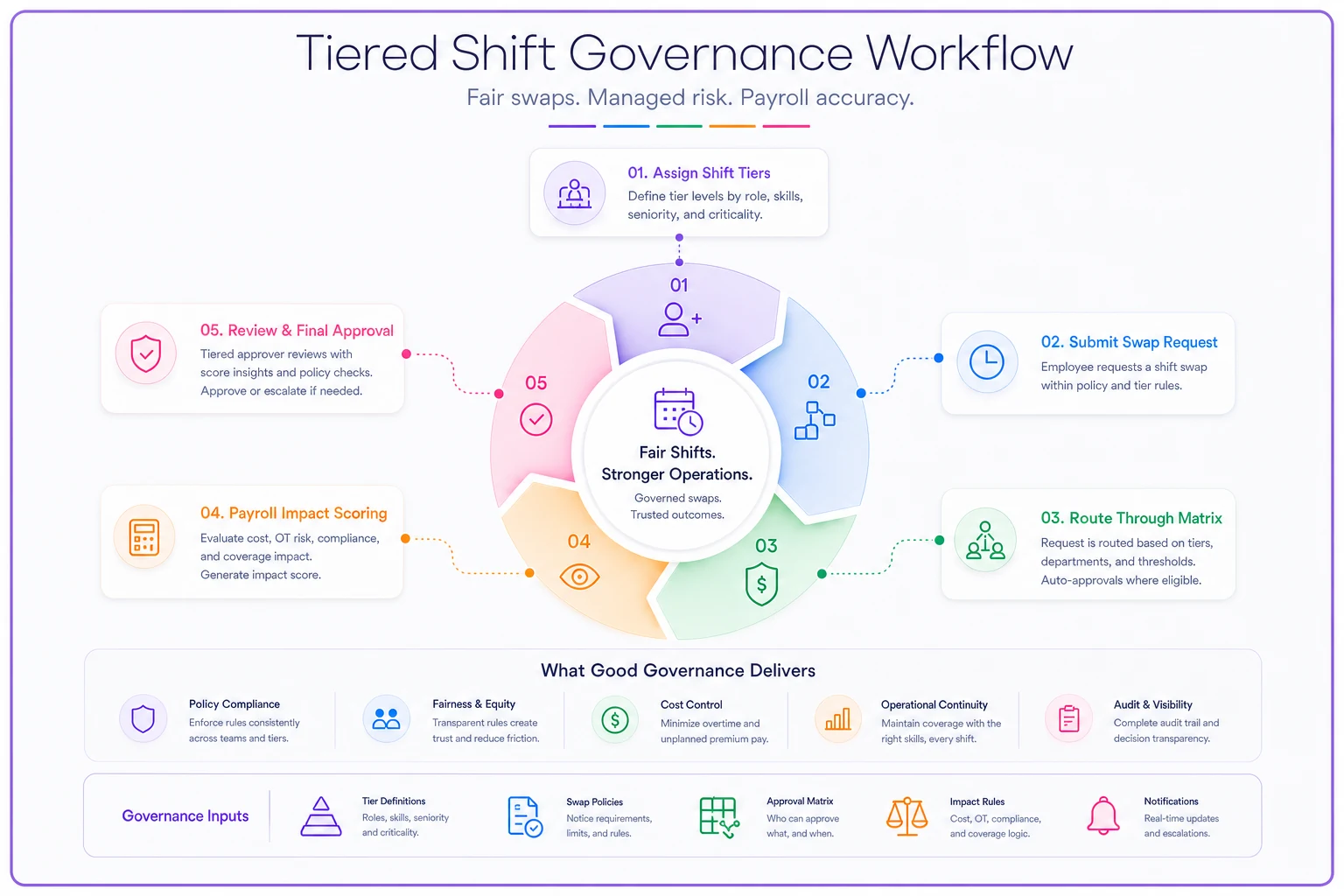
The framework starts with acknowledging that not all shifts are equal and not all swaps carry the same risk. Here's how to structure it:
This diagram shows how tiers, swap approvals, and payroll scoring link together.
Tier 1: Critical Coverage Positions
-
A named backup for every shift
-
Mandatory overlap during transitions
-
Zero tolerance for unapproved swaps
-
Automatic escalation if coverage drops below minimum
A medical practice built a coverage score for their X-ray tech role after a no-show left them unable to see patients for half a day. Green means two qualified people are scheduled, yellow means one, red means none. Red triggers automatic alerts to the practice manager and backup tech.
Tier 2: Skilled Operations Roles
-
Swaps allowed within the same skill level
-
24-hour notice preferred but not mandatory
-
Supervisor approval for cross-tier swaps
-
Weekly review of swap patterns
Tier 3: General Coverage Positions
-
Peer-to-peer swaps allowed
-
Simple notification (not approval)
-
Bulk coverage requirements rather than specific assignments
-
Monthly review for abuse patterns
The tier structure alone eliminates a large chunk of scheduling conflicts because expectations are clear upfront.
The swap approval matrix that actually scales
Traditional swap approval breaks because it treats every change as equivalent. A Tuesday cashier swapping with Wednesday morning goes through the same process as a closing manager taking a week off. This creates two problems simultaneously: important swaps get delayed, and managers waste time on trivial ones.
| Swap Type | Approval Required | Time Limit | Fallback |
|---|---|---|---|
| Same day, same role | None (notification only) | Instant | N/A |
| Same week, same role | Peer confirmation | 2 hours | Auto-approve |
| Cross-tier swap | Supervisor | 24 hours | Escalate to manager |
| Overtime impact | Manager + Finance | 24 hours | Deny |
| Compliance impact | Manager + HR | 48 hours | Deny |
The critical piece: the matrix has to connect to your payroll-ready time & attendance process. Otherwise approved swaps create downstream payroll errors that nobody catches until checks go out.
A dental practice group with forty employees across three locations built this matrix after discovering unauthorized swaps were generating around $2,800 in monthly payroll corrections. They embedded it directly into their scheduling software — swap requests route automatically based on type, with built-in escalation timers.
Payroll impact scoring — the missing piece
Most scheduling tools show coverage. Better ones show labor cost. Almost none show payroll impact scoring — the actual cost of schedule changes including overtime triggers, shift differentials, minimum hour guarantees, and split-shift penalties.
The scoring system tracks three things:
Direct cost impact: The immediate pay difference. If Sarah makes $18/hour and Marcus makes $22/hour, swapping an 8-hour shift is a $32 impact. Simple math that almost nobody runs before approving.
Threshold triggers: The hidden costs that kick in based on rules. Jennifer picking up an extra shift looks fine until it pushes her into overtime for the week. Tom covering Sunday triggers weekend differential.
Cascade effects: The downstream consequences. Approving Michael's vacation means three people hit overtime covering his shifts. Letting Amy swap out of her closing shift means calling someone in at time-and-a-half.
A distribution center added scoring after labor costs swung 15% month-to-month despite stable order volumes. Every swap request now shows:
-
Base impact
+$47
-
OT trigger risk
High (employee at 38 hours)
-
Differential impact
+$15 (2 hours of night differential)
-
Total score
$62 + HIGH RISK
Managers can still approve high-impact swaps — but at least they know what they're approving. Labor cost variance dropped to 3% in the first quarter after implementation.
The operational rules that prevent downstream chaos
Rules without enforcement are just suggestions. The governance framework needs operational teeth.
The 72-Hour Lock Rule
No schedule changes within 72 hours of shift start, except genuine emergencies. It sounds strict until you work through the alternative. Last-minute changes create payroll coding errors, communication failures, coverage gaps, and — maybe worst of all — employees who stop trusting the posted schedule.
A home healthcare agency ran without this rule for years. Care coordinators were spending roughly 40% of their time managing last-minute changes. After the lock went in, that dropped under 10%. Emergency changes still happened, but they became actual emergencies instead of convenience swaps.
The Cascade Prevention Protocol
-
Does the swap create overtime for anyone?
-
Does it trigger minimum staffing violations?
-
Does it create a coverage gap somewhere else?
-
Does it violate any compliance rules — minor hours, break requirements?
One retail chain found that 60% of their overtime came from cascade effects — one approved change triggering three more. Their scheduling system now runs these checks automatically, flagging high-risk swaps before anyone approves them.
The Payroll Reconciliation Checkpoint
Every Thursday at 2 PM, freeze the schedule for payroll review. Compare scheduled hours against actual worked, flag variances over 2 hours, and resolve before payroll runs. This catches unapproved worked shifts, missed clock-outs inflating overtime, department coding errors, and differential pay mistakes.
Run the cascade checks on a simulated swap batch weekly to surface edge-case approval paths before they hit live payroll.
Without this checkpoint, errors compound. An employee works an unapproved shift, gets paid overtime, assumes it's fine, does it again. By the time someone notices, you're looking at weeks of corrections and an employee whose pay is being clawed back.
Real-world implementation
A 150-employee manufacturing facility put this full framework in place after monthly payroll adjustments were averaging $8,000 — roughly 3% of total payroll just going toward fixing errors.
Phase 1 (Weeks 1-2): They mapped shifts into tiers. Production line operators became Tier 1, warehouse staff Tier 2, administrative and shipping Tier 3. That alone reduced confusion about who could cover what.
Phase 2 (Weeks 3-4): They built the swap approval matrix, starting simple — any swap affecting overtime needed manager approval, everything else was peer-to-peer. They used their existing scheduling software's approval workflow with clear routing rules layered on top.
Phase 3 (Weeks 5-8): They added payroll impact scoring, initially just overtime triggers. A straightforward spreadsheet calculation showing the cost of each swap request. Managers started declining high-cost swaps they'd been blindly approving.
-
Payroll adjustments dropped to under $500 monthly
-
Employee schedule satisfaction scores increased 22%
-
Manager time on scheduling issues dropped by roughly 6 hours per week
-
Voluntary turnover fell from 5.2% to 3.8% monthly
The framework didn't eliminate every scheduling problem. It made problems visible and manageable. More importantly, employees started trusting that their paychecks would be right.
When governance becomes invisible
The best scheduling governance systems become invisible to employees. They just experience schedules that work, swaps that process quickly, and checks that match expectations.
A regional restaurant chain with 400+ employees across twelve locations built their framework about eighteen months ago. Today their managers spend roughly 90 minutes weekly on scheduling, down from close to six hours. Employees submit swap requests through an app that automatically routes based on the rules, shows impact scores, and gives instant feedback.
The framework integrates with their timekeeping and payroll systems, catching most errors before they happen. When they rolled out their new timekeeping system, the governance framework made adoption smoother — employees already trusted the scheduling process, so the transition was less of a fight.
The retention numbers tell the real story. In an industry where 75% annual turnover is considered normal, they're running at 45%. Exit interviews barely mention scheduling or payroll anymore. The problems that used to drive people out simply stopped showing up.
Beyond basic scheduling
Once the foundational governance is solid, you can add more sophisticated layers:
Preference scoring: Employees rank shift preferences, and the system optimizes assignments within governance constraints. The person who actually wants overnight shifts gets them, while coverage requirements stay intact.
Skill progression tracking: As employees gain certifications or complete training, they automatically become eligible for higher-tier shifts. No manual updates, no missed promotions.
Predictive coverage modeling: Based on historical patterns, the system suggests optimal scheduling three weeks out — accounting for typical swap rates, seasonal absence trends, and business cycles.
Cost-neutral swap optimization: The system identifies swaps that don't impact total labor cost and auto-approves them, removing manager time from decisions that don't need it.
None of this works without solid governance underneath. Without the framework, you're just building more sophisticated ways for scheduling to break.
The compound effect of scheduling stability
Stable scheduling creates compounding benefits that most businesses never trace back to their source.
Employees with predictable schedules have more consistent attendance. They can arrange childcare, plan appointments, and actually organize their lives. That reduces last-minute callouts significantly.
Predictable paychecks improve retention. The cost of replacing an hourly employee ranges somewhere between $3,000 and $7,000 depending on the role — preventing a handful of departures pays for the entire governance system.
Managers freed from constant scheduling fires can actually manage. Training, coaching, process improvement — the work that grows the business.
Accurate labor costs make better business decisions possible. When you know your true labor cost per unit of output, you can price correctly, bid accurately, and forecast reliably.
A commercial cleaning company tracked these compound effects over two years. Beyond direct savings on payroll corrections and overtime, they attributed roughly $200,000 in retained contracts to improved service consistency. Crews showed up reliably, with the right people, properly trained. Clients noticed.
Implementation priorities
If building the complete framework feels like a lot, here's the practical sequence:
Week 1: Define your shift tiers. Classify every role as critical, skilled, or general. Write it down somewhere everyone can reference.
Week 2-3: Build the swap approval matrix. Start with overtime triggers — any swap creating OT needs approval. Everything else can come later.
Week 4-5: Add payroll impact visibility. Even a basic spreadsheet showing swap costs changes how managers make decisions.
Week 6-8: Implement operational rules. Start with the 72-hour lock and the weekly reconciliation checkpoint.
Week 9-12: Refine based on actual usage. You'll hit edge cases, unusual situations, and legitimate exceptions. Build them into the framework rather than working around it every time.
The businesses that actually make scheduling governance stick share one trait: they treat scheduling as an operational system, not an administrative chore. They invest in making it work because they understand what it costs when it doesn't.
Every payroll error, every coverage gap, every person who leaves because their schedule is unpredictable — those aren't isolated incidents. They're symptoms of missing governance. Build the framework and the symptoms go away.
The question isn't whether you need this. It's whether you build it now or after the next payroll disaster forces your hand.
Ready to optimize your workforce time management?
Join 2,000+ companies using GoTimio to improve timesheet accuracy, reduce payroll errors, and boost team productivity.