



If you've already read the payroll integration runbook covering connector testing and safe cutover steps, you know the why. This is the how — the actual code, the DDL, the retry tables. The stuff you copy into your repo and adapt.
The specific failure this article prevents: an employee gets paid twice because a batch POST timed out, your code retried it, and the payroll vendor processed both attempts. Or the opposite — a timeout made you skip a line, and 14 people got shorted. Both come down to the same thing: your integration doesn't have a deterministic way to say "I've already done this exact thing, don't do it again."
The core problem: non-deterministic keys
Most duplicate-pay incidents trace back to one bad decision — using a timestamp, a random UUID generated at send time, or an auto-increment row ID as the idempotency key.
-
Deterministic — same logical operation always produces the same key
-
Scoped — includes the pay period and employee/line so two different periods never collide
-
Stable across retries — generated once, stored, and reused for every attempt
The key should answer: "What business event is this, exactly?" Not "when did I send it."
Python: canonical key generation
``python
import hashlib
import json
def payrolllinekey(tenantid, payperiodid, employeeid, lineversion):
"""
Deterministic idempotency key for a single payroll line.
lineversion increments only when the HR-approved amount changes,
so a corrected line gets a NEW key (intentionally reprocessable).
"""
canonical = {
"t": str(tenantid),
"pp": str(payperiodid),
"emp": str(employeeid),
"v": int(lineversion),
}
# sortkeys ensures byte-stable serialization across runs/machines
blob = json.dumps(canonical, sortkeys=True, separators=(",", ":"))
digest = hashlib.sha256(blob.encode("utf-8")).hexdigest()
return f"pl{tenantid}{payperiodid}{digest[:24]}"
def batchkey(tenantid, payperiodid, runattemptgroup):
"""
Key for the whole batch envelope. runattemptgroup stays constant
across network retries but changes if HR re-opens the run.
"""
raw = f"{tenantid}:{payperiodid}:{runattemptgroup}"
digest = hashlib.sha256(raw.encode("utf-8")).hexdigest()
return f"batch{payperiodid}{digest[:20]}"
``
The line_version field is the detail people miss. You want a corrected line to be reprocessable — if HR fixes someone's overtime, that's a genuinely new operation. Bumping the version bumps the key. A plain network retry keeps the version, keeps the key, and the vendor deduplicates it. One field does both jobs.
Node.js: same logic, same hashes
``javascript
const crypto = require("crypto");
function payrollLineKey(tenantId, payPeriodId, employeeId, lineVersion) {
const canonical = {
t: String(tenantId),
pp: String(payPeriodId),
emp: String(employeeId),
v: Number(lineVersion),
};
// Key order here must match Python's sortkeys output
const ordered = {};
Object.keys(canonical).sort().forEach((k) => (ordered[k] = canonical[k]));
const blob = JSON.stringify(ordered);
const digest = crypto.createHash("sha256").update(blob, "utf8").digest("hex");
return pl${tenantId}${payPeriodId}${digest.slice(0, 24)};
}
``
If part of your stack is Python and part is Node, verify both produce identical digests for the same inputs. A one-character difference in JSON serialization — spaces after colons, key ordering — produces a completely different hash, and your dedup breaks silently. Write a cross-language test that asserts the same key string. Teams have lost a full day to a ", " vs "," separator mismatch. It's not a fun debugging session.
SQL: deriving the key in the database
``sql
-- Postgres: deterministic line key using built-in digest()
-- requires: CREATE EXTENSION IF NOT EXISTS pgcrypto;
SELECT
'pl' || tenantid || '' || payperiodid || '' ||
substr(
encode(
digest(
tenantid || ':' || payperiodid || ':' ||
employeeid || ':' || lineversion,
'sha256'
),
'hex'
),
1, 24
) AS idempotencykey
FROM payrolllines
WHERE payperiodid = :payperiod_id;
``
One caution: the SQL concatenation order and delimiters must match whatever your app code uses, if both can generate keys for the same line. Pick a single source of truth. Mixing app-generated and DB-generated keys for the same records is how you end up with two valid-looking keys for one payment.
Where the keys live: Redis and Postgres schemas
You need two storage layers for different jobs. Redis gives you a fast "have I seen this key in-flight?" check with automatic expiry. Postgres gives you the durable, auditable record that survives a Redis flush.
Accurate time tracking made effortless.
GoTimio empowers your team to log, monitor, and manage work hours seamlessly.
- Real-time time tracking
- Automated timesheet approvals
- Payroll and billing integration
No credit card required
Redis: short-lived in-flight dedup
``
# Set the key only if it doesn't exist, with a TTL.
# NX = only set if not present. EX = expire in seconds.
SET idemp:pl422024Q1_a1b2c3... "processing" NX EX 172800

# 172800 = 48 hours. Long enough to cover a stuck retry window,
# short enough that reopened runs weeks later aren't blocked.
``
The 48-hour TTL is deliberate. Too short and a batch that's legitimately retrying across a long backoff window loses its lock. Too long and a genuinely new, corrected run for the same line hits a stale key. Two days comfortably covers almost every retry-and-resume cycle without lingering.
In application code the flow is: SET ... NX returns success → you own the operation, proceed. Returns nil → someone's already handling it (or finished), check Postgres for the final result before doing anything.
Postgres: durable idempotency ledger
``sql
CREATE TABLE idempotencyrecords (
idempotencykey TEXT PRIMARY KEY,
tenantid BIGINT NOT NULL,
payperiodid TEXT NOT NULL,
employeeid BIGINT,
requesthash TEXT NOT NULL, -- hash of full payload sent
responsestatus INT, -- final HTTP status we accepted
responsebody JSONB, -- vendor's response, for resume
state TEXT NOT NULL
DEFAULT 'pending' -- pending|succeeded|failed
CHECK (state IN ('pending','succeeded','failed')),
attemptcount INT NOT NULL DEFAULT 0,
createdat TIMESTAMPTZ NOT NULL DEFAULT now(),
updatedat TIMESTAMPTZ NOT NULL DEFAULT now()
);
-- Prevents two different payloads from reusing one key by accident.
-- If requesthash differs for an existing key, that's a bug — alert on it.
CREATE UNIQUE INDEX idxidempkeyhash
ON idempotencyrecords (idempotencykey, requesthash);
-- Retention / cleanup support: find old settled records to archive.
CREATE INDEX idxidempsettled
ON idempotencyrecords (state, updated_at)
WHERE state IN ('succeeded','failed');
``
The request_hash column catches a specific class of bug: the same key sent with a different payload. That should never happen in correct code, so when the unique index on (key, hash) rejects it, you've found a logic error before it becomes a payroll error. Treat that constraint violation as a loud alert, not a silent catch.
For retention, settled records don't need to live in the hot table forever. A nightly job can move anything succeeded/failed older than roughly 90 days to cold storage. You keep the audit trail without bloating dedup lookups.
Retry policy: status codes mapped to exact parameters
Vague retry logic — "try 3 times" — is where duplication sneaks in. Different HTTP responses mean genuinely different things and your retry behavior has to match. Here's the table to hand a developer on day one.
| HTTP status | Meaning | Retry? | Base delay | Multiplier | Max attempts | Jitter |
|---|---|---|---|---|---|---|
| 408 Request Timeout | Server gave up waiting | Yes | 2s | 2.0 | 5 | ±20% |
| 409 Conflict | Duplicate — already processed | No | — | — | — | — |
| 422 Unprocessable | Bad data in a line | No (fix data) | — | — | — | — |
| 429 Too Many Requests | Rate limited | Yes — honor Retry-After | from header | — | 6 | ±10% |
| 500 Internal | Server error | Yes | 2s | 2.0 | 5 | ±20% |
| 502 / 503 / 504 | Gateway / unavailable | Yes | 3s | 2.0 | 5 | ±25% |
| 400 Bad Request | Malformed request | No | — | — | — | — |
Two rules that do most of the work: never retry a 409 (the vendor is telling you it's already done — retrying just hammers them and risks confusing your own state), and always honor Retry-After on a 429 instead of running your own backoff curve. If the vendor says "wait 30 seconds," your 2-second exponential math is wrong and you'll keep getting throttled.
The backoff implementation
``python
import random
import time
RETRYABLE = {408, 429, 500, 502, 503, 504}
def computedelay(attempt, base, multiplier, jitterpct, retryafter=None):
if retryafter is not None:
# Vendor told us exactly how long to wait. Add small jitter
# so a fleet of workers doesn't all wake at the same instant.
return retryafter + random.uniform(0, retryafter 0.1)
raw = base (multiplier * (attempt - 1))
jitter = raw jitterpct
return raw + random.uniform(-jitter, jitter)
def sendwithretry(sendfn, idempotencykey, maxattempts=5,
base=2.0, multiplier=2.0, jitterpct=0.2):
for attempt in range(1, maxattempts + 1):
resp = sendfn(idempotencykey=idempotencykey) # SAME key every time
if resp.statuscode < 400:
return resp
if resp.statuscode == 409:
# Already processed — treat as success, fetch prior result
return resp
if resp.statuscode not in RETRYABLE:
raise PermanentError(resp.statuscode, resp.text)
if attempt == maxattempts:
raise RetriesExhausted(idempotencykey, resp.statuscode)
retryafter = None
if resp.statuscode == 429 and "Retry-After" in resp.headers:
retryafter = float(resp.headers["Retry-After"])
time.sleep(computedelay(attempt, base, multiplier,
jitterpct, retryafter))
``
The idempotency_key is passed in and reused on every attempt — never regenerated inside the loop. That single discipline is what makes retries safe. The jitter matters more than it looks: without it, a hundred parallel workers that all hit a 503 at once will retry at exactly 2s, 4s, 8s — synchronized thundering herds that keep the vendor down. The ±20% spread breaks the sync.
Partial-success batch handling with per-line retries and resume tokens
This is where most integrations get it wrong. You POST a batch of 500 lines. The vendor returns 207 Multi-Status saying 487 succeeded, 11 failed with 503, and 2 failed with 422. Teams retry the whole batch — re-sending the 487 that already worked. Even with idempotency keys protecting you, you're wasting throughput and risking rate limits.
Parse the per-line results and retry only the retryable failures, keyed individually.
``python
def processbatchresponse(respbody, linesbykey):
"""
respbody["results"] = [{ "key": ..., "status": 200|422|503, ... }]
Returns (succeededkeys, retrylines, deadletterlines)
"""
succeeded, retrylines, deadletter = [], [], []
for result in respbody["results"]:
key = result["key"]
status = result["status"]
if status < 400 or status == 409:
succeeded.append(key)
elif status in RETRYABLE:
retrylines.append(linesbykey[key]) # keep original line+key
else:
# 422/400 — data problem, don't retry blindly
deadletter.append({"line": linesbykey[key],
"status": status,
"detail": result.get("detail")})
return succeeded, retrylines, dead_letter
``
The resume token ties this together across process restarts. Before you send a batch, write a resume record. After each response, update which keys have settled. If your worker crashes mid-run, you pick up from the token instead of resending everything.
``sql
CREATE TABLE batchresumetokens (
token UUID PRIMARY KEY DEFAULT genrandomuuid(),
batchkey TEXT NOT NULL,
payperiodid TEXT NOT NULL,
totallines INT NOT NULL,
settledkeys JSONB NOT NULL DEFAULT '[]', -- keys already done
lastcursor INT NOT NULL DEFAULT 0, -- offset into line list
state TEXT NOT NULL DEFAULT 'inprogress',
createdat TIMESTAMPTZ NOT NULL DEFAULT now(),
updated_at TIMESTAMPTZ NOT NULL DEFAULT now()
);
``
On resume: load the token, skip any line whose key is in settledkeys, continue from lastcursor.
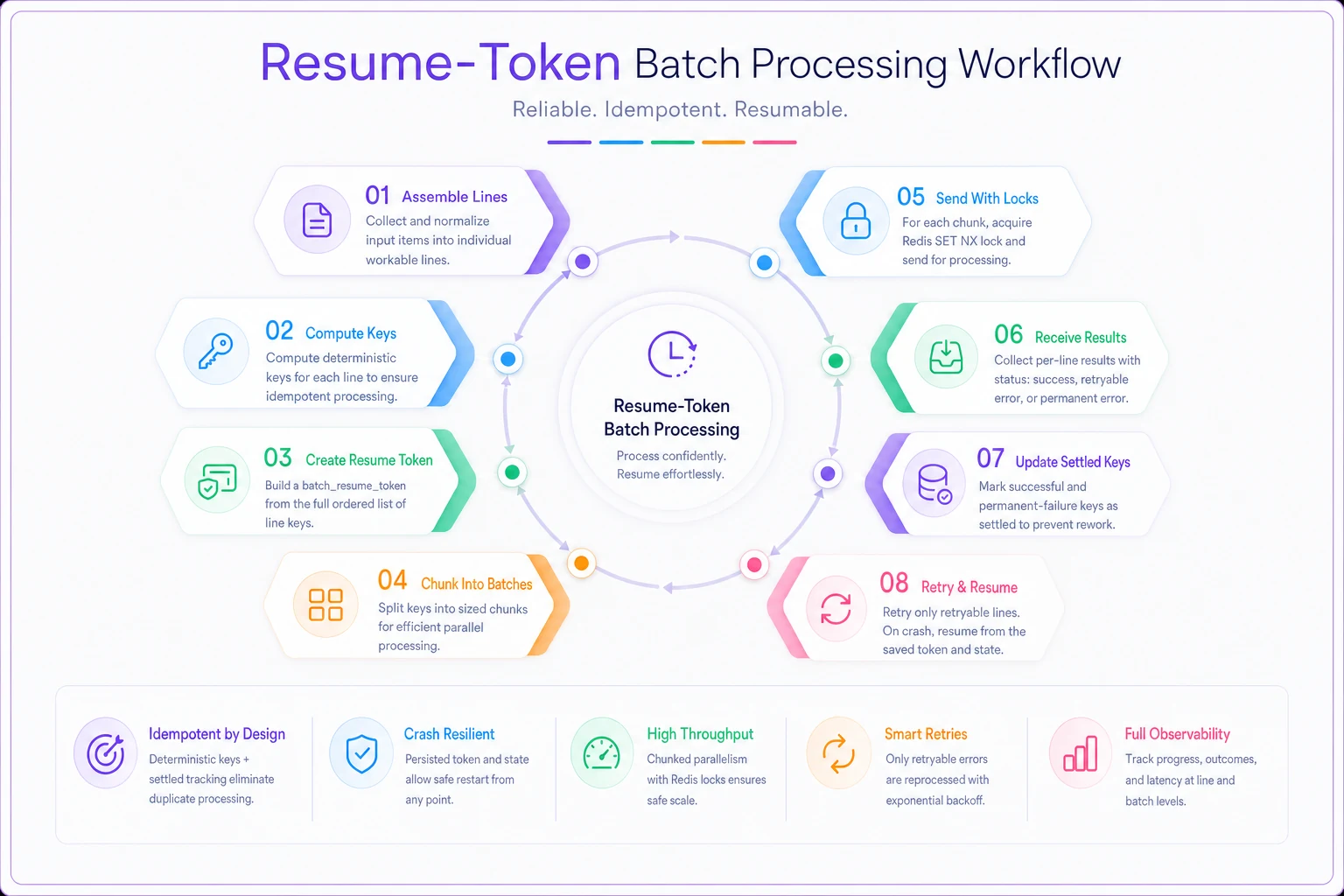
Because the line keys are deterministic, a resumed run can't accidentally re-pay a settled line even if the token is slightly stale — the vendor's idempotency check is your backstop. Belt and suspenders.
The resume workflow, step by step
-
Assemble all lines for the pay period, compute a deterministic key for each.
-
Create a
batchresumetokenwithtotallinesand emptysettledkeys. -
Chunk lines into batches (sizing below) and send each with
SET NXRedis locks. -
On each response, append settled keys to the token, record failures in the dead-letter set, advance
last_cursor. -
For retryable failures, run
sendwithretryper line with its original key. -
If the worker dies, reload the token, filter out
settled_keys, resume from cursor. -
When
settled + deadletter == totallines, mark the tokencompleteand alert on any dead-letter rows.
When settled + deadletter == totallines, mark the token complete and alert on any dead-letter rows.
Batch sizing and backpressure during resume and cutover
Batch size is a tradeoff nobody tunes until it hurts. Too large and a single partial failure forces you to parse and re-chunk hundreds of lines. Too small and request volume alone triggers rate limits.
For most mid-market payroll volumes — a few hundred to a few thousand employees — chunks of 100–250 lines tend to work well. Big enough to be efficient, small enough that retrying the failed subset is cheap.
-
Cap concurrent in-flight batches per pay period. One worker owns a period at a time, or use a Redis lock on
batch{payperiod_id}so a second worker can't start the same period. -
Respect a token bucket for requests/second sized below the vendor's documented rate limit, not at it — leave roughly 20% headroom for retries.
-
Pause intake on sustained 429s. Three 429s in a short window should stop new batches until in-flight ones drain.
-
Never re-enqueue a batch whose resume token is still
in_progress. Check token state before any requeue.
When smaller batches make sense
If your vendor returns opaque all-or-nothing responses with no per-line status, shrink batches aggressively — down to 25–50 lines — so a failure blast radius stays small. You're trading request overhead for containment, which is the right trade when you can't surgically retry.
When this is overkill
If you're pushing a single payroll run of 30 employees once a month to a vendor with a clean idempotent API, you don't need resume tokens and token buckets. A deterministic key plus the retry table is plenty. Don't build the full machinery for volume you'll never have — the resume-token layer earns its keep around the point where a batch failure means re-sending enough lines that manual recovery stops being realistic.
A real scenario
A regional staffing firm running payroll for roughly 1,400 field workers across three clients kept getting duplicate-pay tickets — usually two or three per cycle, but one month it hit 19 people double-paid because a batch POST timed out during a vendor maintenance window and their job retried the entire file with freshly generated UUID keys.
The fix was exactly what's above: deterministic keys derived from tenant + payperiod + employee + lineversion, a Postgres idempotency ledger with the (key, request_hash) unique index, and per-line retries off a 207 response instead of whole-batch replays. Batch size dropped from a single 1,400-line push to chunks of about 200, with a Redis lock per pay period.
Duplicate-pay incidents dropped to zero across the next several cycles. Recovery time after a vendor hiccup went from "re-run and manually reconcile the whole file" to "resume from token in a few minutes." The reconciliation team stopped dreading maintenance windows.
Final thought
Idempotency in payroll isn't a library you bolt on — it's a small set of disciplined choices: derive keys from the business event, store them durably with a request-hash guard, map every status code to a specific retry rule, and never retry a whole batch when you can retry a line. Get those four right and the duplicate-pay tickets simply stop arriving.
The code above is meant to be copied and adapted, not admired — paste it, change the field names to match your schema, and write the cross-language key test before you ship.
Ready to optimize your workforce time management?
Join 2,000+ companies using GoTimio to improve timesheet accuracy, reduce payroll errors, and boost team productivity.