

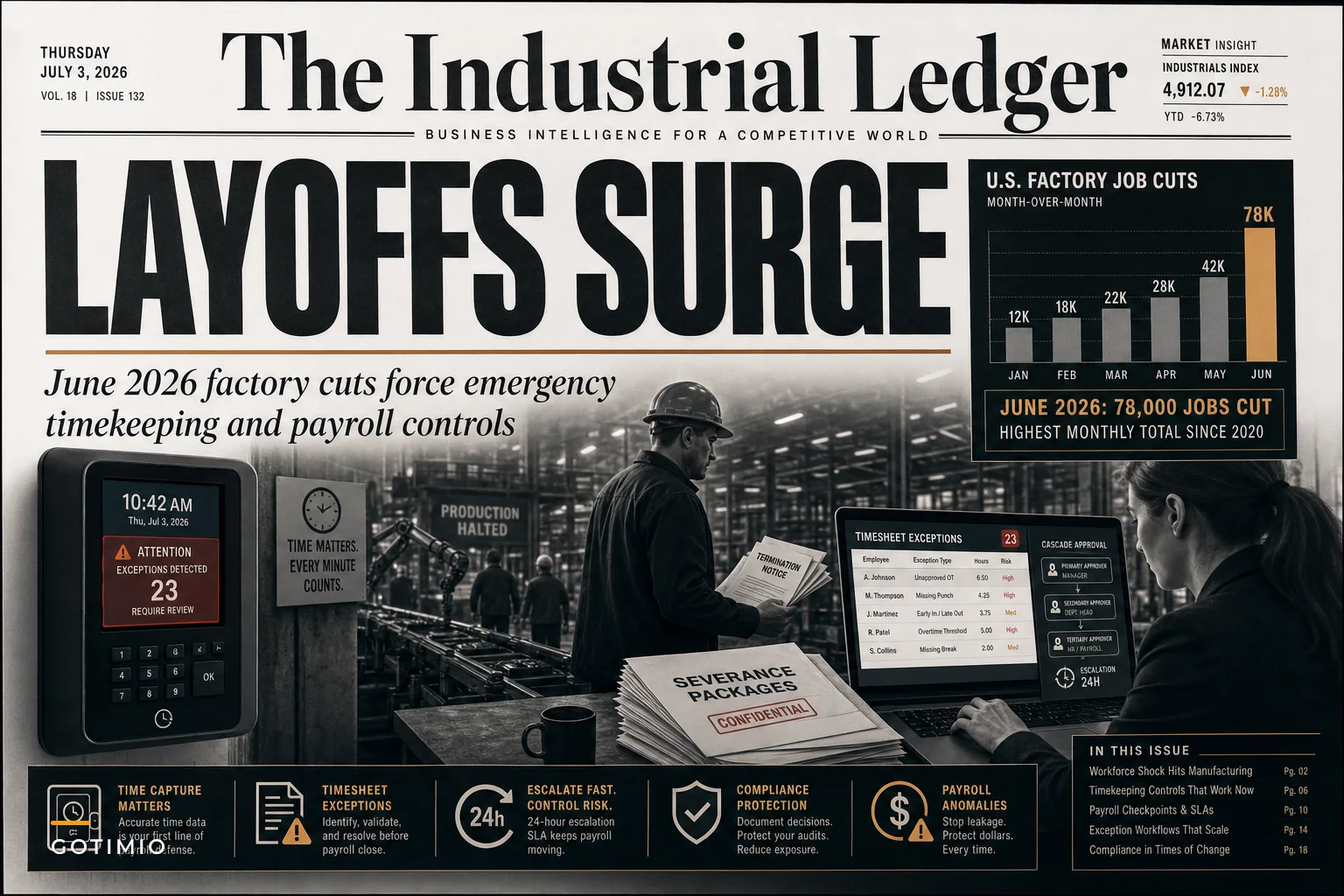

The numbers coming out of manufacturing right now are brutal. CNBC reported that June factory job cuts hit levels not seen since 2009, outside of the pandemic spike. Thousands of workers across automotive suppliers, metal fabricators, and industrial equipment manufacturers got pink slips — all within a matter of weeks.
What the headlines miss is everything that happens after. Every one of those layoffs creates a cascade of payroll and timekeeping problems that HR teams are scrambling to handle. When you cut 20% of your workforce on a Tuesday, you still need accurate payroll for everyone on Friday. The remaining workers are pulling overtime to cover shifts. Supervisors who normally approved timesheets are gone. And your payroll team is drowning in retroactive adjustments, final pay calculations, and compliance deadlines that vary by state.
The manufacturing operations that handle it smoothly tend to have one thing in common: they built controls for rapid headcount changes before they needed them. The ones that didn't are looking at weeks of payroll corrections, overtime violations, and expensive compliance mistakes.
The immediate timesheet mess that follows manufacturing layoffs
Manufacturing runs on predictable shift patterns. First shift at 6 AM, second at 2 PM, third at 10 PM. Supervisors know their crews, approve exceptions quickly, payroll runs clean. Then layoffs hit and that entire system breaks.
Typical scenario: a Midwest auto parts supplier cuts 85 positions across three shifts. The production manager who approved timesheets for 40 workers? Gone. The lead who handled punch corrections for nights? Also gone. Now you've got line workers with no one to approve their overtime, temps who don't know who to report exceptions to, and a payroll team trying to reconstruct who worked what during the transition week.
The problems compound fast. Workers forget to clock out during chaotic shift changes. Overtime spikes because remaining staff are covering extra shifts, but nobody's tracking who's approaching weekly limits. Retroactive edits pile up because supervisors are too overwhelmed to review daily. By the time payroll runs, you're looking at dozens of manual corrections and potential wage violations.
What makes manufacturing particularly vulnerable is the shift structure itself. Unlike office workers who flex their hours, manufacturing runs on strict shift times with specific overtime rules. Miss a punch correction for someone working a double, and you've created a Department of Labor complaint. Shift differentials, weekend premiums, mandatory break rules — every timesheet error carries financial and legal weight.
Why standard payroll controls break during rapid headcount reduction
Most manufacturing HR teams have decent controls for normal operations. Weekly supervisor approvals, overtime pre-authorization, standard exception workflows. These systems assume stable headcount and consistent management structure. During layoffs, three critical assumptions fail at once.
Accurate time tracking made effortless.
GoTimio empowers your team to log, monitor, and manage work hours seamlessly.
- Real-time time tracking
- Automated timesheet approvals
- Payroll and billing integration
No credit card required
First, your approval chain breaks. The supervisor who reviewed timesheets every Thursday at 3 PM is cleaning out their desk. Their backup is overwhelmed trying to manage a department with 30% fewer people. Timesheets start auto-approving or sitting in limbo.
Second, overtime controls become useless. Pre-authorization works when you know next week's schedule. When you're reshuffling entire shifts to maintain production with fewer workers, those limits evaporate. Workers hit 50, 60 hours before anyone notices, and your labor budget explodes while you're supposedly cutting costs.
Third, your exception handling capacity disappears. Every manufacturing payroll team knows certain employees always have corrections — missed punches, job code switches, break adjustments. During normal operations these get handled routinely. During layoffs, exception volume triples while the people who understood the corrections are gone. You either rush approvals and miss errors, or delay payroll and frustrate the workers who stayed.
A plastics manufacturer went through this earlier this year. They laid off 120 workers, including half their shift supervisors. The following payroll cycle had over 400 timesheet exceptions, compared to a normal 50 or 60. Their two-person payroll team spent three straight days on manual corrections, missed compliance deadlines, and still had to issue 30-plus off-cycle checks for errors they couldn't catch in time.
Building emergency approval matrices that actually work
The first thing HR needs during manufacturing layoffs isn't sympathy — it's a functioning approval matrix that accounts for missing supervisors. The typical fix of "just assign everything to the department head" creates bottlenecks and increases errors.
What works better is cascade approval rules. Every timesheet has three potential approvers ranked by proximity to the actual work. Primary is the direct supervisor. Secondary is a peer supervisor from the same shift who understands the work patterns. Tertiary is an operations lead who can validate against production records. The system escalates automatically after 24 hours at each level.
-
Regular hours within 5% of scheduled time
-
Standard shift patterns with proper punch pairs
-
Total hours under 40 for the week
-
Employees with no historical exception patterns
Everything else gets flagged. This typically cuts approval workload by 60-70% while still catching the high-risk exceptions.
The matrix also needs role-based overrides. Your payroll manager should be able to approve any timesheet in an emergency. Your HR ops lead should be able to batch-approve standard patterns. These overrides need audit trails, but during layoffs, speed matters more than perfect hierarchical approval.
Pre-configure escalation windows and override permissions during normal operations so they can be toggled quickly during a layoff.
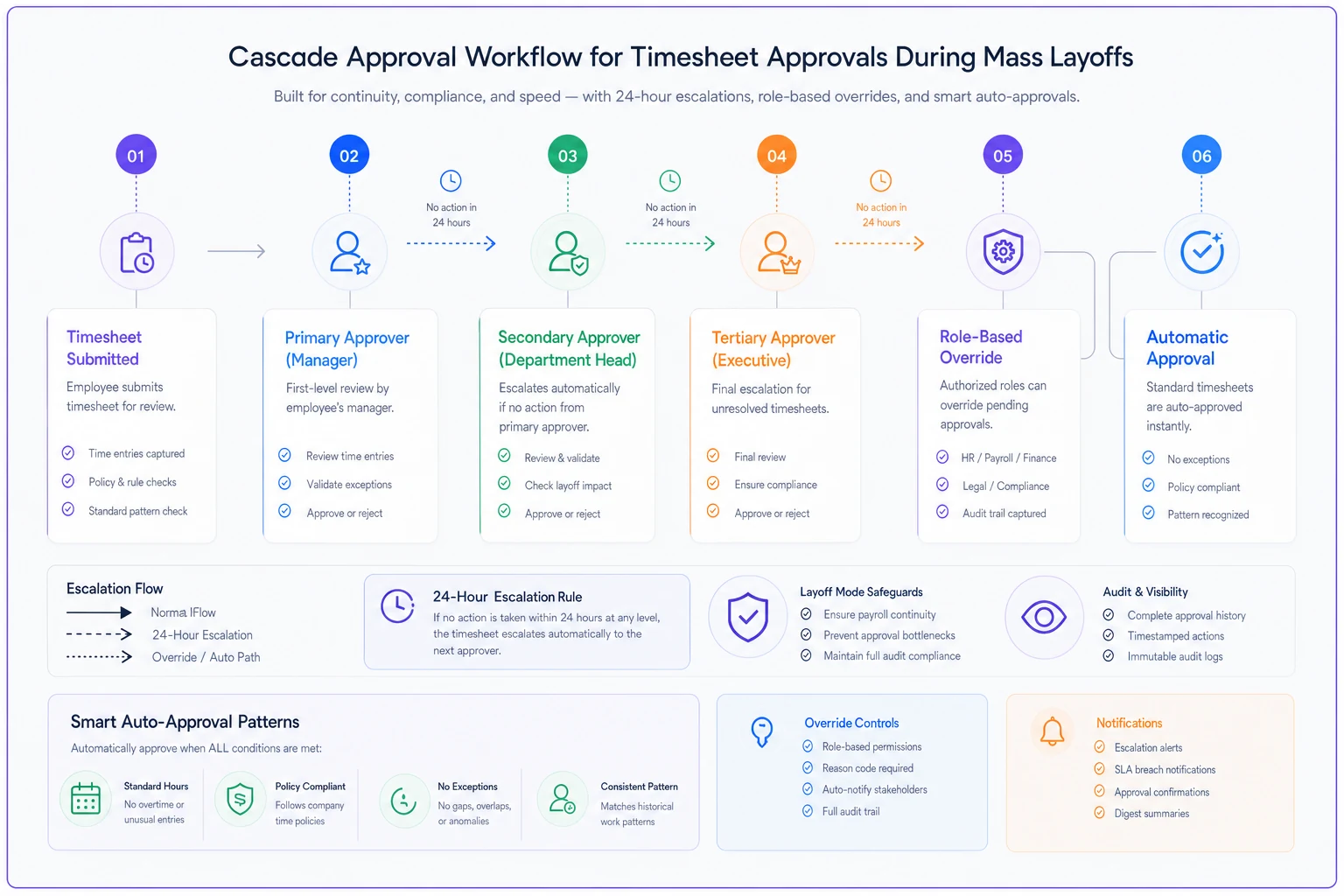
A simple diagram of the cascade and auto-approval rules helps teams implement this quickly.
Automated controls that prevent wage violations during chaos
Manual overtime tracking fails during layoffs. By the time someone notices an employee worked 65 hours, it's too late — you're paying premium rates and facing compliance exposure. More supervision isn't the fix. Automated controls that trigger before problems occur are.
Start with real-time overtime alerts. Not weekly summaries — instant notifications when someone crosses 35 hours. That gives you a full shift to adjust schedules before hitting overtime territory. Set escalating alerts at 35, 38, and 39.5 hours, each going to different stakeholders. The floor supervisor gets the first alert to adjust assignments. HR gets the second to verify authorization. Payroll gets the final warning to ensure proper coding.
Shift-spacing rules matter too. Manufacturing workers switching from nights to days need minimum rest periods. During restructuring, these get missed. Set system blocks that prevent scheduling or punch acceptance that violates your state's rest requirements. A worker finishing at 11 PM shouldn't be able to punch in at 5 AM regardless of operational pressure.
Geographic punch restrictions become critical when you're short-staffed. Workers might clock in from break rooms, parking lots, or even offsite to save time. Off-site punches create compliance problems. Geofences that restrict punches to designated areas — with documented override processes for legitimate exceptions — are worth setting up before the next crisis, not during one.
One of the more useful controls is automatic job code switching based on headcount thresholds. When a department drops below minimum staffing, the system automatically codes any overtime as "emergency coverage" rather than regular OT. This tracks the true cost of reduced headcount and creates documentation for wage audits.
Final pay calculations and state-specific termination requirements
Final paychecks for manufacturing workers are complicated even under normal circumstances. Add mass layoffs and you're juggling state-specific requirements, PTO calculations, and severance agreements — all with strict deadlines that trigger penalties when missed.
California wants final pay immediately upon termination. Missouri gives you seven days. Texas follows the next regular pay cycle. Miss those deadlines and you're paying waiting time penalties that can equal a full day's pay for each day late. Keeping track of who lives where and which rules apply becomes its own project during mass layoffs.
The calculation gets messier with manufacturing's common pay structures. Shift differentials need to be averaged correctly for PTO payouts. Piece-rate workers need their rates calculated properly for unused vacation. Bonuses might need pro-rating. Tool allowances might need to be recouped or paid out. Each item has specific rules that vary by state and your own policies.
What typically gets missed is the interplay between final pay and benefits termination. An employee terminated on the 15th might have health insurance through month-end. If you're processing immediate final pay, you need to collect their benefit contributions for the full month. Miss this and you're either eating those costs or trying to collect from former employees after the fact.
Creating buffer zones between termination and payroll cutoff
The worst payroll disasters during layoffs happen when terminations land too close to payroll cutoff. Terminate workers on Thursday for a Friday payroll run and you're guaranteed errors, missed calculations, and compliance violations.
Smart teams build mandatory buffer zones. No terminations within 72 hours of payroll cutoff. This gives time for final timesheet reviews, PTO balance verification, and proper system updates. It also gives workers a window to flag any missing time or expenses before losing system access.
-
Freeze timesheet editing privileges while maintaining read access
-
Run preliminary final pay calculations for supervisor review
-
Process actual terminations in your HRIS
-
Generate final paychecks with all adjustments included
The buffer zone also helps with equipment returns and final expense reports. Manufacturing workers often have tools, safety equipment, or uniforms that need to come back. If you process final pay before getting equipment returned, you lose your leverage. The buffer creates time for orderly returns and proper documentation.
Rapid redeployment tracking across departments and shifts
Layoffs rarely hit all departments equally. You might cut 30% from assembly while maintenance stays intact. This creates immediate redeployment opportunities — moving remaining workers to cover critical gaps. Without proper tracking, redeployment becomes a payroll problem fast.
Workers temporarily covering different roles need accurate job coding for proper pay rates. Someone from packaging helping in shipping might earn a different hourly rate. One manufacturer had roughly 40 workers covering departments they'd never worked before. Three weeks later, they discovered half were being paid the wrong rates — thousands in corrections, plus the time to sort it all out.
Union environments add more complexity. Different departments might have different agreements, overtime rules, or seniority systems. A senior machine operator helping in maintenance might have different overtime triggers than regular maintenance staff. These nuances need to be tracked accurately or you're facing grievances and potential contract violations.
Cross-shift redeployment brings its own complications. A day-shift worker temporarily covering nights needs shift differential adjustments. Are they eligible for the same premiums as regular night workers? How long before temporary becomes permanent? These decisions need clear documentation and consistent application from the start, not after the fact when someone files a complaint.
Overtime redistribution patterns that minimize compliance risk
When you lose 25% of your workforce but need to maintain production, overtime spikes. How that overtime gets distributed can mean the difference between smooth operations and legal exposure. The instinct to give all overtime to whoever's willing creates serious risks.
You'll create constructive dismissal claims. If someone normally working 40 hours can't get any overtime while others are hitting 60 hours weekly, they might claim you're pushing them out. Document your overtime distribution methodology and apply it consistently.
Fatigue-related safety incidents also spike. A machine operator working 70 hours a week is a workers' comp claim in progress. Set maximum weekly hours regardless of operational pressure. Most manufacturers cap at 60 hours absolute maximum, with 55 hours triggering management review.
Uneven distribution also hides true labor costs. If 20% of remaining workers are pulling all the overtime, your cost per unit looks artificially low. You think the layoffs saved money, but you're spending more on premium pay than you saved on headcount. Spreading overtime more evenly gives you accurate operational numbers and usually makes the workforce more sustainable.
Rotating mandatory overtime lists work well here. Everyone in a classification takes turns being on-call for extra shifts. This prevents burnout and favoritism complaints while keeping coverage. It requires more coordination, but it beats the alternatives.
Protecting remaining supervisors from approval overload
Your remaining supervisors are already stretched. Managing larger teams, processing the disruption, trying to hold productivity together. Doubling or tripling their timesheet approvals on top of that is a real problem, not just an inconvenience.
The instinct is to divide departed supervisors' direct reports equally among whoever's left. This seems fair but ignores practical limits. A supervisor who managed 20 timesheets well might completely fail with 45. They'll rubber-stamp everything or create bottlenecks that delay payroll — neither is acceptable.
A better approach is temporarily centralizing routine approvals. Create an HR operations role specifically for timesheet review during the transition. This person handles all standard approvals and only escalates exceptions to line supervisors. It sounds like overhead, but it's cheaper than overtime errors and compliance violations by a wide margin.
Simplify what supervisors actually review. Instead of full timesheets, give them exception-only reports — just the anomalies: excessive overtime, unusual patterns, missing punches. Let automated systems handle standard validations. This can cut supervisor review time significantly while actually improving accuracy on the things that matter.
System configurations that handle volatile headcount
Your time and attendance system wasn't built for 20% workforce swings. The default configurations assume gradual changes. During layoffs, these defaults create real problems.
User deactivation timing is critical. Terminate system access too early and employees can't submit final corrections. Too late and terminated employees might still punch in or approve timesheets. The solution is staged deactivation: first remove approval rights, then editing rights, then viewing rights — each tied to specific timelines after the termination date.
Auto-approval rules need temporary adjustment. The rule approving timesheets under 41 hours made sense at full staffing. Now, with everyone pulling overtime, it's approving timesheets that need actual review. Temporarily tighten auto-approval to only the most standard patterns, then gradually relax as staffing stabilizes.
Reporting hierarchies need frequent updates too. Most systems mirror your org chart for approval routing, and that org chart is changing daily during layoffs. Instead of constantly updating complex hierarchies, temporarily flatten the structure. Create broader approval groups based on shifts or departments rather than specific supervisor relationships.
Integration points with payroll need extra monitoring. When you're processing unusual volumes of final pays and retroactive adjustments, integration errors multiply. Set up additional validation reports comparing system records to payroll outputs. You want to catch errors before checks are cut, not after.
Building a 30-60-90 day stability timeline
The chaos doesn't resolve overnight. You need a structured timeline to return to normal operations without dropping critical controls too early or maintaining emergency measures too long.
Days 1-30: Crisis Management Focus entirely on compliance and accuracy. Maintain daily timesheet audits, manual overtime monitoring, and enhanced approval processes. This isn't sustainable long-term, but it prevents major violations during peak chaos. Accept that efficiency is secondary to accuracy right now.
Days 31-60: Stabilization Start transitioning back to automated controls. Gradually expand auto-approval rules as patterns stabilize. Reduce manual audits to weekly. Begin training new supervisors on approval responsibilities. Document lessons learned while they're still fresh. This phase determines whether you'll actually recover or stay in permanent crisis mode.
Days 61-90: New Normal Implement permanent changes based on reduced headcount. Finalize new approval hierarchies. Adjust overtime policies to reflect current staffing. Update job codes and pay rates to match reorganized departments. Conduct a full payroll audit to catch any lingering issues from the transition.
The timeline needs clear metrics for advancement. Don't move to phase two just because 30 days passed. Require specific benchmarks: timesheet exceptions below threshold, overtime hours stabilized, all final pays processed correctly. These gates prevent premature relaxation of controls, which is usually when the second wave of errors hits.
Technology integration points that matter most
During manufacturing layoffs, certain system integrations become critical failure points. The connection between time tracking and payroll always matters, but during workforce transitions, any integration hiccup creates cascading problems.
The HRIS to timekeeping sync is paramount. When you terminate someone in your HRIS, they need to be properly flagged in timekeeping immediately — not at the next scheduled sync cycle. A four-hour delay might mean they punch in for another shift. Set up real-time or at minimum hourly syncs during layoff periods.
Benefits integration affects final pay calculations directly. Your timekeeping system needs current benefit deduction information to calculate final paychecks correctly. If someone changed their 401k contribution last week, that needs to be reflected. These systems often sync weekly during normal operations. During layoffs, you need daily syncs at minimum.
Production tracking systems provide useful validation. When someone claims they worked a double shift, production records should confirm output during those hours. This helps validate overtime claims, prevents timesheet inflation during chaotic periods, and gives you documentation if wrongful termination claims emerge later.
The most overlooked integration is with your access control systems. When workers badge into the building, that data should feed your timekeeping system for validation. During layoffs, this becomes your audit trail for who was actually on-site versus who might be buddy punching or padding hours.
| Integration | Normal Sync Frequency | Recommended During Layoffs |
|---|---|---|
| HRIS → Timekeeping | Daily or batch | Real-time or hourly |
| Benefits → Payroll | Weekly | Daily |
| Production → Timekeeping | Weekly | Daily |
| Access Control → Timekeeping | Daily | Real-time |
Getting these integrations right is what separates a payroll operation that survives a layoff cycle from one that generates months of audit exposure afterward.
Post-layoff audit requirements and documentation needs
Three months after layoffs, when everyone's moved on, the audit requests start showing up. Department of Labor wants overtime records. State workforce commission needs termination documentation. Former employees' attorneys request timesheet histories. Without solid documentation from the layoff period, you're trying to reconstruct events from memory.
Document every approval override during the transition. When the payroll manager approved 200 timesheets because supervisors were gone, that needs to be logged with justification. A simple override log works: date, employee, normal approver, actual approver, reason. This protects you from claims of improper payment or favoritism.
Preserve all communications about schedule changes and overtime distribution. The email asking for weekend volunteers, the messages approving emergency overtime — create a centralized repository for scheduling communications during the layoff period. These become critical evidence if someone claims forced overtime or discriminatory treatment.
System configuration changes need particular attention. Every adjustment to auto-approval rules, overtime thresholds, or integration settings should be documented with date, person, and business justification. When auditors ask why certain controls were relaxed, you need to show it was intentional crisis management, not negligence.
Final pay calculations deserve their own documentation package. Keep not just the final numbers but the calculation methodology: which policy version was used, how partial period accruals were handled, how unused PTO was valued. These details matter when former employees challenge their final payments months later, and they will.
Creating sustainable controls for the next cycle
Manufacturing is cyclical. The current layoffs won't be the last workforce adjustment your organization faces — Business Insider's ongoing layoff tracker shows this kind of volatility is becoming more routine across sectors. The question is whether you'll be better prepared next time.
Codify emergency procedures while the experience is fresh. That cascade approval matrix you built on the fly? Document it properly. The overtime distribution method that prevented complaints? Make it official policy. The buffer zones that kept payroll from going sideways? Build them into your standard termination procedures.
Create template communications for common scenarios. Draft the "temporary supervisor assignment" email now, while you remember what information employees actually needed. Prepare the "overtime policy during restructuring" memo while the effective language is clear. These templates save hours during the next crisis.
Build measurement systems that track the right metrics during transitions. Timesheet exceptions per 100 employees. Average hours to approval. Percentage requiring manual intervention. Off-cycle payment frequency. These metrics help you spot problems early and demonstrate control to auditors.
Most importantly, maintain minimum viable controls even during stable periods. The approval matrix shouldn't completely disappear when you're fully staffed. Overtime monitoring shouldn't stop when hours are normal. Keep scaled-down versions of crisis controls active so they're ready when needed.
Conclusion: Beyond surviving the current crisis
The manufacturing layoffs hitting right now are putting HR teams in impossible positions. Maintaining payroll accuracy while infrastructure crumbles. Preventing compliance violations while controls fail. Supporting remaining workers while systems are overloaded.
What separates companies that come out stronger from those that stay in permanent crisis mode is treating payroll and timekeeping controls as operational infrastructure, not administrative overhead. They're the foundation that lets you navigate workforce transitions without creating secondary disasters.
The immediate fixes — emergency approval matrices, automated overtime controls, buffer zones between termination and payroll — stop the bleeding. The real value comes from building systematic approaches that handle volatility as a normal condition rather than a surprise.
Manufacturing employment will stay volatile. Cost pressures aren't going away. Demand uncertainty continues. The question isn't whether you'll face rapid headcount changes again — it's whether you'll handle them better. The controls, processes, and systems you build now determine whether future transitions are manageable or catastrophic.
Start with stabilizing current operations. Implement emergency controls that prevent immediate compliance failures. Then build toward sustainable systems that handle workforce volatility without requiring heroic manual effort every time. The next cycle will come.
Ready to optimize your workforce time management?
Join 2,000+ companies using GoTimio to improve timesheet accuracy, reduce payroll errors, and boost team productivity.