

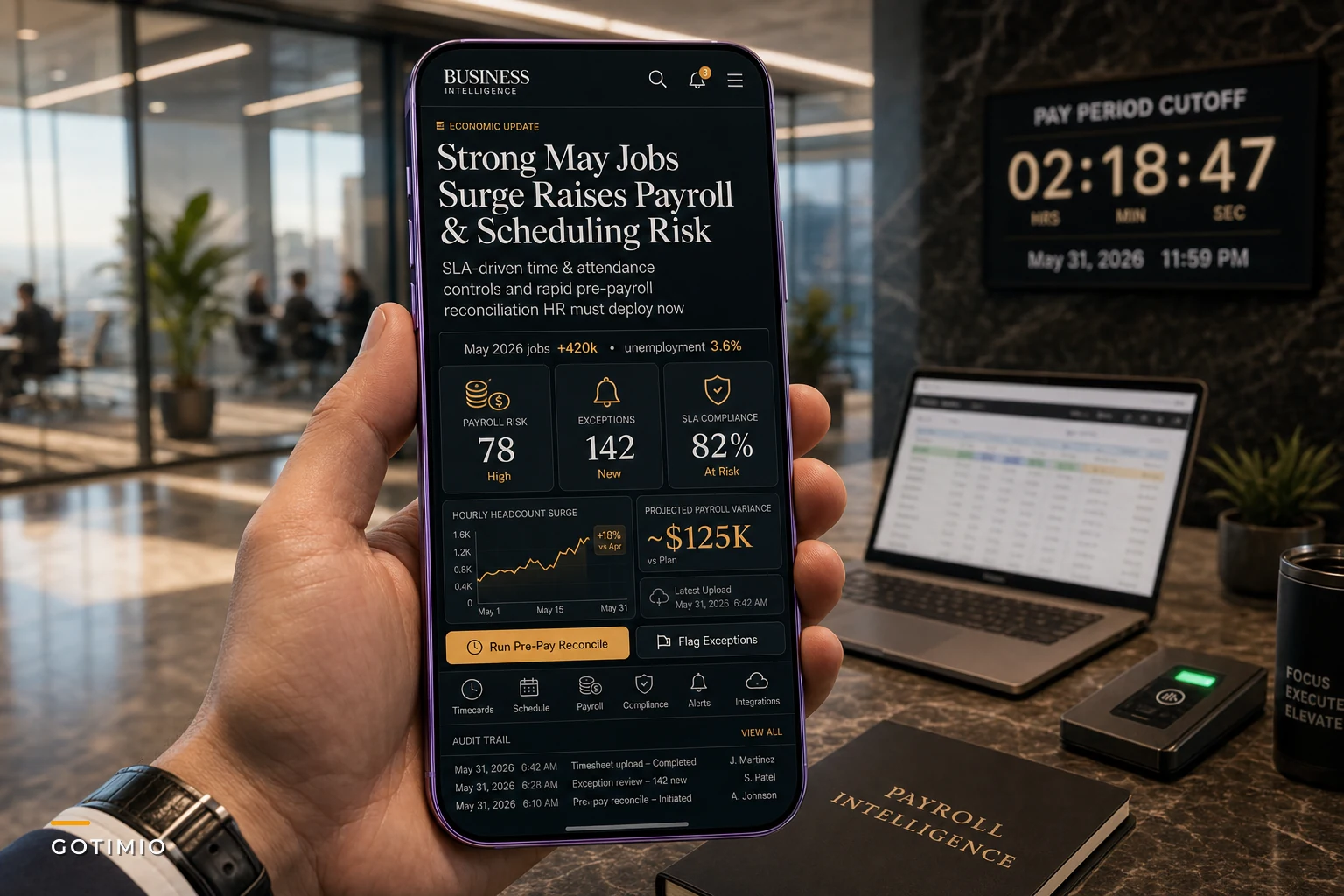

The latest employment data from the Bureau of Labor Statistics dropped this morning, and if you run payroll or manage schedules, you probably already know what this means. Another 172,000 jobs added in May, unemployment holding steady at 4.3%. We're heading straight into summer hiring season with no signs of slowing down.
For your Thursday afternoon reality check: more new hires flooding your onboarding pipeline, shift swaps multiplying like crazy, and overtime creeping up while you're still trying to close out last week's payroll reconciliation.
The timing is brutal. June through August is when most businesses see their scheduling complexity peak — vacation coverage, seasonal workers, extended hours. Add sustained hiring pressure to the mix, and you've got a recipe for payroll disasters that can cost thousands and take weeks to untangle.
## The Real Cost of Getting Payroll Wrong Right Now
A healthcare staffing company discovered they'd been overpaying float pool nurses for two pay periods last month. The error? Their payroll reconciliation process couldn't keep up with shift differentials and location changes. Total damage: $47,000 in overpayments that took 80 hours to fix.
This happens more often than most people realize. Payroll reconciliation failures don't announce themselves until it's way too late. With hiring this active, the typical warning signs get buried under operational noise. Your payroll team processes 30% more new hire paperwork. Scheduling managers juggle more shift changes. Everyone moves faster, checks less carefully.
The math gets ugly fast. Take a 150-employee operation running biweekly payroll. Add 12-18 new hires per month (standard in this labor market), and you're looking at roughly 25-35 additional timecards to verify each pay period. That's 10-15 more scheduling exceptions to resolve, plus extra hours of payroll prep time. Overtime calculation errors become three times more likely.
Most payroll teams already run lean. This additional volume doesn't just slow things down — it breaks the reconciliation workflows that keep payroll accurate.
## Why Traditional Reconciliation Breaks Under Hiring Pressure
Standard payroll reconciliation assumes relatively stable inputs. Regular employees, predictable schedules, occasional exceptions. The process works when variables stay within expected ranges.
Accurate time tracking made effortless.
GoTimio empowers your team to log, monitor, and manage work hours seamlessly.
- Real-time time tracking
- Automated timesheet approvals
- Payroll and billing integration
No credit card required
Sustained hiring growth creates cascading complexity that breaks these assumptions.
Volume overload hits first. Your payroll coordinator who typically reviews 80 timesheets now faces 110 or more. Quality checks that used to catch discrepancies get rushed or skipped entirely. Small errors compound into significant variances.
Data fragmentation becomes critical. New hires exist in multiple systems at different stages — partially onboarded in HR, not yet synced to time tracking, scheduled but not properly coded for department allocation. Each system gap creates reconciliation blind spots.
Exception handling spirals out of control. Training shifts, buddy shifts, partial shifts during onboarding — none fit standard timecard patterns. Manual overrides multiply. Audit trails become impossible to maintain.
Most businesses don't realize their reconciliation process has failed until employees complain about incorrect paychecks or finance discovers massive variances during month-end close.
## Building Surge-Ready Reconciliation Workflows
After watching dozens of businesses navigate similar hiring surges, clear patterns emerge about what works versus what sounds good in theory.
The businesses that maintain payroll accuracy during growth spurts share three characteristics.
First, they pre-validate timecard data before it hits payroll processing. Not after submission, not during review — but continuously throughout the pay period. This means catching impossible punches (like someone clocked in at two locations) immediately, not discovering them Tuesday night before Wednesday's payroll run.
Second, they maintain parallel reconciliation tracks for different employee segments. New hires get daily validation for their first two pay periods. Overtime-eligible roles get automatic variance alerts. Salaried staff run on exception-only review. This segmentation prevents high-risk errors from hiding in routine processing.
Third, they build reconciliation checkpoints into scheduling workflows, not just payroll workflows. When a manager approves a shift swap, the system immediately validates it won't create overtime. When someone picks up an extra shift, department coding gets verified before the shift starts, not after timecard submission.
This diagram shows how validation, segmentation, and scheduling checkpoints flow together.
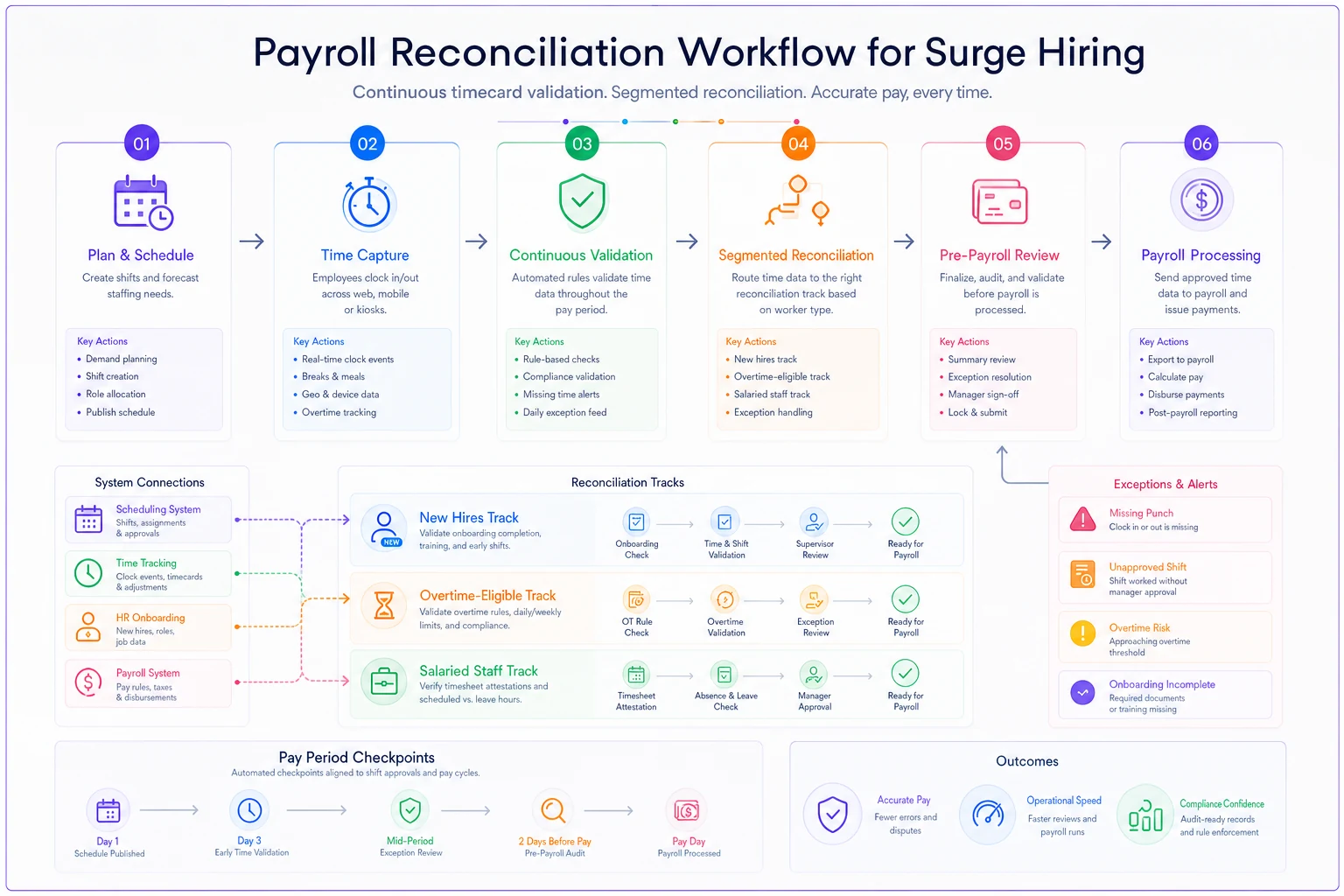
Use the flow to identify which handoffs to automate and where pre-payroll checks should occur.
## The Scheduling-to-Payroll Handoff Problem
The gap between when schedules get published and when timecards get processed becomes a reconciliation nightmare during hiring surges.
Monday: Schedule published for next week, includes 8 new hires Tuesday: 3 new hires' start dates change, schedule not updated Wednesday: 2 shift swaps approved verbally, not logged Thursday: Department manager adds coverage shifts for training Friday: Original scheduler out sick, nobody validates changes Saturday-Sunday: Actual shifts worked don't match any documented schedule Following Monday: Timecards submitted Tuesday: Payroll team discovers nothing matches
The reconciliation effort to untangle this took 6 hours of comparing schedules, timecards, emails, and text messages. Multiply this across departments, and payroll reconciliation becomes a full-time job.
Smart operations solve this by enforcing schedule lock periods and requiring all changes to flow through the same system. They're building pre-payroll reconciliation steps that catch mismatches before they become payroll problems.
## Quick Wins You Can Implement This Week
You can't overhaul your entire payroll process overnight, but you can reduce reconciliation burden with targeted improvements.
Daily variance reports for high-risk categories catch problems early. Set up exception reporting for anyone approaching overtime threshold (at 35 hours, not 40), new hires with more than 45 hours in their first week, any timecard with manual edits exceeding 4 hours, and department codes that don't match scheduled departments.
Flag new hires in your time system as 'onboarding' to automatically trigger daily validation rules for their first pay periods.
Manager pre-approval workflows eliminate downstream reconciliation headaches. Before timecards submit to payroll, require managers to explicitly approve any overtime hours, shift differentials, timecards with edits, and hours outside scheduled times.
Automated new hire tracking prevents the most expensive errors. Create dedicated reconciliation rules for employees in their first 60 days — flag any day exceeding 10 hours, alert on consecutive days exceeding 6, validate department codes match onboarding assignments, confirm pay rates match offer letters.
These aren't revolutionary changes. But implemented consistently, they prevent the kinds of errors that turn into reconciliation marathons.
## Technology's Role Without the Hype
Every software vendor wants to sell you the "future of payroll automation." The reality is more practical. Technology helps when it matches your actual operational workflow.
The most effective payroll reconciliation improvements often come from better information flow, not better algorithms. A construction company reduced their reconciliation time by about 60% just by giving field supervisors mobile access to approve timecards on-site, rather than waiting until they returned to the office.
For businesses handling this hiring surge, technology investments that reduce reconciliation burden include unified time capture that eliminates data entry across systems, real-time validation rules that prevent bad data from entering the system, and audit-ready reporting that maintains clear documentation for every edit, override, and approval.
Building these capabilities into your standard time and attendance workflows creates the foundation for handling volume surges without proportionally increasing reconciliation effort.
The key isn't finding the perfect system — it's implementing whatever system you choose consistently and training your team to use it properly.
## Planning for Summer's Operational Reality
The sustained job growth Reuters reported isn't slowing down heading into summer. Seasonal hiring will amplify the pressure on your payroll and scheduling operations.
| Risk Factor | June | July | August |
|---|---|---|---|
| New hire volume | +20% | +35% | +30% |
| Schedule volatility | High | Critical | High |
| Overtime exposure | Moderate | High | Critical |
| Reconciliation complexity | 2x normal | 3x normal | 2.5x normal |
| Error discovery lag | 3-4 days | 5-7 days | 4-5 days |
The pattern is predictable: June's hiring sets up July's complexity, which explodes into August's overtime surge as everyone tries to cover vacations with insufficient staff.
June preparation: Lock down your core reconciliation workflows. Document every manual step. Identify which processes break first under volume pressure. Train backup personnel on critical procedures.
July execution: Increase reconciliation frequency to catch errors faster. Move from biweekly to weekly validation cycles for high-risk departments. Implement daily overtime monitoring. Require same-day approval for all schedule exceptions.
August survival: Focus on preventing errors rather than catching them. Lock schedules 72 hours in advance. Eliminate verbal approvals entirely. Run preliminary payroll calculations mid-period to catch trends early.
## The Hidden Reconciliation Multiplier
A two-hour delay in timecard approval seems minor. But when you're processing 40% more timecards, that two-hour delay creates a domino effect: payroll processing starts late Tuesday instead of Tuesday morning, reconciliation gets compressed into Tuesday afternoon instead of having all day, errors discovered Tuesday night can't be fixed until Wednesday morning, payroll runs Wednesday afternoon instead of Wednesday morning.
This cascade happens every pay period during hiring surges. The stress accumulates. Your best payroll people burn out. Mistakes multiply.
Breaking this cycle requires rethinking reconciliation as a continuous process, not a deadline-driven sprint. The businesses surviving this hiring surge without payroll disasters run reconciliation tasks throughout the pay period, not cramming everything into the 48 hours before payroll runs.
## Making Reconciliation Sustainable
This job growth isn't a temporary spike — it's the new operational normal. Your payroll reconciliation process needs to handle not just current volume but sustained growth throughout summer and into fall.
Organizations successfully managing this transition have stopped treating reconciliation as a back-office burden. They treat it as a critical operational function that directly impacts employee satisfaction and financial accuracy.
-
Dedicated reconciliation ownership rather than splitting responsibilities. One person owns the accuracy of time data from capture through payroll processing. They have authority to enforce standards, halt payroll if needed, and mandate process changes.
-
Daily reconciliation hygiene replacing periodic deep cleans. Spending 30 minutes daily on validation beats spending 8 hours every two weeks on forensic reconstruction. Small, consistent efforts prevent the accumulation of errors that create reconciliation emergencies.
-
Investment in reconciliation capabilities through both training and tools.
Your payroll team needs time to learn new validation techniques, authority to push back on bad data, and technology that makes their job possible rather than barely manageable.
## Your Next Two Weeks Matter
The strong May jobs report signals what you probably already feel — the operational pressure isn't letting up. Your choice isn't whether to deal with increased payroll complexity but how to handle it without sacrificing accuracy or burning out your team.
Start with the highest-impact changes. Pick three reconciliation improvements you can implement before your next payroll run. Maybe it's daily overtime monitoring, maybe it's manager pre-approval requirements, maybe it's segmented validation rules for new hires. Whatever you choose, implement it fully rather than partially attempting everything.
Payroll reconciliation isn't just about catching errors — it's about preventing them. Every hour spent on proactive validation saves three hours of reactive investigation. Every workflow improvement compounds across every future pay period.
The businesses thriving during this hiring surge aren't the ones with perfect systems. They're the ones making incremental improvements every week, building reconciliation capabilities that scale with their growth rather than breaking under pressure.
Your employees depend on accurate paychecks. Your finance team depends on clean payroll data. Your organization depends on sustainable operations. Getting reconciliation right isn't optional — but neither is it impossibly complex. Focus on the fundamentals, build gradually, and maintain consistency even when everything else feels chaotic.
The summer ahead will test your operational resilience. Make sure payroll reconciliation strengthens rather than undermines your ability to capture the growth opportunities this sustained hiring market creates.
Ready to optimize your workforce time management?
Join 2,000+ companies using GoTimio to improve timesheet accuracy, reduce payroll errors, and boost team productivity.