
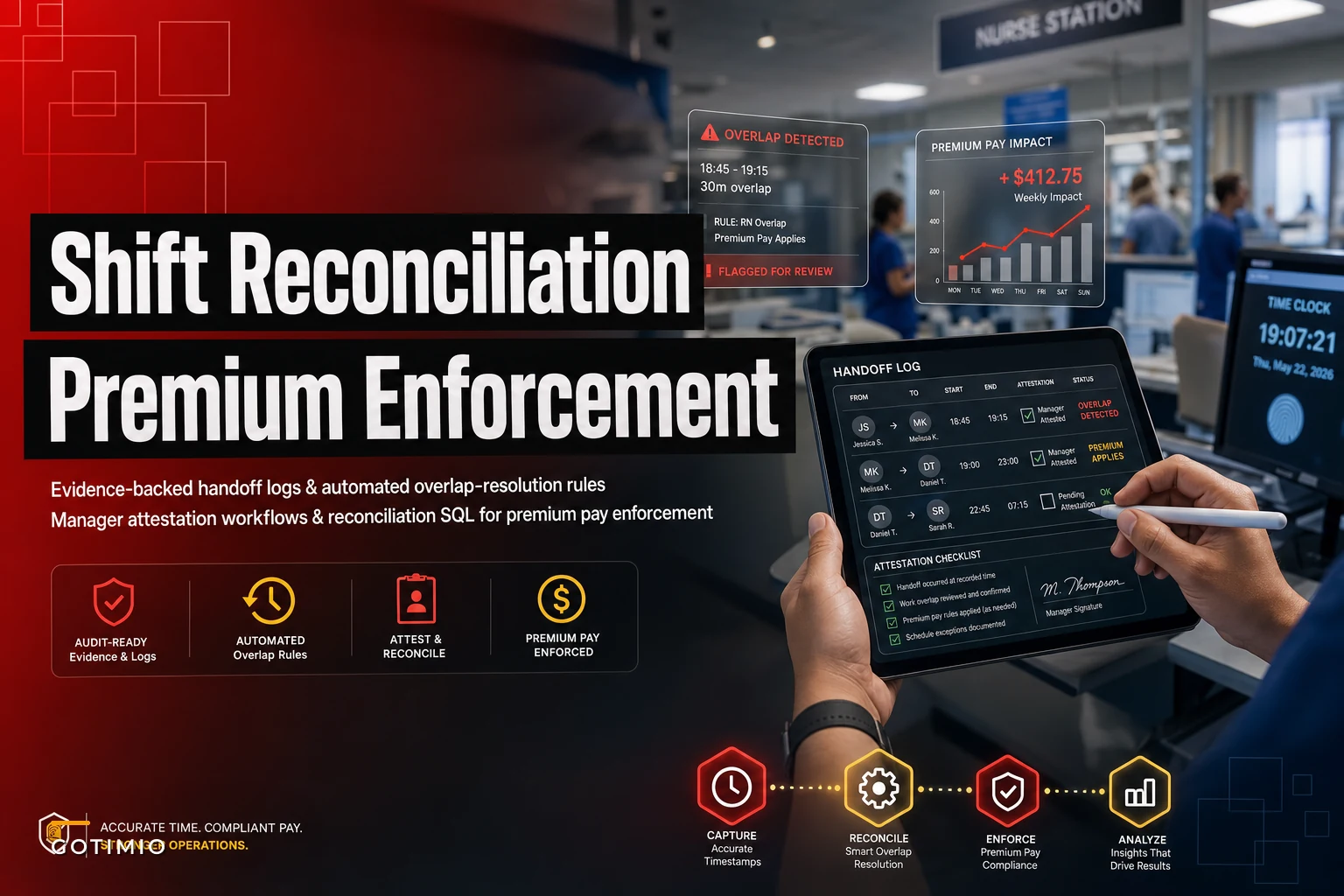

Overlap pay in healthcare is one of those line items that quietly bleeds money until finance runs a full-year audit and everyone acts surprised. On a nursing floor, two people clocked in for the same 15 minutes isn't automatically wrong — handoffs require overlap. The problem is telling the legitimate overlap from the accidental, the padded, and the straight-up policy violation that triggers premium pay nobody agreed to.
That's the gap this article lives in. Not "why overlap happens" — you already know bedside report takes time. The real question is: when two timecards cover the same clock minutes on a shift that carries a differential (nights, weekends, holiday, call-back), which overlap earns premium pay, which gets paid straight, and which gets denied entirely — and can you defend that decision when the union rep or the DOL asks?
The specific failure: overlap that silently converts into premium liability
Here's the mechanic that catches most HR teams off guard.
A day RN is scheduled out at 19:00. The night RN is scheduled in at 18:45 for handoff. That 15-minute planned overlap is normal and budgeted. But the night shift carries a $4.50/hr differential plus, in many facilities, an overtime multiplier once the night RN crosses 40 hours for the week.
Now the day RN doesn't clock out until 19:40 — late discharge, family conversation, whatever. The night RN is already clocked in. You now have 55 minutes of overlap, and 25 of those minutes land in a window where the night differential applies and the day RN may be tipping into daily overtime depending on jurisdiction.
Multiply that across a 60-bed unit running two or three overlaps per shift pair, seven days a week. The individual amounts look like noise — $3, $6, $11 per event. The annual total on a mid-size hospital floor lands somewhere in the $40k–$70k range, and almost none of it was authorized.
The uncomfortable part: a lot of it should have been paid. Late discharges are real work. But without reconciliation, you can't separate the legitimate premium overlap from the accidental, so you either overpay everything or start clawing back pay and destroy trust. Both outcomes are bad.
Why reconciliation breaks down in practice
The overlap data exists. The timestamps are sitting in your system. The failure is almost never missing data — it's missing rules and evidence to interpret the data.
Accurate time tracking made effortless.
GoTimio empowers your team to log, monitor, and manage work hours seamlessly.
- Real-time time tracking
- Automated timesheet approvals
- Payroll and billing integration
No credit card required
Three things go wrong, usually together:
No evidence standard for the handoff. Everyone agrees handoff overlap is payable. Nobody defined what proves a handoff actually happened versus two people who just clocked in early. Without an evidence requirement, every overlap defaults to "probably legit," and probably-legit is how liability compounds.
No automated rule deciding which rate applies. When the overlap straddles a differential boundary, someone has to decide: does the premium rate apply to the overlapping minutes, or only straight time? If that decision lives in a payroll clerk's head, it's inconsistent across pay periods and impossible to audit.
Manager sign-off happens after the money is already committed. The charge nurse approves timecards in bulk at end of pay period, sees nothing unusual (because overlap looks normal), and signs. The premium pay is already baked in before anyone checked whether it was earned.
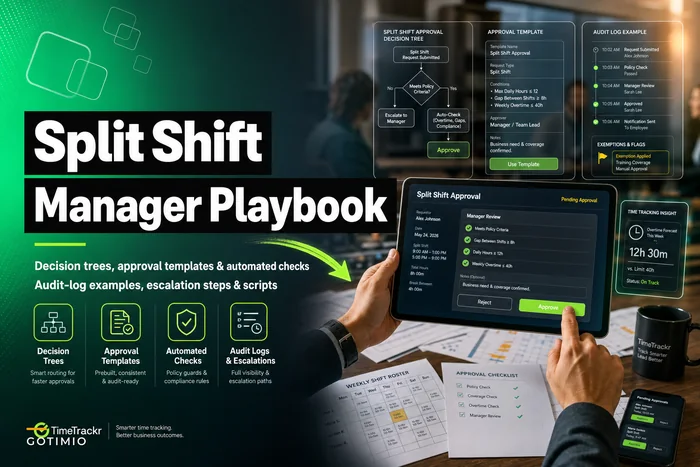
This is the same root cause behind a lot of split-shift pay leakage — decisions made without a defined trigger. If you've dealt with that, the split-shift approval playbook for managers covers the decision-tree logic that applies here too; overlap reconciliation is essentially the same discipline pointed at a different seam in the schedule.
Handoff evidence requirements: what actually proves an overlap earned pay
Before you can reconcile anything, you need a defensible answer to "what counts as a real handoff." Vague standards get challenged and lost. Here's the evidence hierarchy that holds up:
-
Tier 1 — System-corroborated. A documented handoff note or SBAR entry timestamped inside the overlap window, by the incoming nurse, referencing the outgoing nurse. This is the gold standard. If the handoff charting lands at 19:05 and both nurses are clocked in, that overlap is self-justifying.
-
Tier 2 — Schedule-corroborated. The overlap falls within the planned handoff window (say, 15 minutes) and both parties were scheduled for it. Payable up to the scheduled limit, no further.
-
Tier 3 — Supervisor-attested. Overlap exceeds the planned window but a charge nurse attests in writing to a specific operational reason — late discharge, code, admission in progress. Payable with the attestation on record.
-
Tier 4 — Unsupported. Overlap with no charting, outside the planned window, no attestation. Not payable at premium. Investigate before paying even straight time.
The insight most facilities miss: you don't need to deny Tier 4 overlaps outright — you need to route them. An unsupported overlap isn't fraud; it's usually a missed note or a real reason nobody wrote down. Routing it to the charge nurse for a 30-second attestation converts most of them into clean Tier 3 approvals and surfaces the genuine problem cases.
Route Tier 4 overlaps to the charge nurse for a one-line attestation before payroll cutoff; many convert to Tier 3 without dispute.
An unsupported overlap isn't fraud; it's usually a missed note or a real reason nobody wrote down. Routing it to the charge nurse for a 30-second attestation converts most of them into clean Tier 3 approvals and surfaces the genuine problem cases.
Automated overlap-resolution rules
Once you have an evidence tier, the rate decision can be deterministic. Here's the resolution logic as a set of rules rather than clerk judgment:
| Overlap condition | Differential applies? | Pay treatment | Required evidence |
|---|---|---|---|
| Within planned handoff window, both scheduled | Yes, at the incoming shift's rate | Pay premium for overlap minutes | Tier 2 (schedule) |
| Exceeds planned window, handoff charting present | Yes | Pay premium, flag for trend review | Tier 1 (charting) |
| Exceeds planned window, no charting, attested | Yes | Pay premium with attestation logged | Tier 3 (supervisor) |
| Exceeds planned window, no charting, no attestation | No | Hold overlap minutes; route to manager | Tier 4 → escalate |
| Overlap pushes incoming nurse into OT | Apply jurisdiction OT rule to overlap minutes only | Premium + OT per policy | Tier 1 or 3 required |
| Both parties off-shift (neither scheduled) | No | Reject both overlapping entries | Investigate |
Two rules do most of the heavy lifting. First: premium applies to overlap minutes at the rate of the shift whose differential window those minutes fall in — not whoever's card you're looking at. The day nurse's 19:00–19:25 minutes sit inside the night differential window, so if they're payable, they may carry the night premium depending on your pay rules. Get this wrong in either direction and you're either underpaying or creating liability.
Second: cap scheduled overlap pay at the scheduled amount. If the plan is 15 minutes of handoff and the overlap runs 40, only the planned 15 auto-approves; the remaining 25 drop to Tier 3/4 for attestation. This single cap prevents the slow creep that drives most of the annual overpay.
These two rules together cover the majority of overlap scenarios without any human involvement. The cases that fall outside them are genuinely edge cases — and those are the ones worth a manager's attention.
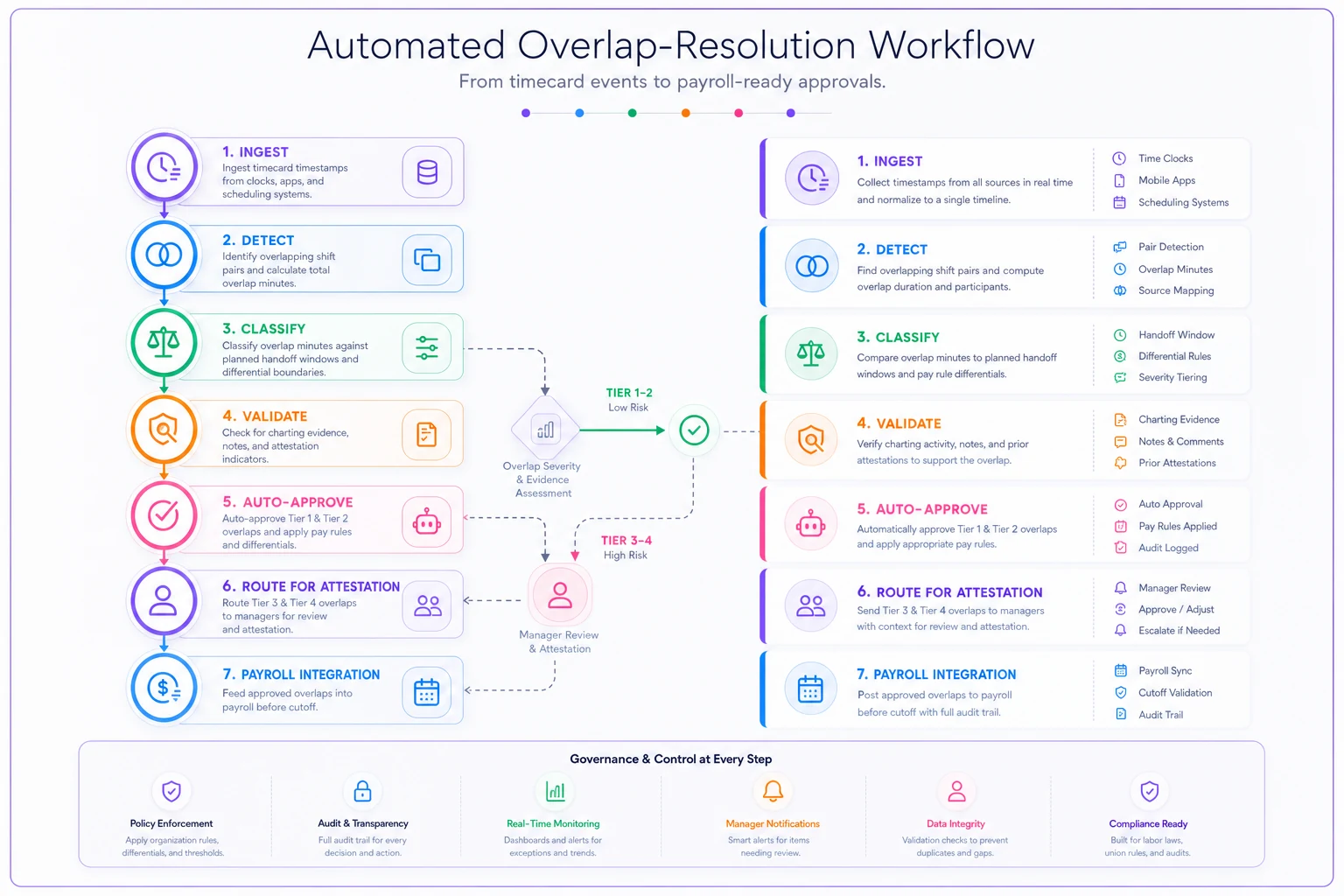
The diagram shows the stepwise flow from detection to approval and escalation; keep it in your pre-cutoff validation path.
These two rules together cover the majority of overlap scenarios without any human involvement. The cases that fall outside them are genuinely edge cases — and those are the ones worth a manager's attention.
Manager sign-off templates
End-of-period bulk approval is where premium liability gets rubber-stamped. The fix isn't more approvals — it's approvals that only surface the overlaps that actually need a human decision.
A workable sign-off packet for a charge nurse should contain, per overlap exception (not per timecard):
-
The two employees and the overlapping minutes
-
Which differential window the minutes fall in and the dollar impact
-
The evidence tier the system auto-assigned
-
For Tier 3/4 only
a one-line attestation field and a reason code
Here's a sign-off template structure that keeps the record defensible:
OVERLAP EXCEPTION — PERIOD 2024-21 Unit: 4-West | Shift pair: Day→Night | Date: 11/14 Outgoing: R. Alvarez (out 19:38) Incoming: T. Okafor (in 18:45) Overlap minutes: 53 | Planned window: 15 Auto-approved (scheduled): 15 min @ night diff = $1.13 Pending review: 38 min @ night diff = $2.85 Reason for extended overlap: Reason code: [ ] Late discharge [ ] Admission [ ] Code [ ] Charting lag [ ] Other: Charge nurse attestation: Signed: ___
The point of the template is that the manager approves a reason, not a number. When finance or a regulator pulls the record later, there's a named person, a specific operational cause, and a timestamp. That's the difference between "we paid it" and "we paid it because."
The reconciliation SQL
Everything falls apart if you can't detect overlaps programmatically and bucket them by evidence tier before payroll runs. Here's the core detection pattern — pairing shifts that overlap on the same unit and classifying the overlap minutes against the planned handoff window and differential boundaries.
WITH shiftpairs AS ( SELECT a.empid AS outgoingemp, b.empid AS incomingemp, a.unitid, a.clockout AS outgoingout, b.clockin AS incomingin, -- overlapping window GREATEST(a.clockin, b.clockin) AS overlapstart, LEAST(a.clockout, b.clockout) AS overlapend, s.plannedoverlapmin, s.diffwindowstart, -- night diff boundary s.diffrate FROM punches a JOIN punches b ON a.unitid = b.unitid AND a.empid <> b.empid AND a.clockout > b.clockin -- genuine overlap AND b.clockin > a.clockin JOIN shiftrules s ON s.unitid = a.unitid AND b.clockin::date = s.effectivedate ), classified AS ( SELECT sp., EXTRACT(EPOCH FROM (overlapend - overlapstart))/60 AS overlapmin, -- minutes of overlap that land inside the differential window GREATEST(0, EXTRACT(EPOCH FROM ( overlapend - GREATEST(overlapstart, diffwindowstart) ))/60) AS premiumoverlapmin, -- did a handoff note land inside the overlap? EXISTS ( SELECT 1 FROM handoffnotes h WHERE h.incomingemp = sp.incomingemp AND h.notedat BETWEEN sp.overlapstart AND sp.overlapend ) AS hascharting FROM shiftpairs sp ) SELECT outgoingemp, incomingemp, unitid, ROUND(overlapmin) AS totaloverlapmin, ROUND(premiumoverlapmin) AS premiummin, CASE WHEN hascharting THEN 'TIER1CHARTING' WHEN overlapmin <= plannedoverlapmin THEN 'TIER2SCHEDULED' ELSE 'TIER4UNSUPPORTED' -- needs attestation to become TIER3 END AS evidencetier, ROUND((premiumoverlapmin/60.0) diffrate, 2) AS premiumexposure FROM classified WHERE overlapmin > 0 ORDER BY premiumexposure DESC;
A few things worth flagging about this query. The premiumoverlapmin calculation is where people most often go wrong — you're not paying premium on the whole overlap, only the slice that falls inside the differential window. Run it the lazy way and you'll overstate exposure and overpay. The hascharting subquery is what elevates an overlap to Tier 1 automatically, meaning your highest-confidence approvals need zero human touch. Ordering by premiumexposure DESC puts the biggest dollars in front of the charge nurse first, so a five-minute review handles roughly 80% of the money.
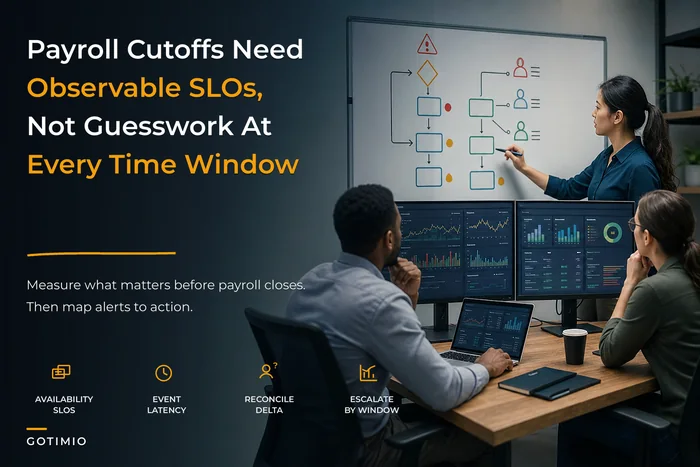
Run this before every payroll cutoff, not after. Catching exposure after the run means retro adjustments, and retro adjustments on premium pay are exactly the kind of thing that erodes trust on a nursing floor. If you want to wire this into period-close timing with proper alerting, the thinking in payroll-aware SLOs for time systems translates directly — treat the pre-cutoff overlap scan as a payroll-blocking check with a defined escalation path.
A real scenario
A roughly 220-bed regional hospital kept flagging night-shift overtime variances that finance couldn't explain. Monthly premium pay on two med-surg floors was running $9k–$11k over budget, consistently, with no obvious cause.
The reconciliation scan surfaced it fast: planned handoff overlap was 15 minutes, but actual overlap on the day-to-night pair was averaging close to 40 minutes, and nearly all of it was being paid at the night differential with no evidence tier applied. Some was legitimate — late discharges are brutal on med-surg. But a meaningful chunk was charting lag and nurses clocking in early out of habit.
-
About 55% of extended overlap was Tier 1/3 (real, documented, kept paying it)
-
About 45% was Tier 4 — habitual early clock-ins and charting-lag cases
They didn't claw anything back. They fixed scheduling so early clock-ins stopped auto-paying, and routed the genuine extended handoffs through attestation. Monthly premium variance dropped to around $3k–$4k over budget — and now the remaining overage was documented work that finance could actually accept. Call it $70k–$90k a year in recovered exposure, with the added benefit that the pay they kept paying was finally defensible.
When this approach makes sense — and when it doesn't
Do this if you run differential-heavy shifts (nights, weekends, holidays) with structured handoffs and you've seen unexplained premium or overtime variance. Clinical environments with charting systems are the ideal case because Tier 1 evidence is already being generated — you're just connecting it to payroll.
Skip the full build if your overlaps don't touch a differential or overtime boundary. If everyone's on straight time, overlap is a scheduling-efficiency question, not a pay-liability one, and this machinery is overkill.
Who should not run this cold: anyone without charge-nurse buy-in. The second this reads as "surveillance to deny pay," you've lost. Frame it correctly — the system protects legitimate handoff pay by making it defensible, and only routes genuinely ambiguous cases for a quick human call. The nurses doing real late-discharge work benefit most, because their overlap stops looking suspicious in the aggregate.
The point
Healthcare shift overlap reconciliation isn't about catching people — it's about separating the overlap you should pay at premium from the overlap you're paying by accident. The timestamps already tell you what happened. What's usually missing is an evidence standard for handoffs, a deterministic rule for which rate applies to the overlapping minutes, and a sign-off that captures why before the money is committed.
Get those three in place, run the reconciliation before the payroll cutoff instead of after, and the ambiguous overlaps stop being a silent liability. You end up paying for the handoffs that actually happened, denying the ones that didn't, and — maybe most importantly — being able to prove the difference when someone asks.
Get those three in place, run the reconciliation before the payroll cutoff instead of after, and the ambiguous overlaps stop being a silent liability. You end up paying for the handoffs that actually happened, denying the ones that didn't, and — maybe most importantly — being able to prove the difference when someone asks.
Ready to optimize your workforce time management?
Join 2,000+ companies using GoTimio to improve timesheet accuracy, reduce payroll errors, and boost team productivity.