

Split shifts look simple on the schedule and turn messy the second payroll runs. A cook comes in for the lunch rush, goes home for four hours, comes back for dinner. On paper that's two blocks. In practice it can trigger premium pay in some states, an unpaid break question in others, and a manager approval that half the time never got logged anywhere someone could actually find.
The problem isn't that managers don't know the rules. It's that the approval happens in a hallway, over text, or in someone's head — and then three weeks later nobody can reconstruct why a split-shift premium was paid or waived. That gap is where audits get expensive and where employees start to feel like the rules change depending on who's on shift.
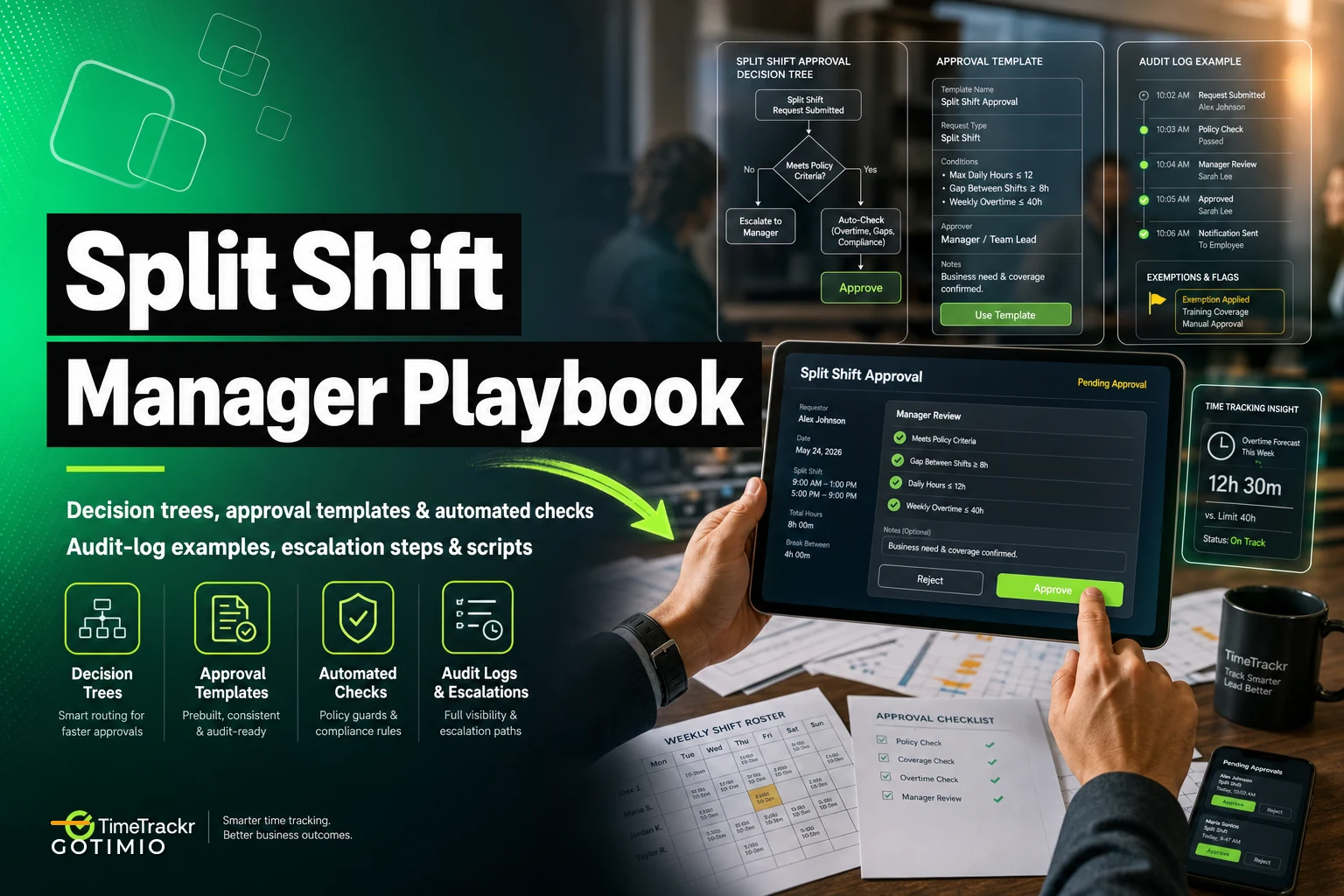
This is a working playbook for that specific decision: when a split shift needs approval, when a premium applies, when an exemption is legitimate, and how to leave a paper trail that holds up. No broad scheduling theory — just the decision points, the templates, and the log entries.
Where split-shift approvals actually break
The failure almost never happens at the moment the split is scheduled. It happens at three specific handoffs.
The verbal-yes handoff. An employee asks "hey can I split my Thursday so I can pick up my kid?" The manager says sure. Nothing gets written. Payroll sees two disconnected time blocks with a four-hour gap and has no idea whether this was approved, employee-requested, or a system error. In states with split-shift premium rules — California being the obvious one — whether the split was employer-imposed or employee-requested changes whether a premium is owed. If nobody recorded which one it was, you default to the version that costs you money, or worse, you guess.
The premium-exemption guess. A manager knows some splits require a premium and some don't. They also know that if the employee's total earnings for the day already clear a certain threshold, the premium may be offset. So they make a judgment call in the moment and move on. The judgment might even be correct. But "manager was pretty sure" is not a defense when a wage claim lands eighteen months later.
The exception that became normal. One department starts approving splits liberally because it's convenient. Six months in, it's an unwritten policy that nobody at the HR level knows exists. Now you've got inconsistent treatment across teams doing identical work — which is exactly the pattern that turns one complaint into a class-wide problem.
The rules at most hourly operations are usually fine. The enforcement and the record are the weak point.
The core decision tree
Before any split shift gets approved, it should pass through the same sequence every time — regardless of who the manager is or how busy the floor is. Here's the logic:
Accurate time tracking made effortless.
GoTimio empowers your team to log, monitor, and manage work hours seamlessly.
- Real-time time tracking
- Automated timesheet approvals
- Payroll and billing integration
No credit card required
-
Is the gap a real split, or just a long break? Draw a hard line. If the unpaid gap exceeds your defined threshold (commonly 60 minutes, but check your jurisdiction), it's a split shift and enters this workflow. Anything shorter is a break and follows normal break rules.
-
Who initiated the split? Employer-requested or employee-requested. This is the single most important field and the one most often skipped. Tag it explicitly.
-
Does a split-shift premium apply in this jurisdiction? If yes, move to step 4. If no, log the reason ("no statutory split premium in [state]") and approve.
-
Is the split employee-requested for the employee's own convenience? In several premium jurisdictions, a genuinely employee-requested split for personal reasons is exempt from the premium. This must be documented with the employee's own words or a request record — not the manager's summary.
-
Does the day's total pay already meet or exceed the premium offset threshold? If the employee's earnings for the day already clear the required minimum-plus-premium amount, the premium may be satisfied. Calculate it, don't eyeball it.
-
Approve, deny, or escalate. If any step is unclear, escalate rather than approve. An unclear split that gets escalated costs a manager ten minutes. An unclear split that gets waved through can cost a lot more.
Here's a quick visual of that six-step workflow.
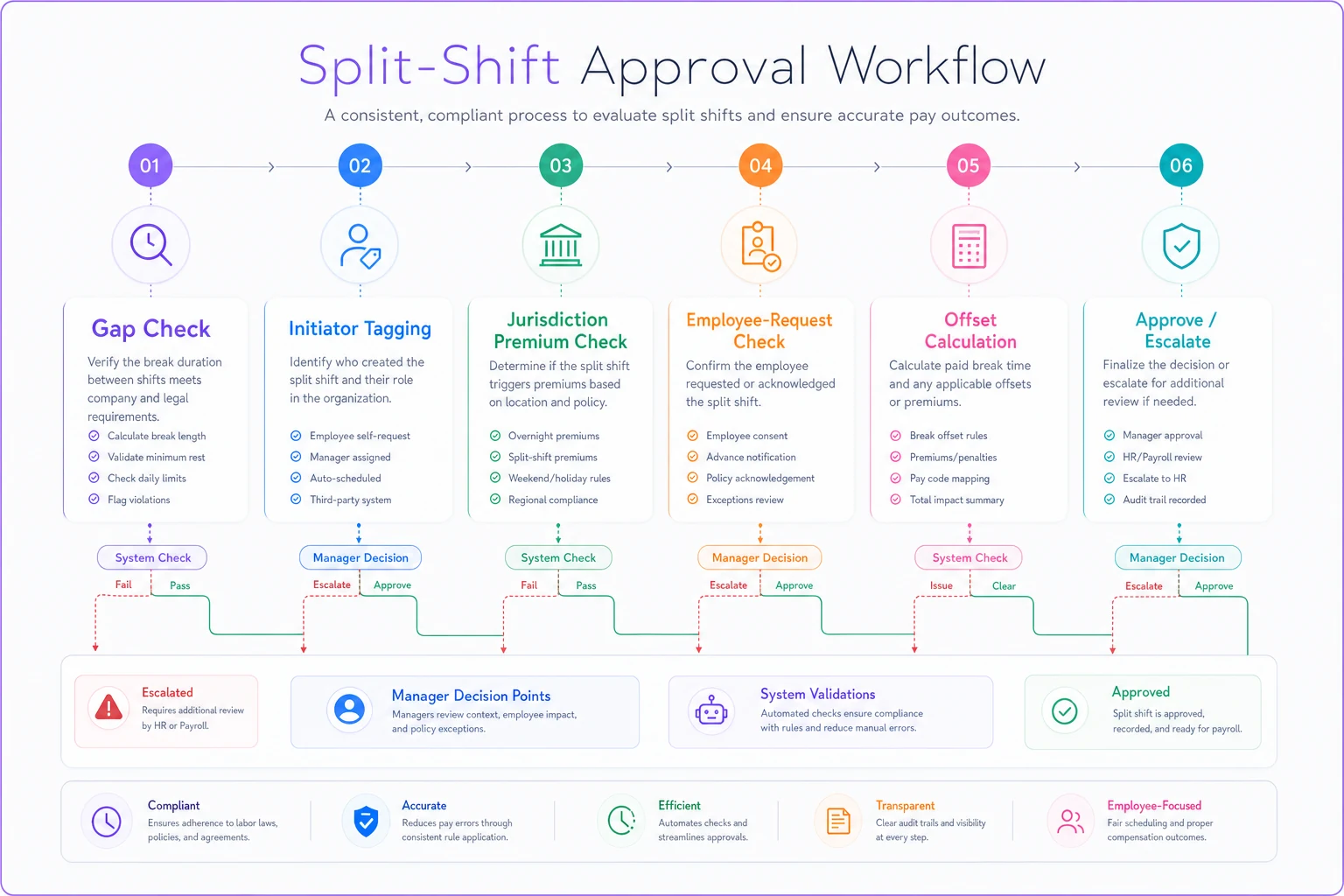
Running every split through the same six steps is about consistency. Two managers looking at the same situation should reach the same answer and leave the same record. That's what makes it defensible.
Approval templates that capture the right fields
The template matters more than people think, because it forces the questions managers tend to skip verbally. A blank approval box gets a blank answer. A structured one doesn't.
Below is a minimum viable split-shift approval record. Every field exists to answer a question an auditor or a wage claim will eventually ask.
| Field | Why it exists | Example entry |
|---|---|---|
| Employee ID | Ties record to the person | E-4471 |
| Date of split | Anchors to the pay period | 2025-03-13 |
| Block 1 / Block 2 times | Defines the gap | 10:30–14:00 / 18:00–22:15 |
| Gap length | Confirms it's a split | 4h 00m |
| Initiated by | Premium eligibility hinges on this | Employee-requested |
| Reason (if employee) | Supports exemption claim | "Requested to cover afternoon childcare" |
| Jurisdiction rule applied | Shows you knew the law | CA split-shift premium |
| Premium owed? | The actual determination | No — daily earnings exceed offset |
| Offset calculation | Proves the math | Daily total $148.20 > threshold $131.60 |
| Approver | Accountability | M-Reyes |
| Timestamp | Sequence integrity | 2025-03-12 16:42 |
Pay attention to the reason field for employee-requested splits. That's the one that saves you. A manager writing "employee wanted it" is weak. The employee's actual stated reason, captured close to when they made the request, is what supports a premium exemption if it's ever questioned.
Automated enforcement checks
A template only helps if it's actually filled out and if bad entries get caught. Manual review of every split shift doesn't scale past a handful of employees, so the enforcement layer is where consistency gets locked in.
Checks worth running automatically:
-
Gap threshold check. Any shift pair with an unpaid gap over your threshold gets flagged as a split and blocks payroll processing until the approval record exists. No record, no clean run.
-
Missing initiator field. If "initiated by" is blank, the entry can't be finalized. This single check eliminates most of the ambiguity that costs money later.
-
Premium-offset recalculation. Don't trust the manager's math. Recompute the daily earnings against the offset threshold and flag any mismatch between the calculated result and the recorded determination.
-
Exemption-claim validation. If premium is marked "not owed" because it's employee-requested, confirm the reason field is populated. An exemption with no supporting reason gets flagged for review.
-
Consistency drift. Compare split-approval patterns across departments. If one team is approving splits at three times the rate of comparable teams, surface it before it becomes an unwritten policy.
These are the same kinds of controls that make retroactive corrections defensible in an auditable correction policy with an approval matrix — the split-shift case is just a specific flavor of the broader "prove why this exception was allowed" problem.
Sample audit-log entries
When a split-shift approval is done right, the log should read like a story anyone could follow without asking a single follow-up question. Here's what a clean sequence looks like:
2025-03-12 16:40 | E-4471 submitted split request | Thu 03-13 | reason: "afternoon childcare, want to leave 14:00 return 18:00" 2025-03-12 16:42 | M-Reyes reviewed request | initiator=employee 2025-03-12 16:42 | System: gap=4h00m > 60m → classified SPLIT 2025-03-12 16:43 | M-Reyes applied rule: CA split-shift premium 2025-03-12 16:43 | System recalc: daily earnings $148.20 vs offset $131.60 | premium NOT owed (earnings exceed threshold) 2025-03-12 16:44 | M-Reyes APPROVED | premium=none | exemption=employee-req 2025-03-13 22:16 | Actual blocks recorded 10:31–14:02 / 18:00–22:14 2025-03-13 22:16 | System: actuals within approved window → no reflag
Compare that to the version that causes problems:
2025-03-13 22:16 | Two blocks recorded, gap 3h58m | E-4471 2025-03-27 09:10 | Payroll flagged: split shift, no approval on file 2025-03-27 09:14 | M-Reyes note: "yeah that was fine, she asked for it"
The second one might even be true. But "she asked for it," entered two weeks after the fact by the same person defending the decision, carries almost no weight. The timestamp gap alone undermines it. Contemporaneous records beat reconstructed ones every time, and that difference is the entire game when a claim gets reviewed.
Communication scripts
Managers freeze at the actual conversation, so give them words. These aren't scripts to read robotically — they're anchors so the right information gets captured.
When an employee requests a split (capturing the exemption): > "Sure, I can look at splitting your Thursday. Just so I log it right — is this something you'd prefer for your own scheduling, or is it a change on our end? And what's the reason on your side, roughly? I want the record to match what you actually asked for."
When you're imposing a split (premium likely applies): > "We need coverage split across the lunch and dinner rushes Thursday, so I'm scheduling you 10:30 to 2 and 6 to close. Because we're the ones asking for the split, this may trigger split-shift pay for that day — I'll confirm the amount and it'll show on your check."
When you're denying or escalating: > "I want to get this right rather than guess, so I'm going to check with HR on the premium side before I confirm. I'll have an answer for you by end of day."
Escalation isn't weakness. A manager who escalates an unclear split is doing exactly what protects everyone.
When a manual approval process still makes sense — and when it doesn't
Running a small crew — say under fifteen hourly people, splits happening a couple times a week — a disciplined manual template genuinely works. The volume is low enough that a manager can fill out the record properly every time, and the consistency risk stays manageable when there's basically one approver.
Where it falls apart is scale and dispersion. Multiple locations, several managers, splits happening daily. That's where the variation between approvers becomes the liability. Two managers, same facts, different answers — and nobody notices until the patterns get compared. At that point the enforcement checks stop being nice-to-have and become the only realistic way to keep treatment consistent.
This is where operational software with built-in approval workflows earns its keep. Not because it replaces manager judgment, but because it removes the parts that shouldn't require judgment at all — gap classification, premium calculation, field validation. The manager still makes the call; the system just makes sure the record around that call is airtight.
Who should not run this loosely: anyone operating in a split-shift-premium state with more than one approver. The combination of real premium exposure and inconsistent human judgment is the exact recipe that turns into a wage-and-hour headache. If that's you, the enforcement layer isn't optional.
A real scenario
A regional restaurant group running four locations had about 90 hourly staff and used splits constantly for the lunch/dinner coverage pattern. Approvals lived in a mix of texts, a shared spreadsheet, and manager memory. Nobody was doing anything wrong on purpose — but roughly one in five splits had no record of who initiated it.
When they tightened things up, the change wasn't dramatic. They mandated the approval template, required the initiator and reason fields, and added a payroll block for any split without a record. In the first two pay periods, the enforcement check caught around 30 splits that would've processed with no documentation. A handful of those were premiums that should have been paid and weren't — small individually, maybe $12–$18 each, but the kind of thing that compounds into a real liability across a year and multiple employees.
The bigger win was quieter: disputes about split-shift pay basically stopped, because employees could see the reason and the determination on record, and managers stopped guessing. The pattern check also surfaced that one location was approving splits far more freely than the others, which turned out to be a training gap, not a policy disagreement.
Tie it back to the broader shift-change workflow
Split-shift approvals don't live in isolation. They sit right next to swaps, late changes, and coverage backfills — all decisions with premium and audit implications. If you've already got a structured approach for those, the decision tree and required audit fields for late shift changes and swaps share the same DNA: capture who initiated it, apply the rule explicitly, record the math, and leave a timestamp that a stranger could follow.
The through-line across all of it is simple. The rules are usually knowable. What sinks operations is the approval that never got recorded, or got recorded so vaguely it can't defend itself. Fix the record and the split-shift approval stops being a risk and becomes just another routine thing you handle the same way every time.
The through-line across all of it is simple. The rules are usually knowable. What sinks operations is the approval that never got recorded, or got recorded so vaguely it can't defend itself. Fix the record and the split-shift approval stops being a risk and becomes just another routine thing you handle the same way every time.
Ready to optimize your workforce time management?
Join 2,000+ companies using GoTimio to improve timesheet accuracy, reduce payroll errors, and boost team productivity.