

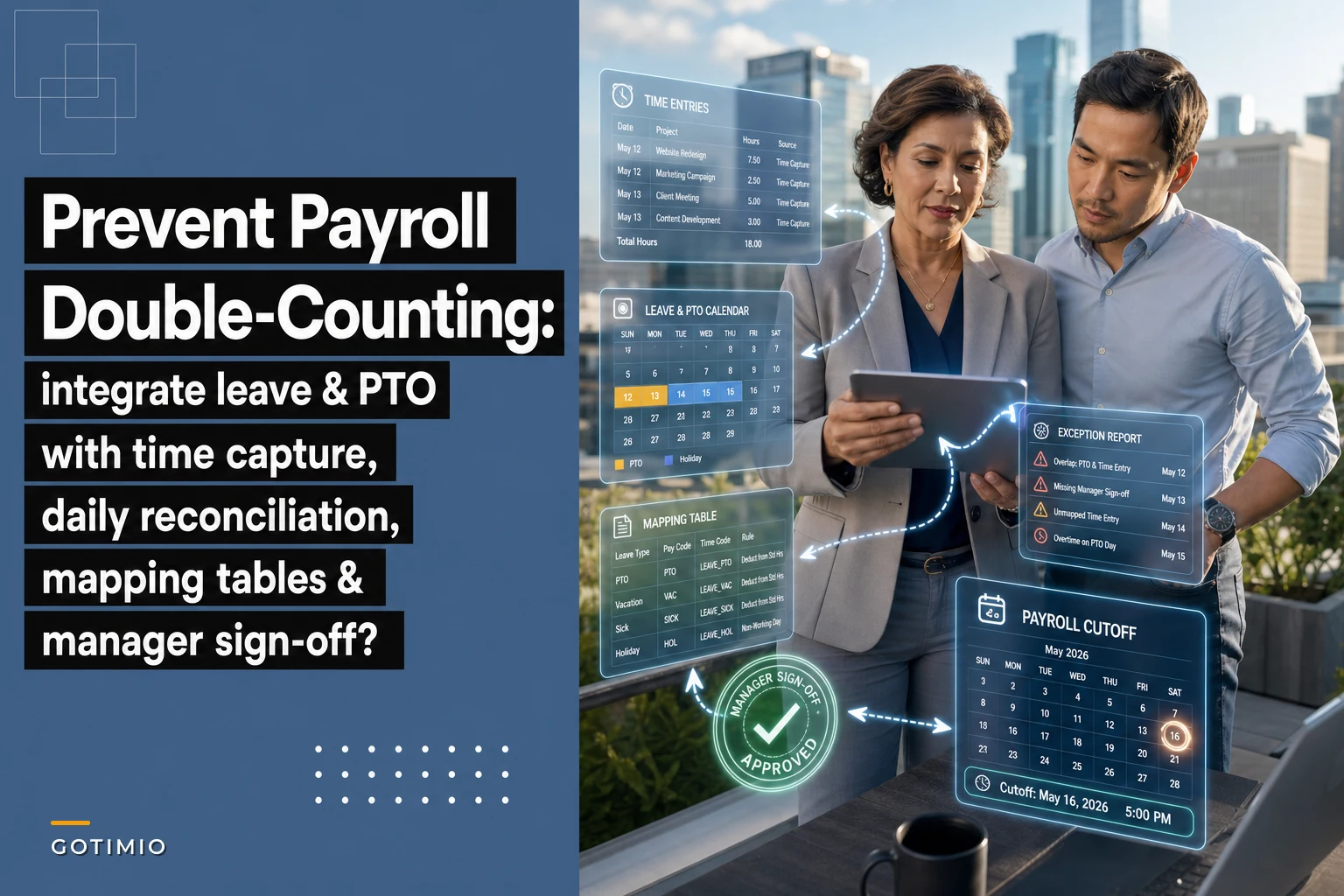

The operations manager at a 78-person logistics company just found out their payroll system paid six employees for both worked hours and vacation days in the same period. The issue? Employees submitted timesheets showing 40 hours worked, then their managers approved pre-scheduled PTO requests three days later. Since payroll had already started processing, the system stacked vacation pay on top of regular hours.
That creates problems beyond the obvious overpayment. Now you've got awkward conversations about clawing back wages, potential compliance violations if you deduct from future paychecks without proper documentation, and a trust issue brewing as employees wonder why basic leave tracking is this hard.
The operational gap between leave systems and time capture
Most businesses run leave management and time tracking as completely separate processes. Time tracking counts hours worked. Leave management tracks PTO balances and approved time off. Neither system knows what the other is doing until someone manually checks both — usually after payroll has already run.
These systems evolved separately, which explains a lot. Time tracking started with punch clocks and moved to digital timesheets. Leave management began with paper forms and shifted to HR software. Even when both live in the same platform, they often operate as distinct modules that don't reconcile automatically.
A regional healthcare staffing agency with around 240 contractors discovered this when their audit uncovered roughly $47,000 in duplicate payments over eight months. Nurses would request PTO through the HR portal, then work their scheduled shifts anyway due to staffing shortages, and forget to cancel the request. The time system captured worked hours, the leave system deducted PTO and triggered payment, and payroll processed both without hesitation.
The deeper problem isn't just duplicate payments — it's maintaining accurate records for compliance, ensuring correct PTO balance deductions, and having data you can actually trust for workforce planning. When your systems don't talk to each other, every payroll cycle turns into a manual reconciliation exercise.
Mapping the intersection points
Understanding where leave and time data should connect means mapping your actual workflows, not the idealized version of them. Start by documenting every point where an employee's schedule intersects with both systems.
Accurate time tracking made effortless.
GoTimio empowers your team to log, monitor, and manage work hours seamlessly.
- Real-time time tracking
- Automated timesheet approvals
- Payroll and billing integration
No credit card required
The critical intersection points are usually:
Pre-schedule conflicts
When an employee requests PTO, your scheduling system needs to know immediately. Otherwise managers keep building shifts during approved vacation time, then wonder why coverage gaps appear when people don't show up.
Day-of status changes
Sick calls create the messiest reconciliation problems. Someone scheduled to work calls in sick at 6 AM. The manager finds coverage and updates the schedule. The employee logs sick time in the leave system. The timesheet still shows scheduled hours. Without a clear mapping, you're processing bad data.
Retroactive adjustments
Employees regularly submit leave requests after the fact — forgot to request PTO before a vacation, didn't report sick time right away, needed FMLA designation retroactively. These create real reconciliation headaches when timesheets are already approved.
Partial day scenarios
An employee works four hours then goes home sick. They clock out at noon but need to use four hours of sick leave for the afternoon. Most systems handle this poorly because they're built to treat a day as either worked or leave, not both.
Building reconciliation checkpoints
The solution isn't necessarily a complex integration project. It's systematic reconciliation at specific checkpoints before payroll runs. Here's a framework that actually prevents double-counting:
Daily reconciliation pattern
Each morning, before managers approve any timesheets, run a simple overlap check. Pull the previous day's clock-in data and compare it against approved leave for the same period. Any employee appearing in both lists needs immediate review.
SELECT e.employeeid, e.name, t.hoursworked, l.leavehours, t.workdate FROM timeentries t JOIN leaverequests l ON t.employeeid = l.employeeid AND t.workdate = l.leavedate WHERE t.status = 'pending_approval' AND l.status = 'approved'
This catches conflicts before managers approve timesheets, which is exactly when you want to catch them.
Run the daily overlap check each morning before managers approve timesheets.
Weekly pre-payroll audit
Three days before payroll cutoff, run a comprehensive reconciliation that includes:
-
Employees with both worked hours and leave in the same period
-
PTO requests approved after timesheet submission
-
Sick leave entered without corresponding schedule changes
-
Overtime hours during weeks with approved leave
The audit generates an exception report that goes to both HR and payroll. Each exception needs manager sign-off with one of three resolutions: cancel the leave, adjust the timesheet, or approve both with written justification (like someone working a partial day before starting vacation).
Manager sign-off protocol
Manager approval can't just be clicking "approve" on a timesheet anymore. The sign-off process needs to explicitly confirm leave status. One approach: add a checkbox to the approval screen that reads "I have verified this employee's leave status for this period."
Better yet, show managers a side-by-side view during approval:
| Employee | Scheduled Hours | Actual Hours | Leave Hours | Total for Payroll |
|---|---|---|---|---|
| Johnson, M | 40 | 32 | 8 (sick) | 40 |
| Smith, K | 40 | 40 | 8 (vacation) | ERROR - REVIEW |
| Davis, L | 32 | 16 | 16 (PTO) | 32 |
Conflicts become obvious before anything gets approved.
Visualize the reconciliation workflow:
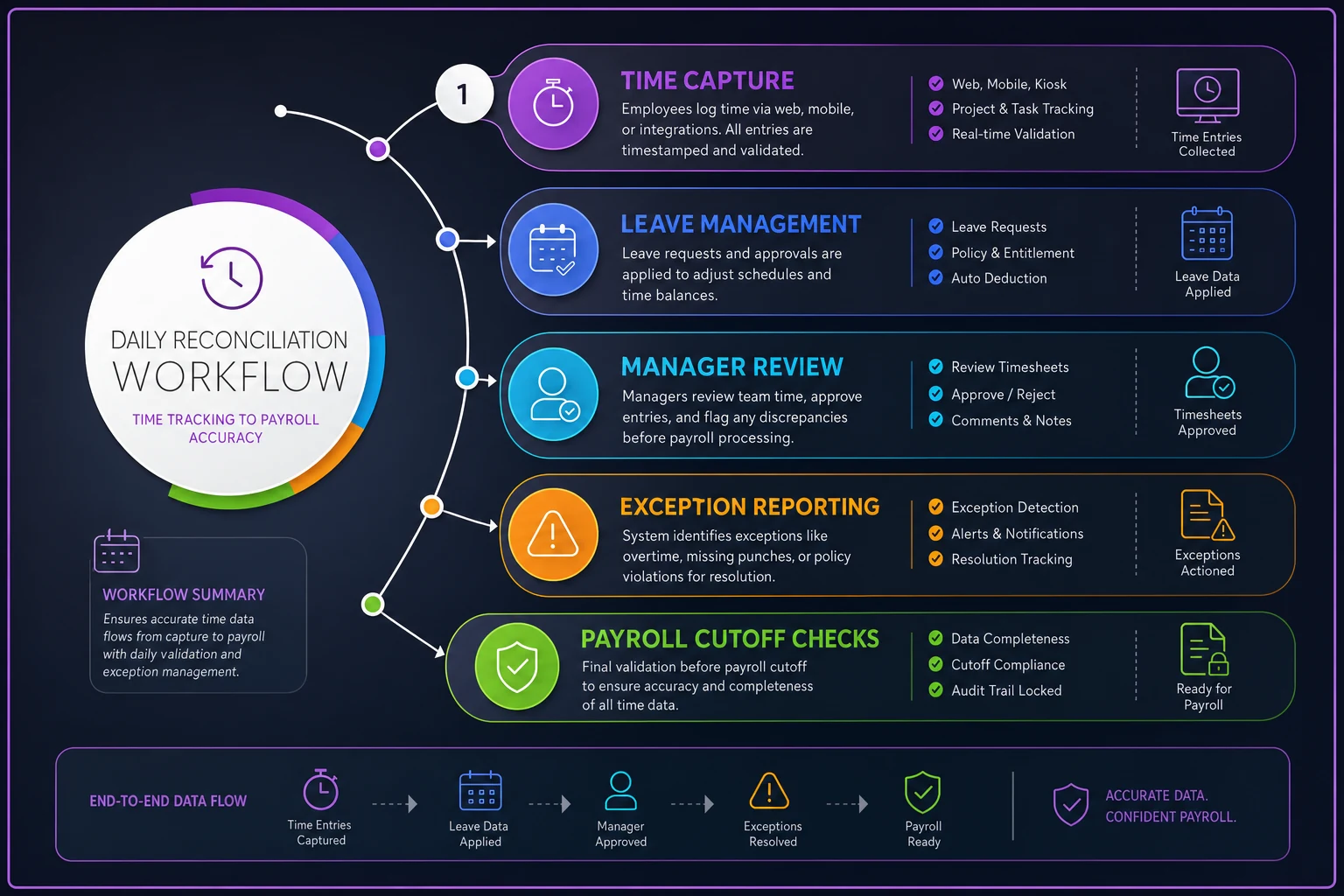
Use this workflow to align teams on checkpoints before payroll.
Timing patterns around payroll cutoffs
The gap between leave approval deadlines and payroll cutoff causes most integration problems. Typical payroll runs Monday morning for the previous week. PTO requests might get approved Sunday night. That timing gap creates havoc.
72 hours before payroll: Final timesheet submission deadline. No changes except emergencies.
48 hours before payroll: Leave request cutoff for the current period. Anything approved after this applies to the next pay period.
24 hours before payroll: Reconciliation window. Finance runs overlap reports, managers review exceptions, HR confirms leave balances.
Payroll processing: System locks. No changes without CFO approval and full documentation.
This feels rigid at first, but it eliminates roughly 90% of double-counting issues. The remaining cases — true emergencies like sudden illness — go through a documented exception process.
The technical reconciliation workflow
Beyond timing and process, you need reconciliation logic that handles edge cases. The most reliable approach uses a deterministic hierarchy for conflict resolution.
-
Actual time worked always wins — If someone clocked in and worked, pay them for work, not leave
-
Approved leave blocks future time — You can't clock in during an approved vacation
-
Partial days split precisely — Work hours and leave hours must sum to scheduled hours
-
Retroactive changes require dual approval — Manager plus HR must both sign off
A retail chain with 23 locations built this logic into their operational workflow. When conflicts surface, the system doesn't guess — it flags for human review with clear options:
-
Replace work time with leave (employee forgot they had approved PTO)
-
Cancel the leave request (employee came in despite approved time off)
-
Split the day (worked partial day, use leave for the rest)
-
Process both with documentation (emergency coverage situation)
When conflicts surface, the system doesn't guess — it flags for human review with clear options.
Preventing drift through continuous monitoring
Double-counting is obvious and eventually gets caught. Drift — the slow divergence between recorded hours and actual reality — is the hidden problem that compounds over months.
-
Employee uses 4 hours PTO but the system deducts 8 from their balance
-
Sick leave gets approved but never deducted from accruals
-
Holiday pay processes alongside regular hours for employees who actually worked
-
Comp time gets recorded as both worked hours and time off
Fixing this requires continuous monitoring, not just checkpoint reconciliation. Run weekly drift detection that compares:
PTO balance calculations: Beginning balance - used + accrued = ending balance If this doesn't match what your system shows, you have drift.
Hours accounting: Scheduled hours = worked hours + leave hours + absent hours Any employee whose hours don't balance has a data problem somewhere.
Accrual verification: Expected accrual (based on policy) = actual accrual (in system) Mismatches point to configuration issues or manual override problems.
Exception handling and edge cases
Real operations throw curveballs that your standard process won't cover. Building a solid leave and time integration means preparing for the weird stuff:
The callback scenario:
An employee on vacation gets called back for an emergency and works 6 hours on Wednesday of their vacation week. You need to restore 6 hours to their PTO balance, pay them for 6 hours of work, potentially calculate overtime if this pushes them past 40 hours, and document why someone on vacation was working.
The sick-to-FMLA conversion:
Employee calls in sick Monday. Still sick Tuesday. Wednesday they provide FMLA documentation. Now you need to retroactively change sick leave to FMLA leave, potentially restore their sick leave balance, track against their FMLA entitlement, and maintain proper documentation for DOL compliance.
The holiday worked plus PTO:
An employee scheduled to work Christmas — a paid holiday — also had pre-approved PTO for that day. Do they get holiday pay plus PTO? Just holiday pay? The answer depends on your policy, but your system has to handle it correctly.
For each exception type, document:
-
How to identify it
-
Who has authority to resolve it
-
What documentation is required
-
How to prevent it next time
For each exception type, document: How to identify it, who has authority to resolve it, what documentation is required, and how to prevent it next time.
Making integration work with your existing tools
Perfect integration would mean your leave system and time system share a single database, reconcile in real-time, and never allow conflicts. Reality is you're probably working with separate systems that barely talk to each other.
The approach that actually works focuses on data hygiene and process discipline, not technical integration. Even if your systems don't communicate, you can build reliable reconciliation through:
Export/import workflows: Every Monday, export approved leave for the upcoming week. Import it into your scheduling system as blocked time. Manual, not elegant, but effective.
Comparison spreadsheets: Build a standard Excel template that pulls data from both systems and highlights conflicts. Anyone can maintain it and it gets the job done.
Audit triggers: Set up email alerts when specific conditions occur — PTO approved after timesheet submission, sick leave exceeding available balance, overtime in the same week as approved leave.
For businesses ready to modernize, building a payroll-ready process requires thinking about integration from day one. AI-powered operational software can automatically flag conflicts before they reach payroll, suggest resolutions based on your existing policies, and maintain audit trails that satisfy compliance requirements.
The key is starting with clear processes, then adding technology to enforce them. Too many businesses try to solve process problems with technology alone, which just automates the chaos.
Building sustainable leave and time integration
The path to reliable leave and time integration isn't about buying better software or building complex APIs. It's about knowing where these systems naturally conflict and putting operational checkpoints in place that catch problems before they hit payroll.
Start with the daily reconciliation query. Just running that simple check each morning will catch most double-counting before it becomes a payroll problem. Add the weekly pre-payroll audit, and you've handled the vast majority of issues.
From there, build out your exception handling. Document the weird situations specific to your business. Create clear escalation paths when systems conflict. Train managers on an approval protocol that actually prevents problems from slipping through.
The businesses that get this right treat leave and time integration as an operational discipline, not a technical problem. They build processes that assume the systems won't integrate perfectly, then add technology to make those processes more efficient. Whether you're managing 50 employees or 500, the same principles apply: reconcile early, audit systematically, and handle exceptions with proper documentation.
Stop treating leave management and time tracking as separate domains. They're two sides of the same question — how you track and pay for employee time. Once you start viewing them that way, preventing double-counting and drift gets a lot more straightforward. It's not about perfect systems. It's about systematic reconciliation that catches problems before they cost you money and credibility.
Ready to optimize your workforce time management?
Join 2,000+ companies using GoTimio to improve timesheet accuracy, reduce payroll errors, and boost team productivity.