

The worst payroll surprises in an acquisition don't show up on day one. They show up in month three, when someone finally reconciles the accrued PTO liability the target company brought over and the number is off by a six-figure margin that nobody budgeted for. By then the legacy system is half-decommissioned, the admin who understood the old accrual rules has left, and Finance is staring at a balance-sheet item they can't defend to auditors.
This is the part of M&A integration almost nobody plans properly. Deal teams model the synergies and the headcount. They rarely model the time-and-attendance data migration, the accrual-rule mismatches, or the data provenance you're legally required to keep from the system you're about to shut off. So harmonisation happens in a rush, reconciliation becomes a fire drill, and the liability numbers get "trued up" with a journal entry that an auditor will eventually ask about.
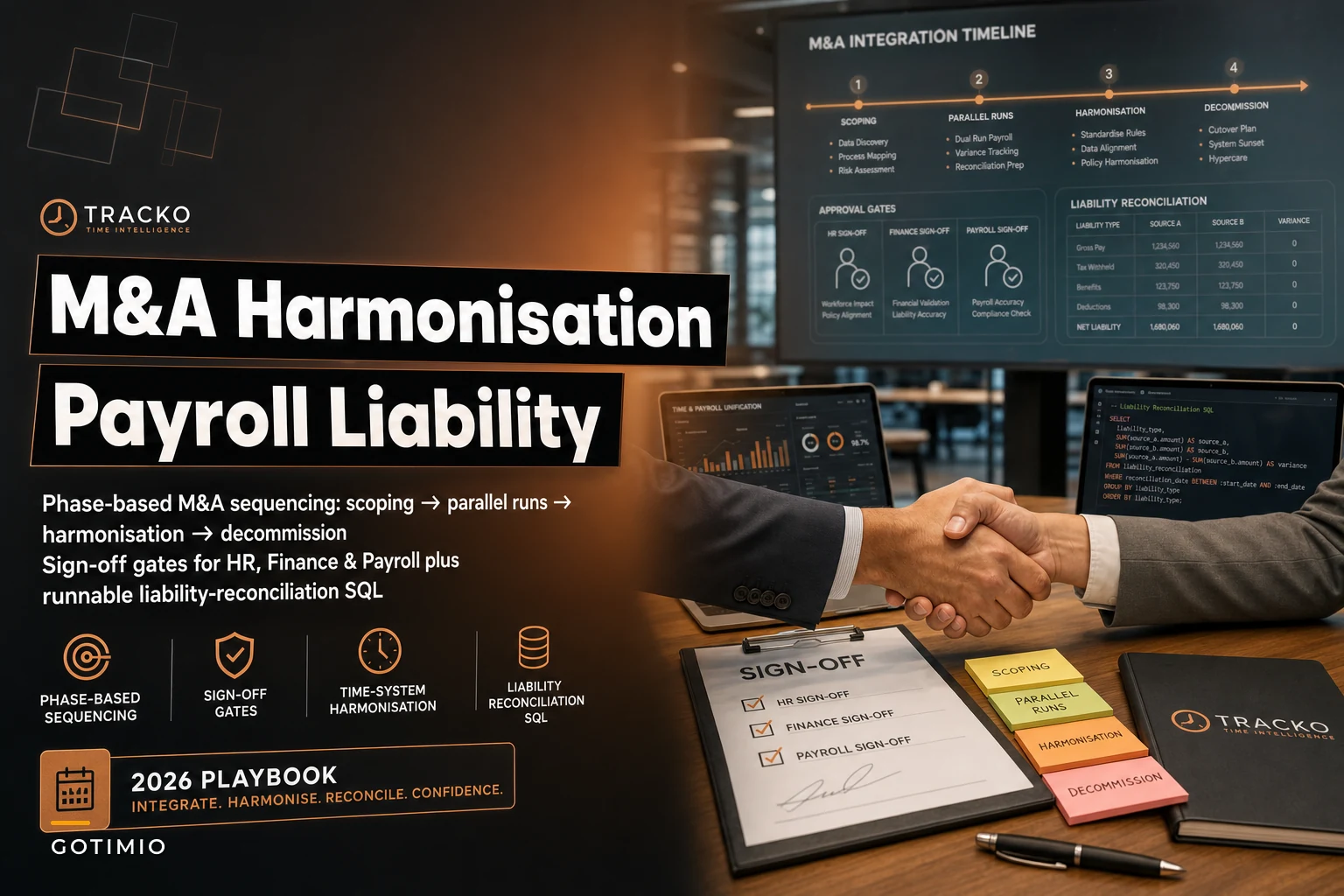
This playbook is about doing it in phases, with sign-off gates that actually mean something. The goal of M&A time system harmonisation isn't a clean cutover on a target date — it's a defensible one, where every accrued-liability number can be traced back to a source record you can still produce.
Why the naive cutover fails
The instinct after close is to pick the acquirer's system, map the fields, and migrate everyone over by the next pay period. It feels efficient. It's also where most of the pain comes from.
-
The acquirer accrues PTO monthly, in arrears, capped at 240 hours.
-
The target accrued PTO per-pay-period, with no cap, and a carryover that rolled on a fiscal-year boundary instead of calendar.
-
The target also had a "banked overtime" scheme in two states that converted unpaid OT into comp time at 1.5x — a liability that never appeared as a simple hours balance.
If you migrate balances as flat numbers — "employee X has 86.5 hours" — you lose the rules that produced those numbers. The moment someone takes leave or you process a termination payout, the new system recalculates using the acquirer's rules, and the payout is wrong. Sometimes it favours the employee, sometimes the company. Either way, you've created an unexplained variance between what the target's books said the liability was and what you're now paying out.
The balance is almost never the hard part. The derivation of the balance is. And derivation lives in the legacy system's configuration, not in the export file.
The four phases, and what each one actually protects
Think of harmonisation as four sequenced phases, each with a specific thing it's protecting and a specific person who signs off before you move on.
Accurate time tracking made effortless.
GoTimio empowers your team to log, monitor, and manage work hours seamlessly.
- Real-time time tracking
- Automated timesheet approvals
- Payroll and billing integration
No credit card required
| Phase | Primary goal | Who signs off | What breaks if you skip it |
|---|---|---|---|
| Scoping | Inventory every accrual rule, liability type, and jurisdiction in both systems | HR + Finance jointly | Hidden liability types surface post-cutover as unbudgeted payouts |
| Parallel run | Run both systems live, reconcile daily/weekly, no migration yet | Payroll lead | Rule mismatches get discovered in production instead of in a controlled window |
| Harmonisation | Converge rules, migrate balances with their derivation, freeze legacy writes | HR + Finance + Payroll | Balances migrate without provenance; audit trail snaps |
| Decommission | Archive legacy data under a retention schedule, revoke write access | Finance + Legal/Compliance | You lose the source-of-truth you'll need for any future dispute or audit |
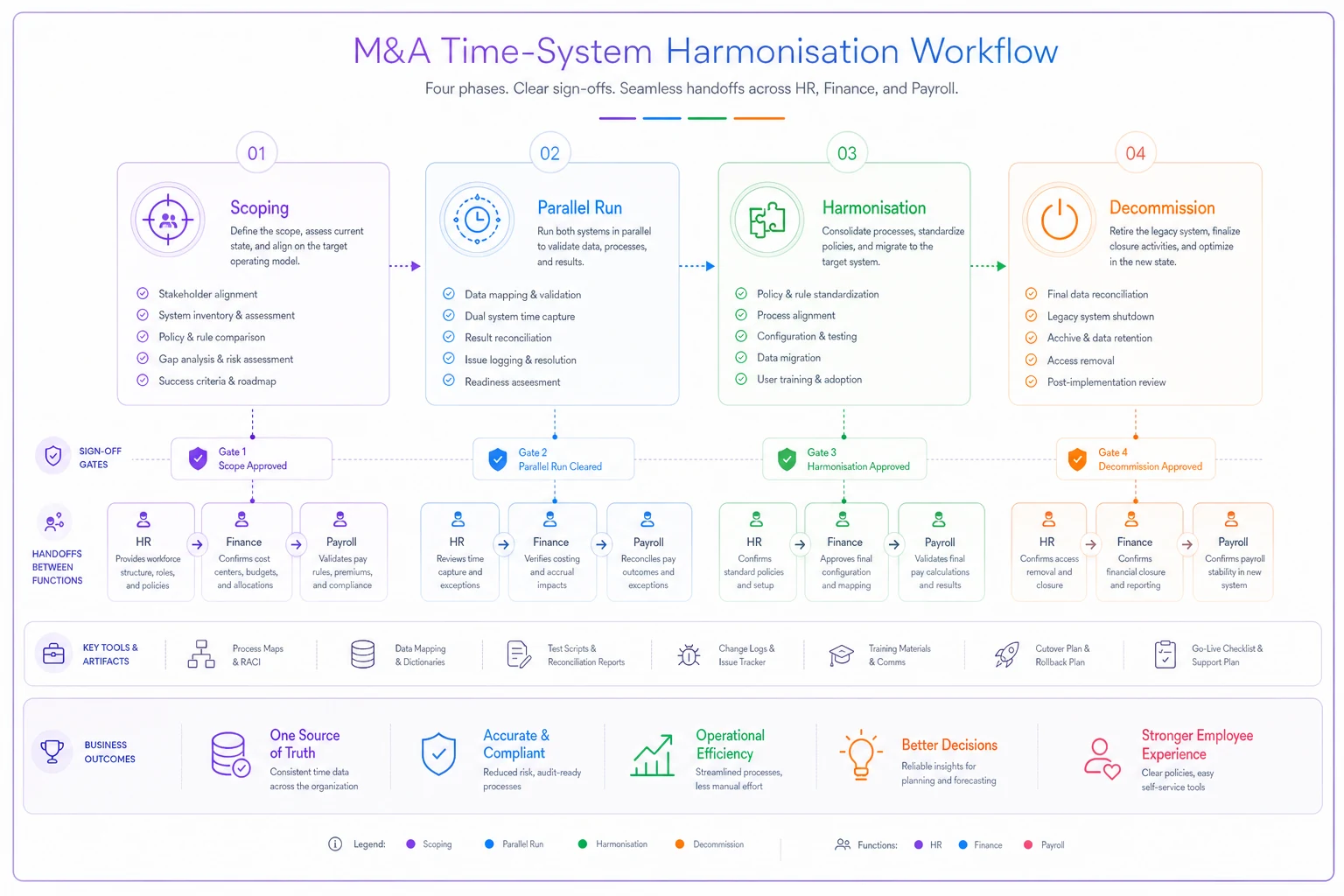
Notice how the sign-off ownership shifts. Scoping is a joint HR/Finance exercise because the liability classification and policy interpretation both matter. Decommission is Finance and Legal because at that point the question is purely whether you can still produce evidence if someone asks. Keeping these gates distinct stops one team from quietly rushing a phase the other hasn't cleared.
Phase 1 — Scoping: build the liability inventory before you touch anything
Phase 1 — Scoping: build the liability inventory before you touch anything
Scoping is where you list every time-derived liability both companies carry. Not just PTO. Sick accrual, floating holidays, comp time, banked OT, sabbatical accrual, jurisdiction-specific mandated leave, and any unpaid-but-owed premiums — shift differentials that were earned but not yet paid.
-
The accrual formula and cadence
-
The cap and carryover rules, including the boundary date
-
The jurisdictions it applies to
-
The current total liability, by employee and in aggregate
-
Where the authoritative record lives
The mistake here is scoping only the categories that exist in the acquirer's system. The target's banked-OT scheme has no equivalent on your side, so it's easy to leave it off the inventory entirely — and that's exactly the one that becomes an unbudgeted payout at the first termination.
A useful rule: if a liability exists in the target's general ledger as an accrual, it must appear in the scoping inventory with a documented derivation. If Finance has booked it, you have to be able to reproduce it.
Phase 2 — Parallel runs: prove the numbers match before you migrate
Phase 2 — Parallel runs: prove the numbers match before you migrate
Parallel running means both time systems stay live and you reconcile their outputs on a regular cadence — usually weekly, across one or two full pay cycles. Nobody's migrated yet. You're running the target population through both rule sets and comparing.
This is the phase people want to skip to save time, and it's the single most valuable one. It's the only point where you can catch a rule mismatch in a controlled setting instead of in a live payroll run.
-- Liability reconciliation between legacy and target (harmonised) rule sets WITH legacy AS ( SELECT employeeid, liabilitytype, SUM(accruedhours) AS legacyhours, SUM(accruedhours rate) AS legacyvalue FROM legacyliabilitysnapshot WHERE snapshotdate = :rundate GROUP BY employeeid, liabilitytype ), harmonised AS ( SELECT employeeid, liabilitytype, SUM(accruedhours) AS harmhours, SUM(accruedhours rate) AS harmvalue FROM harmonisedliabilitycalc WHERE calcdate = :rundate GROUP BY employeeid, liabilitytype ) SELECT COALESCE(l.employeeid, h.employeeid) AS employeeid, COALESCE(l.liabilitytype, h.liabilitytype) AS liabilitytype, l.legacyhours, h.harmhours, ROUND(h.harmhours - l.legacyhours, 2) AS hoursdelta, l.legacyvalue, h.harmvalue, ROUND(h.harmvalue - l.legacyvalue, 2) AS valuedelta FROM legacy l FULL OUTER JOIN harmonised h ON l.employeeid = h.employeeid AND l.liabilitytype = h.liabilitytype WHERE ABS(COALESCE(h.harmvalue,0) - COALESCE(l.legacyvalue,0)) > :tolerance OR l.employeeid IS NULL -- exists only in harmonised OR h.employeeid IS NULL -- exists only in legacy ORDER BY ABS(value_delta) DESC NULLS LAST;
The FULL OUTER JOIN matters more than it looks. It catches the two cases that flat migrations consistently miss: an employee or liability type that exists in one system but not the other. That's how the target's banked-OT category surfaces — it appears in legacy with no matching harmonised row, because your rules don't have a bucket for it yet.
Automate the weekly reconciliation and surface deltas as observables tied to escalation paths so issues are chased, not just reported.
You run this weekly, drive the deltas toward zero by adjusting the harmonised rule configuration, and only move to migration once the aggregate value delta sits inside a tolerance Finance has signed off on. A realistic tolerance for a mid-size target population might be somewhere in the low hundreds of dollars in aggregate — not zero, because rounding and rate-timing differences produce legitimate small variances, but tight enough that no single material item is hiding inside the total.
If you've already built payroll-aware SLOs for your time systems, this reconciliation becomes another observable you track with a threshold and an escalation path rather than a one-off spreadsheet.
Phase 3 — Harmonisation: migrate the derivation, not just the balance
Phase 3 — Harmonisation: migrate the derivation, not just the balance
Once the parallel run proves the rule sets agree within tolerance, you converge. This is where you actually migrate balances — but the discipline that saves you later is migrating each balance with a snapshot of how it was derived.
In practice that means, at the moment of migration, you freeze legacy writes and capture an immutable record for every employee: the opening balance, the rule version that produced it, the as-of date, and a reference back to the source records. Something like:
INSERT INTO liabilitymigrationledger ( employeeid, liabilitytype, openinghours, openingvalue, sourcesystem, sourceruleversion, asofdate, sourcerecordref, migratedat, migratedby ) SELECT employeeid, liabilitytype, legacyhours, legacyvalue, 'TARGETLEGACYTAS', ruleversion, :freezedate, sourcerecordref, NOW(), :operator FROM legacyliabilitysnapshot WHERE snapshotdate = :freeze_date;
That sourceruleversion and sourcerecordref are the whole point. Two years from now, when an auditor or a former employee's attorney asks how a termination payout was calculated, you can trace the opening balance back to the exact legacy rule and records that produced it — even though the legacy system itself is long gone.
A common and expensive mistake here is running the migration without freezing legacy writes first. If the old system is still accepting punches or edits during the migration window, your snapshot drifts and you end up reconciling a moving target. Freeze writes, snapshot, migrate, verify — in that order.
Phase 4 — Decommission: retention and provenance, not just shutdown
Phase 4 — Decommission: retention and provenance, not just shutdown
Turning the legacy system off is not the same as being done with its data. The records that derived every migrated balance carry a retention obligation that usually outlives the system by years — wage-and-hour statutes, tax record rules, and jurisdiction-specific payroll retention periods all keep running.
-
What you archive — the raw time records, the accrual configuration, the rule versions, and the migration ledger that links old to new
-
How long — governed by the longest applicable statutory retention across every jurisdiction the target operated in, not a single default
-
In what form — an archive you can actually query or render, not a proprietary backup you can't open once the vendor contract lapses
-
Who can still reach it — read-only, access-logged, with write access fully revoked
The format trap is real. Plenty of teams "archive" by taking a final database backup of the legacy system and cancelling the vendor contract the same week. A year later a dispute lands, and the only way to read the backup is software they no longer license. Archive to a neutral, queryable format and verify you can restore and read it before the contract ends.
This is where your broader timesheet data lifecycle and e-discovery blueprint should drive the decision — the acquired system's records fold into the same retention tiers and restore SLAs you already run, rather than becoming an orphaned one-off.
A worked example
A facilities-services company acquiring a smaller regional competitor — roughly 240 employees across three states. The target accrued PTO per pay period with no cap and ran a banked-OT comp-time scheme in two of those states.
On paper, the target's PTO liability came across at a number everyone accepted during due diligence. The deal team planned a straight cutover the following pay period. Instead, the integration ran a two-cycle parallel run first.
The reconciliation SQL surfaced two things the diligence spreadsheet hadn't caught. First, the no-cap carryover meant around 30 long-tenured employees carried PTO balances that the acquirer's 240-hour cap would have silently truncated on migration — a quiet reduction in owed liability that would have been both a morale problem and, in two of those states, a legal one. Second, the banked-OT scheme showed up as legacy-only rows with no harmonised match, representing a liability in the low tens of thousands that the GL carried but the migration plan had no bucket for.
Catching both during the parallel window meant they could be scoped, priced, and signed off by Finance and HR before cutover instead of surfacing as a reconciliation variance three months later. The cutover itself landed about a week later than originally planned. Trading a week of schedule to avoid an unbudgeted payout and a truncation dispute wasn't a hard call.
When a phased approach is overkill
Not every acquisition needs the full four-phase sequence. If you're acquiring a very small team, both companies already run the same time system under the same configuration, and the target carries no exotic liability types, a direct migration with a single reconciliation pass is fine. Running a two-cycle parallel for a dozen people on identical rules is just ceremony.
-
The target operates in jurisdictions the acquirer doesn't
-
There are liability types with no equivalent on the acquirer's side — banked OT, comp time, sabbatical accrual
-
The two accrual cadences or carryover boundaries differ
-
The GL carries a material time-derived liability that auditors will test
-
The legacy system is being retired, not kept
If two or more of those apply, skipping the parallel run is how you turn a manageable integration task into a post-close reconciliation emergency.
Who should not run this themselves
If your payroll team is already underwater on the regular cycle and you have nobody who can own daily reconciliation during the parallel window, don't attempt a compressed timeline on top of that. The parallel-run phase needs someone watching the deltas every cycle and chasing each variance to root cause. Without that ownership, the parallel run becomes a box-ticking exercise that produces reports nobody reads — which is arguably worse than not running it, because it creates false confidence.
Equally, if nobody on the acquirer side can read the legacy system's accrual configuration before it's turned off, pause. You cannot migrate derivation you don't understand, and you cannot write a defensible provenance record for a rule you're guessing at. Get someone — even on a short retained-contractor basis — who knew the old system, and capture that knowledge while the system is still live.
The one thing to get right
If you take a single principle from all of this: never migrate a liability balance without also migrating the rule and the records that produced it. The balance is a snapshot. The derivation is the thing you'll actually be asked to defend — at the next audit, at the next termination payout, at the next dispute from an employee who thinks their carryover was shorted.
The phased sequencing, the reconciliation SQL, the sign-off gates — all of it exists to protect that one property. Get the derivation and provenance right, and a messy two-company merge becomes something you can stand behind when someone finally asks where the number came from. Skip it, and you're left truing up six-figure variances with a journal entry and a hope that nobody looks too closely.
Ready to optimize your workforce time management?
Join 2,000+ companies using GoTimio to improve timesheet accuracy, reduce payroll errors, and boost team productivity.