



The first time a company runs payroll across three countries on a system built for one, they usually don't find out something is wrong until someone in another timezone gets paid incorrectly. By then it's not a config problem — it's a trust problem, a compliance problem, and a "why did legal just email me" problem all at once.
What breaks when your timekeeping crosses borders
Multi-region time systems fail in a specific way. They don't collapse. They drift. A rounding rule that's legal in Texas quietly overpays in Ontario. A grace period that works in a warehouse breaks in a jurisdiction with daily overtime thresholds. Each region looks fine in isolation. The failure lives in the gaps between them.
This is a playbook for HR leaders, ops managers, and owners who are past the "one office" phase and staring down a genuinely global setup. It's built around three phases: a policy registry, a multi-region rule matrix, and cutover KPIs — with vendor criteria, sign-off artifacts, and harmonisation templates that keep the whole thing from turning into a fire drill.
Why single-region logic quietly poisons multi-region rollouts
Most companies don't design a multi-region time system. They inherit one. You had a system that worked at home, opened a location abroad, bolted on some overtime rules, added a timezone dropdown, and told yourself you'd clean it up later.
Accurate time tracking made effortless.
GoTimio empowers your team to log, monitor, and manage work hours seamlessly.
- Real-time time tracking
- Automated timesheet approvals
- Payroll and billing integration
No credit card required
That's the pattern behind almost every messy global rollout. The original system encoded a hundred assumptions nobody wrote down — the workweek starts Monday, overtime is weekly not daily, breaks are unpaid, "midnight" means server midnight. None of those hold universally. When you expand, those buried assumptions become invisible landmines.
The part people consistently underestimate: the technical migration is the easy half. The hard half is that your policies were never actually documented — they were living inside a system configuration nobody fully understood. So when someone asks "what's our meal-break rule in France?" the honest answer is "whatever the software happens to do," which is a terrible answer to give an auditor.
A workable rollout starts by separating three things people usually blend together:
-
Policy — the legal and business rules that govern how time turns into pay
-
Configuration — how those rules are expressed in whatever system you use
-
Behavior — what the system actually does when real punches hit real edge cases
Single-region companies get away with blurring these because the three tend to line up. Cross a border and they diverge immediately.
A quick note on who actually owns this
The registry fails when it's "HR's project" or "IT's project." Overtime law is HR. Rounding logic is payroll. Timestamp handling is engineering. Break enforcement might be operations. If any one group owns the whole thing, the parts outside their expertise get filled with guesses. The registry is a cross-functional artifact or it's fiction.
Phase 1: Build a policy registry before you touch configuration
The policy registry is the boring foundation that everything else stands on. It's a single source of truth capturing, per region, every rule that affects how time becomes money. Not the system settings — the rules, in plain language, with the legal citation or business owner attached.
This comes first for a simple reason. If you jump straight to configuring a new system, you're translating undocumented assumptions into a new tool and hoping nothing gets lost. The config-first approach reliably reproduces old mistakes in a new interface, plus a few fresh ones from the migration itself.
A useful policy registry entry captures at minimum:
-
Region / jurisdiction (be specific — sub-national rules matter, provinces and states differ)
-
Rule category (overtime, breaks, rounding, holidays, night differentials, rest periods)
-
The actual rule in plain language
-
Legal source or internal policy owner
-
Effective dates (rules change; you need history)
-
Known conflicts with other regions' rules
That last field is the one people skip and later regret. It's where you flag things like "our global rounding standard is illegal here" before it becomes a payroll correction with interest.
Give the registry a named owner and a quarterly review cycle to prevent decay.
One pattern worth naming: registries decay the moment they're treated as a one-time project. A policy captured in January and never revisited is a liability by December. The registry needs an owner and a review rhythm, or it becomes the confident-looking document everyone trusts right up until it's wrong.
Phase 2: The multi-region rule matrix — where conflicts get resolved on purpose
Once you have a registry, the rule matrix is where you make the hard decisions deliberately instead of letting the system make them for you by accident.
The matrix takes every rule category and lays it across every region so conflicts become visible. This is where you discover that you can't have a single global rounding policy, or that your standard workweek definition contradicts local law in two places, or that "paid break" means different things in different offices and your labor cost reporting has been quietly incomparable the whole time.
Here's a simplified version of what one row looks like across regions:
| Rule category | Region A | Region B | Region C | Harmonisation decision |
|---|---|---|---|---|
| Overtime trigger | Weekly (40h) | Daily (8h) + weekly | Weekly (48h) | Region-specific — no global default |
| Rounding | Nearest 15 min | Not permitted | Nearest 15 min | Global default + Region B carve-out |
| Meal break | Unpaid, optional | Mandatory, tracked | Mandatory, unpaid | Track everywhere, pay per region |
| Week start | Sunday | Monday | Monday | Standardize on Monday for reporting |
| Night differential | None | 20% after 22:00 | 15% after 21:00 | Region-specific |
The value isn't the table itself — it's the forced conversation. Every cell where regions disagree is a decision someone has to own. And there are only really three outcomes for any conflict: standardize (pick one rule everyone follows), localize (each region keeps its own), or hybrid (a global default with documented carve-outs).
The mistake that keeps coming up is defaulting to "standardize everything" because it feels cleaner. It isn't. Standardizing an overtime trigger across regions with different laws isn't simplification — it's choosing to be non-compliant in the regions that don't match. The clean-looking global policy is frequently the illegal one.
Worth internalizing: reporting can standardize even when pay can't. You might be legally required to calculate overtime three different ways, but you can still normalize how you report labor cost so leadership isn't comparing apples to timezone-shifted oranges. Separating the pay layer from the analytics layer is what lets you satisfy local law and still get a coherent global view.
Phase 3: Cutover KPIs — how you know the rollout actually worked
The riskiest moment in any multi-region rollout is cutover, and the most common failure is declaring victory too early. The old system gets switched off, the new one runs, the first payroll looks roughly right, everyone exhales. Then the edge cases arrive — the person who worked across a DST change, the contractor with retroactive hours, the region whose month-end fell on a weekend.
Cutover KPIs exist so "looks roughly right" is never the standard. You want measurable, per-region signals that tell you whether the new system is producing correct results before real money moves on them.
A practical cutover scorecard runs a parallel period — old and new systems side by side — and watches:
-
Gross pay variance per region — new vs. old, by employee. Small expected deltas (from intentional policy fixes) are fine. Unexplained ones are stop-the-line events.
-
Overtime calculation match rate — the single most error-prone category, so it gets its own metric per region.
-
Exception volume — how many entries need manual correction. A spike in one region points straight at a mis-mapped rule.
-
Break/rest compliance flags — are mandatory-break regions actually enforcing them?
-
Timezone/DST boundary accuracy — spot-check every shift crossing a date or DST line.
-
Reconciliation completeness — did every punch from the old system land, correctly, in the new one?**
Here's a simple workflow view of the cutover process.
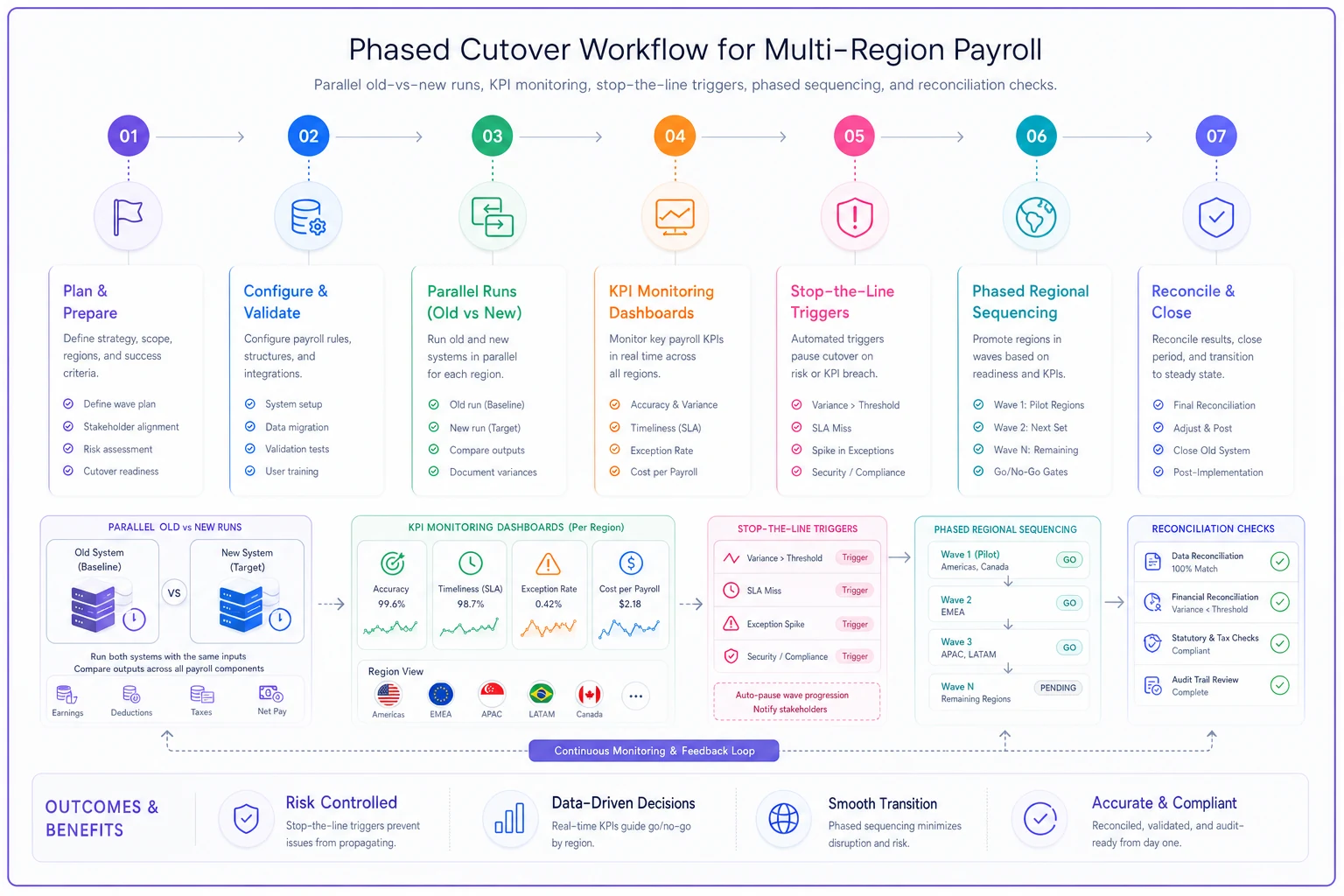
The teams that get this right treat cutover as a phased event, not a switch. One region goes first, runs parallel, gets validated against these KPIs, and only then does the next region follow. Rolling out five regions simultaneously to "save time" is how you turn one payroll incident into five. The mechanics of connector testing and safe cutover sequencing deserve their own attention — the payroll integration runbook covers the idempotency and retry patterns that keep a parallel run from double-counting.
When a global cutover is a bad idea
Sometimes the honest answer is "not yet." A big-bang multi-region cutover only makes sense when your policy registry is complete, your rule matrix has zero unresolved conflicts, and you've run at least one clean parallel period per region. If any region still has open questions, cutting it over on schedule to hit a project deadline is trading a delay for a payroll crisis. Delays are recoverable. Underpaying an entire region is a lot harder to walk back.
Choosing a vendor without getting sold a demo
Vendor selection is where a lot of the eventual pain gets locked in. The demo always works — it's built to. What matters is whether the system handles your conflict cells, the ones in your rule matrix that don't have a clean answer.
Bring your rule matrix into the evaluation. Don't ask "does it do overtime?" Ask "show me daily-plus-weekly overtime in Region B with a night differential and a mandatory unpaid break, calculated correctly, and let me see the audit trail." Vendors who can do it will show you. Vendors who can't will pivot to talking about the roadmap.
Criteria that actually separate systems at multi-region scale:
-
Per-region rule isolation — can regions have genuinely different logic without one region's config breaking another's?
-
Canonical time handling — does it store an unambiguous timestamp and handle DST correctly, or does it store local wall-clock time and hope for the best?
-
Audit depth — every calculation traceable to the rule and version that produced it
-
Effective-dated rules — can it run last month's rules for last month's corrections while this month uses new ones?
-
Reconciliation tooling — can it prove, not just assert, that inputs match outputs?
-
Data residency — some regions legally require data to stay in-region; find out before signing
And bind the important promises contractually. A vendor's SLA around data feeds, uptime, and cutover support is where marketing meets reality — the vendor SLA framework for time feeds breaks down the clauses and onboarding tests worth insisting on before production.
Executive sign-off artifacts: making the decision defensible
At enterprise scale, someone senior has to put their name on this. That person is not going to read your rule matrix cell by cell, and they shouldn't have to. Their job is to confirm the risks were identified and accepted knowingly. Your job is to give them artifacts that make that possible.
Three documents carry the weight:
The harmonisation decision log. Every conflict from the rule matrix, the decision made (standardize / localize / hybrid), who made it, and why. This is the document that protects everyone when someone later asks "who decided France gets a rounding exception?" The answer is written down, dated, and owned.
The risk-acceptance summary. The residual risks that couldn't be fully eliminated — a region with ambiguous law, a legacy data gap, a timing dependency — stated plainly with the mitigation and the accepted exposure. Executives sign off on risk, not on perfection. Pretending there's no residual risk is what turns a known issue into a scandal.
The cutover go/no-go criteria. The specific KPI thresholds that mean "proceed" versus "hold," agreed before cutover so the decision isn't made emotionally at 2am during a parallel run. When the overtime match rate in Region C is at 94% and the threshold was 99%, the pre-agreed criteria make the no-go call for you.
The pattern that separates smooth rollouts from painful ones: sign-off artifacts written for the reader, not the author. If your risk summary requires a payroll analyst to interpret, the executive can't actually accept the risk — they're just signing something they don't understand, which helps nobody when it goes wrong.
Harmonisation templates that keep this repeatable
The first region rollout is exploration. The tenth should be routine. Templates turn hard-won lessons into a repeatable process instead of relearning the same edge cases in every new market.
The templates worth building and reusing:
-
Region onboarding checklist — the standard set of policy questions to answer before a new region is configured, so nothing gets discovered mid-payroll
-
Conflict resolution template — the standard format for logging and deciding a rule conflict, so decisions are made consistently
-
Parallel-run test plan — the standard set of scenarios (DST crossing, retroactive edit, month-end boundary, max-overtime week) every region gets validated against
-
Rollback plan — what you do if a region's cutover fails validation, decided in advance
The template most people skip is the rollback plan, because writing it feels like admitting failure. It isn't. A documented rollback is what lets you cut over with confidence — you can afford to move fast on a region precisely because you know exactly how to back out if the KPIs go red.
The broader adoption side — getting managers and employees across regions to actually trust and use the new system — is its own challenge that outlasts the technical cutover. The timekeeping adoption playbook covers the mechanics of that transition and is worth reading alongside this before you set a rollout date.
A real scenario: three regions, one drifting system
A mid-sized engineering services firm — around 600 people — had grown into operations across the US, Canada, and Germany, all running on a system originally set up for the US business. On paper it worked. In practice, the Canadian province with daily overtime was being calculated on a weekly basis, and German mandatory break tracking simply didn't exist because the original config never needed it.
The drift showed up quietly. Canadian payroll corrections were running maybe a dozen a cycle, always chalked up to "one-offs." German labor cost reporting looked unusually clean because it was silently ignoring break rules entirely. Nobody had connected the dots since each region's numbers looked plausible on their own.
The fix wasn't a new vendor first — it was the registry and matrix. Documenting the rules per region surfaced eleven conflict cells nobody had ever explicitly decided. Three of them were active compliance gaps. Building the matrix, running a parallel period per region, and only cutting over each one once its KPIs cleared took roughly a full quarter — slower than leadership wanted.
The outcome was what mattered: Canadian payroll corrections dropped to near-zero, the German break gap got closed before it became a regulatory issue, and for the first time leadership had labor cost numbers across all three regions that were actually comparable. The correction volume alone — a couple hours of payroll rework every cycle across two regions — had been quietly costing more than the whole project, and that's before counting the compliance exposure nobody had priced in.
The system view
The reason multi-region timekeeping breaks isn't complexity — it's hidden complexity. Every region adds rules, and every rule interacts with every integration downstream: payroll, labor cost reporting, compliance, project profitability. A single-region system hides those interactions because they mostly agree. Scale reveals every disagreement at once, usually on a payroll deadline.
The three-phase approach works because it forces disagreements into the open before they cost money. The registry makes the rules explicit. The matrix makes the conflicts explicit. The cutover KPIs make correctness measurable instead of assumed. And the sign-off artifacts make sure a human being knowingly accepted whatever risk remains, rather than discovering it later in a regulator's letter.
The companies that struggle with global rollouts almost always treat it as a technology migration. The ones that get it right treat it as a governance problem that happens to involve technology. Get the policy layer right, decide the conflicts on purpose, measure the cutover honestly — and the software becomes what it should be: the thing that faithfully executes decisions you already made carefully, one region at a time.
The companies that struggle with global rollouts almost always treat it as a technology migration. The ones that get it right treat it as a governance problem that happens to involve technology. Get the policy layer right, decide the conflicts on purpose, measure the cutover honestly — and the software becomes what it should be: the thing that faithfully executes decisions you already made carefully, one region at a time.
Ready to optimize your workforce time management?
Join 2,000+ companies using GoTimio to improve timesheet accuracy, reduce payroll errors, and boost team productivity.