



Retro rate changes are one of those payroll events that look small on paper and turn into a mess in practice. Someone signs off on a raise effective three pay periods ago. Now finance has to recalculate wages, adjust the general ledger, figure out which cost centers absorbed the difference, and produce a paper trail that survives an audit. Miss one step and you either underpay someone, overpay someone, or book the adjustment to the wrong account — and nobody notices until quarter-end.
This isn't about whether retro pay is legal or how to calculate it. Most teams can do the math. The problem is the controls around it: who approves what, what window the change applies to, how it lands in the ledger, and whether you can reconstruct the whole thing six months later. That's where things quietly fall apart.
Where retro rate changes actually go wrong
The math itself is rarely the failure point. The failures cluster in four predictable spots.
Approval ambiguity. A manager emails HR: "Bump Marcus to $28/hr, backdated to the 1st." HR processes it. Nobody asks whether a $2.50/hr increase applied retroactively across four weeks needs a second signature. It doesn't get flagged because there's no rule saying it should.
Undefined time windows. "Backdated to the 1st" — the 1st of what? The current month? The pay period? The date the promotion was verbally agreed? This usually happens when the effective date lives in someone's inbox instead of a validated field. Two people interpret the window differently and the retro amount comes out $180 apart.
Ledger drift. The retro amount gets paid but the adjustment posts to the current period's expense account instead of being allocated back to the periods where the work actually happened. Your monthly labor cost looks fine until finance tries to reconcile a project's actual cost against billed hours and finds a phantom spike.
No reconstructable trail. Six weeks later someone asks: "Why did Marcus get a $312 retro payment on the 15th?" and the answer lives in a deleted Slack thread. This is the same discipline covered in the auditable correction policy for missed punches and retroactive edits — the underlying principle is identical, just applied to rates instead of punches.
The approval matrix: who signs off on what
The single biggest fix is deciding in advance which retro changes need which level of sign-off. Not per-request. As a standing rule. When the threshold logic lives in a table instead of in someone's judgment, the ambiguity disappears.
Accurate time tracking made effortless.
GoTimio empowers your team to log, monitor, and manage work hours seamlessly.
- Real-time time tracking
- Automated timesheet approvals
- Payroll and billing integration
No credit card required
Here's the kind of matrix that actually holds up. The dimensions that matter are the size of the rate delta, how many pay periods it reaches back, and the total dollar exposure.
| Retro scenario | Rate delta | Lookback window | Total exposure | Required sign-off |
|---|---|---|---|---|
| Minor correction | ≤ $1.00/hr | ≤ 1 pay period | < $150 | Manager only |
| Standard raise, current period | ≤ $3.00/hr | ≤ 1 pay period | < $500 | Manager + HR |
| Backdated raise | any | 2–3 pay periods | $500–$2,000 | Manager + HR + Payroll lead |
| Deep retro / reclassification | any | 4+ pay periods | > $2,000 | Manager + HR + Finance + sign-off gate |
| Cross-quarter adjustment | any | crosses a closed period | any | Finance + Controller mandatory |
The last row is the one people forget. Anything that touches a closed accounting period is a different animal — you're not just adjusting payroll, you're reopening a period that finance already reconciled. That always needs controller-level approval, no exceptions.
One pattern worth watching: teams tend to set thresholds on rate-per-hour alone and ignore total exposure. A $0.75/hr bump looks trivial until you apply it retroactively across six weeks and eleven employees. Suddenly it's a $2,400 adjustment that slipped through on "manager only" approval because each individual change looked small.
Time-window rules that remove interpretation
The effective date can't be a free-text field. It needs rules that a system — or a disciplined human — applies the same way every time.
-
Effective date snaps to a pay-period boundary unless explicitly overridden. If someone enters a mid-period date, either the system aligns it to the period start or forces the approver to acknowledge the partial-period calculation.
-
The lookback window is bounded. Retro changes reaching back more than a defined limit (often 90 days) escalate automatically regardless of dollar amount, because deep retro touches tax withholding assumptions and possibly prior quarterly filings.
-
Closed periods are locked. A change whose window crosses a period marked "closed" cannot be processed as a normal edit — it routes to the finance-mandatory path in the matrix above.
Require documented override reasons when snapping dates to pay-period boundaries.
A common example: a promotion is agreed on March 20th but not entered until April 10th. Without a rule, three people calculate three different retro amounts depending on whether they anchor to March 20, the March pay-period start, or April 1. With a snap-to-boundary rule and a documented override reason, everyone lands on the same number and there's a note explaining why.
Ledger-adjustment templates
Paying the retro amount is only half the job. The adjustment has to land in the ledger correctly, allocated to the periods and cost centers where the labor actually occurred. Otherwise your labor cost reporting is quietly wrong.
A workable ledger-adjustment template captures these fields for every retro event:
-
Employee + record ID — the anchor for the whole trail.
-
Original rate and new rate — both, always. "New rate = $28" without the old rate makes the delta unverifiable later.
-
Effective date and processing date — the two dates are almost never the same, and the gap between them is the whole reason retro exists.
-
Affected periods — an explicit list, not "a few weeks back."
-
Per-period delta breakdown — how much of the total belongs to each period.
-
GL accounts and cost centers per period — where each slice posts.
-
Approval chain — who signed off, in what order, with timestamps.
-
Reason code — promotion, correction, reclassification, retroactive union scale, etc.
The part most teams miss: the per-period breakdown is what makes the adjustment auditable rather than just paid. If you post one lump sum to the current month, you've technically paid the employee correctly and simultaneously corrupted your period-over-period labor cost trend. Finance won't catch it until they're reconciling something else entirely.
A short workflow for one retro event
Here's how a single backdated raise should move through the process: Manager submits the change with rate, effective date, and reason → the system (or reviewer) evaluates delta, window, and exposure against the matrix → the request routes to the required approvers in sequence → each approval is logged with a timestamp and identity → payroll calculates the per-period breakdown → the ledger template posts each slice to its correct period and cost center → a sign-off gate confirms totals reconcile before anything is committed → the completed record is written to an immutable audit log.
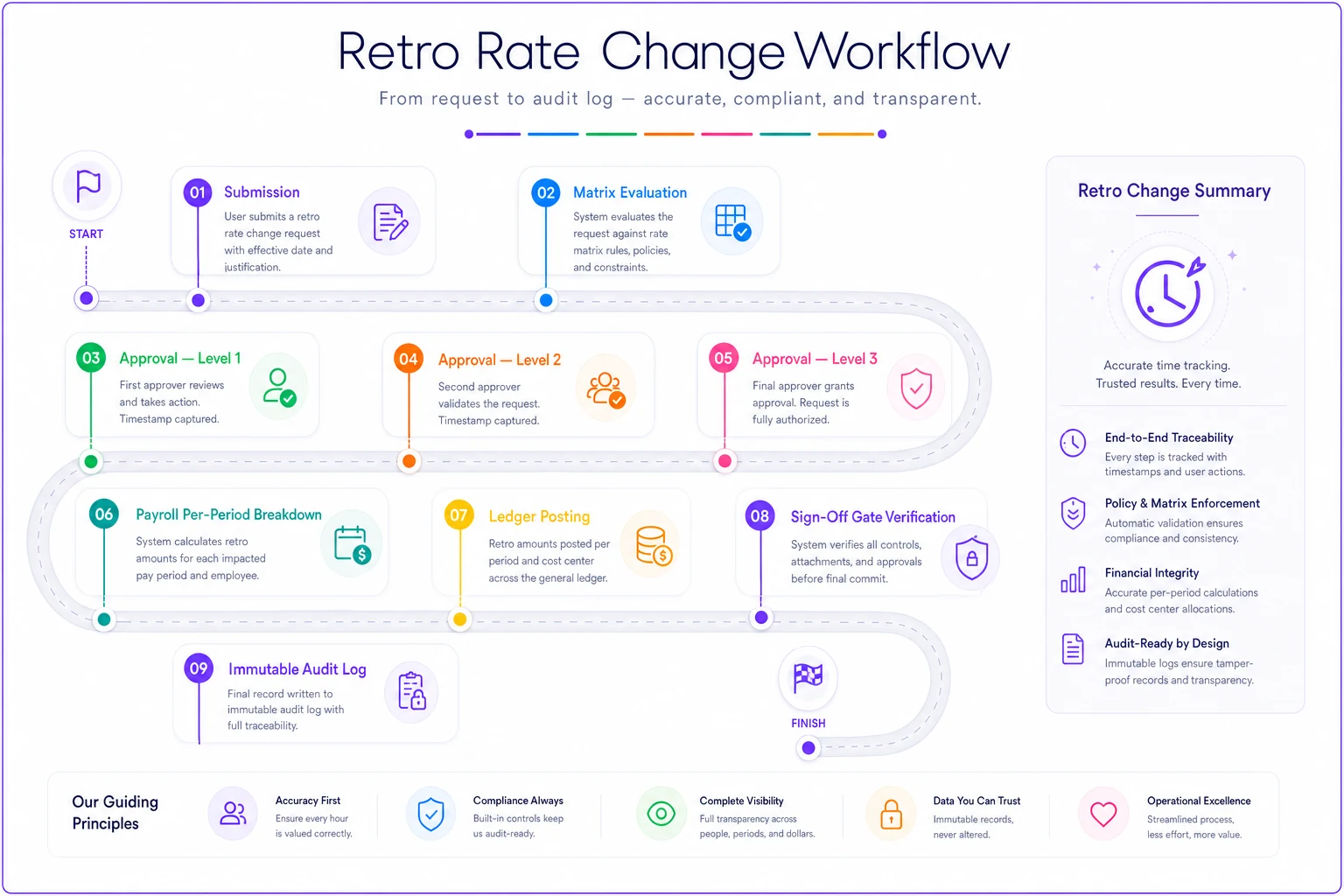
The sign-off gate near the end is deliberate. It's the last checkpoint where someone confirms the sum of the per-period slices equals the total retro payment before it hits the ledger. Skipping it is how a rounding error or a duplicated period slips through unnoticed.
Reconciliation SQL to validate the adjustments
Templates and approvals prevent most errors going in. Reconciliation queries catch the ones that get through anyway. The goal is a set of checks you can run against payroll and ledger data to confirm every retro adjustment is complete, balanced, and properly authorized.
Check 1 — Retro totals match the sum of per-period slices. Every retro payment should equal the sum of its allocated period breakdowns. Any mismatch means either a missing slice or a duplicated one.
SELECT r.retroid, r.employeeid, r.totalretroamount, SUM(s.periodamount) AS allocatedtotal, r.totalretroamount - SUM(s.periodamount) AS variance FROM retroadjustments r JOIN retroperiodslices s ON s.retroid = r.retroid GROUP BY r.retroid, r.employeeid, r.totalretroamount HAVING ABS(r.totalretroamount - SUM(s.period_amount)) > 0.01;
Anything returned here is a broken adjustment. The 0.01 tolerance catches genuine mismatches while ignoring sub-cent rounding.
Check 2 — Every retro event has an approval chain that satisfies the matrix. A retro payment above a threshold with only manager approval is a control failure.
SELECT r.retroid, r.totalretroamount, r.lookbackperiods, COUNT(a.approverrole) AS approvals, STRINGAGG(a.approverrole, ', ') AS chain FROM retroadjustments r LEFT JOIN retroapprovals a ON a.retroid = r.retroid GROUP BY r.retroid, r.totalretroamount, r.lookbackperiods HAVING (r.totalretroamount >= 2000 AND COUNT(a.approverrole) < 4) OR (r.totalretroamount >= 500 AND COUNT(a.approverrole) < 3) OR (r.lookbackperiods >= 4 AND STRINGAGG(a.approverrole, ',') NOT LIKE '%finance%');
This flags any adjustment where the approval depth doesn't match the exposure or lookback window.
Check 3 — No retro adjustment posts into a closed period without the mandated finance approval.
SELECT s.retroid, s.periodid, p.status, r.totalretroamount FROM retroperiodslices s JOIN accountingperiods p ON p.periodid = s.periodid JOIN retroadjustments r ON r.retroid = s.retroid LEFT JOIN retroapprovals a ON a.retroid = r.retroid AND a.approverrole = 'controller' WHERE p.status = 'closed' AND a.approver_role IS NULL;
Any row returned here is a closed-period change that skipped controller sign-off — exactly the scenario that turns a routine raise into an audit finding.
Run these on a schedule, not just when something looks wrong. Building payroll on defined recurring checks rather than spot-checks is covered more broadly in the SLA-based playbook for a payroll-ready time and attendance process — retro reconciliation is one more query you fold into that same rhythm.
A real scenario
A regional HVAC company with around 40 field techs pushed through a wage adjustment after a union rate change. The new scale was backdated seven weeks. Payroll processed all 40 as a single lump-sum retro payment each, posted to the current month's labor expense.
The techs got paid correctly — that part was fine. The problem showed up at month-end when project margins looked off. Roughly $18k of retroactive labor had landed entirely in one period instead of being spread across the seven weeks where the jobs actually ran. Two completed projects that had already been reported as profitable were now, on paper, carrying labor costs from work billed months earlier.
Untangling it took the better part of two days: rebuilding per-period breakdowns by hand, reallocating the ledger entries, reconstructing an approval trail that had only ever existed as an email thread and a spreadsheet. The next union adjustment — similar size — closed cleanly in an afternoon after they moved to a per-period breakdown template with a reconciliation check on the front end. Every slice allocated to the right period, complete sign-off record attached.
The difference wasn't the payroll math. It was that the controls existed before the money moved.
When to build this out — and when not to
When the full matrix and reconciliation stack makes sense: you run payroll across multiple cost centers or projects, retro changes happen with any regularity, or you allocate labor to client billing. The moment retro adjustments touch project profitability or closed periods, the controls pay for themselves the first time they catch a misallocation.
When it's overkill: a small team on a single flat cost center, salaried, with retro changes happening maybe twice a year. A documented effective-date rule and a two-signature approval is plenty. Building per-period SQL reconciliation for four employees is solving a problem you don't have.
Who should not skip the closed-period rule regardless of size: anyone whose books get reviewed — by an accountant, a lender, an investor, or an auditor. Even a small shop shouldn't be quietly reopening reconciled periods without a deliberate, logged decision.
The takeaway
Retro pay isn't hard to calculate. It's hard to control. The failures come from ambiguous approvals, undefined time windows, lump-sum ledger posting, and trails you can't reconstruct — not from arithmetic. A standing approval matrix removes the judgment calls, snap-to-boundary date rules kill the interpretation gaps, per-period templates keep your ledger honest, and a handful of reconciliation queries catch whatever slips through. Set those four up once and the next backdated raise becomes a process instead of a fire drill.
Ready to optimize your workforce time management?
Join 2,000+ companies using GoTimio to improve timesheet accuracy, reduce payroll errors, and boost team productivity.