

Running shift operations means dealing with swap requests every single day. Not the ones that come in days ahead of time — those are easy. The real headache is the Tuesday afternoon text saying someone can't make their Wednesday morning shift, or the Sunday night call about a sick kid right before Monday's opening.
Most businesses handle these with a mix of group texts, sticky notes, and memory. That works fine until you're explaining to payroll why Sarah worked 52 hours when she was scheduled for 38, or why the compliance audit shows unapproved overtime nobody authorized. Or worse, when a critical shift goes uncovered because two supervisors approved conflicting swaps.
The difference between smooth operations and constant firefighting usually comes down to having a clear shift swap runbook. Not a policy document sitting in a binder somewhere — an actual operational playbook that supervisors can execute when that 10pm text comes through.
Why standard shift swap processes break down
The typical swap starts simple enough. Employee A can't work, Employee B volunteers to cover. Supervisor approves, everyone moves on. Except that's rarely how it actually plays out.
Maria texts her supervisor at 8pm about tomorrow's 6am shift. The supervisor starts texting potential covers. Three people respond with different availability windows. One can cover the first half, another can come in two hours late. Meanwhile, nobody's checking whether these changes push anyone into overtime, whether coverage meets minimum staffing requirements, or if the swaps conflict with state break rules.
By morning you've got partial coverage, confused employees, and a shift that technically violates staffing ratios for the first two hours. Plus nobody documented any of it properly, so when payroll processes next week, the hours don't match schedules and you're stuck in a whole reconciliation mess.
The breakdown happens because swaps involve multiple decision points that supervisors make on the fly without clear guidelines. Each one affects overtime calculations, coverage requirements, compliance rules, and payroll processing. Without a structured approach, every urgent swap is a potential operational failure waiting to happen.
The decision tree supervisors actually need
A functional runbook starts with clear decision logic. Not every swap request needs the same level of review — some can auto-approve, some need escalation, and some should trigger immediate alerts.
Accurate time tracking made effortless.
GoTimio empowers your team to log, monitor, and manage work hours seamlessly.
- Real-time time tracking
- Automated timesheet approvals
- Payroll and billing integration
No credit card required
Here's the decision framework that works in practice:
Auto-approve criteria:
-
Swap between same-classification employees
-
No overtime impact for either employee
-
Maintains minimum coverage requirements
-
Both employees confirm in writing
-
Occurs more than 24 hours before shift start
-
No compliance conflicts (break rules, consecutive days, etc.)
Manager review required:
-
Creates overtime for the covering employee
-
Involves different pay rates or classifications
-
Happens within 24 hours of shift start
-
Affects specialized coverage needs
-
Crosses department boundaries
Escalation triggers:
-
Coverage drops below critical minimums
-
Involves employees on performance plans
-
Creates compliance violations
-
Affects client-facing commitments
-
Multiple swaps creating cascade effects
Quick visual to use during training:
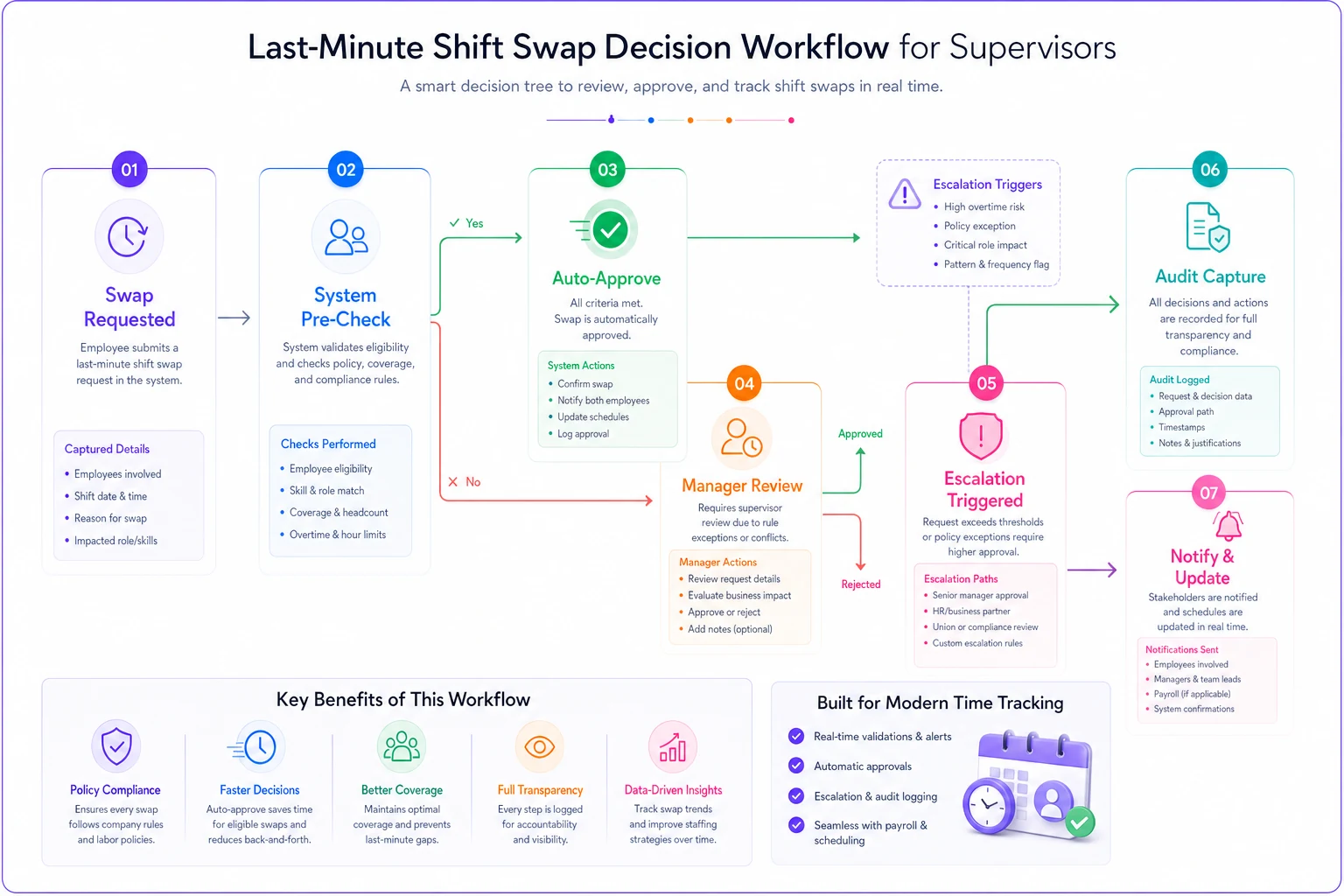
The key is making these decision points explicit. A supervisor dealing with a late-night request should know immediately whether they can approve it themselves or need to escalate. No guesswork, no "I'll figure it out in the morning."
Required audit fields that prevent payroll chaos
Every swap creates a data trail that touches multiple systems. Miss capturing the right information upfront and you're reconstructing everything from scratch when payroll doesn't balance or compliance auditors start asking questions.
The minimum viable audit trail for any shift swap:
| Field | Purpose | Format | Required timing |
|---|---|---|---|
| Original shift owner | Establishes baseline | Employee ID + name | Before any changes |
| Coverage employee | Tracks who actually worked | Employee ID + name | At swap approval |
| Swap timestamp | Compliance tracking | ISO 8601 format | When request submitted |
| Approval timestamp | Authorization trail | ISO 8601 format | When supervisor approves |
| Approver ID | Accountability chain | Supervisor ID + name | At approval |
| Reason category | Pattern analysis | Dropdown selection | At request |
| Overtime impact | Payroll planning | Yes/No + hours if yes | Before approval |
| Coverage verification | Operational continuity | Met/Not met + details | At approval |
| Communication method | Audit compliance | Text/App/Phone/Email | At request |
| Backfill status | Operational tracking | Full/Partial/None | After shift completion |
This isn't about creating bureaucracy. Each field serves a specific purpose. The overtime impact field prevents surprise payroll overruns. Coverage verification ensures minimum staffing is maintained. Communication method protects against "I never agreed to that" disputes.
Format matters too. Employee IDs instead of just names prevents confusion when you have three Marias on staff. ISO timestamps eliminate timezone confusion across multi-location operations. Dropdown categories make it possible to actually track patterns and identify chronic coverage problems over time.
Backfill rules tied to payroll cutoffs
The timing of shift swaps creates specific challenges around payroll processing. A swap that happens after timesheet submission but before payroll lock requires different handling than one that occurs mid-pay-period.
Most payroll systems have three critical windows that affect how swaps get processed.
The pre-submission window (typically Monday–Thursday of payroll week) is where swaps process normally with standard documentation. Original schedules get updated and changes flow through normal approval chains. This is the ideal window, but it rarely lines up with when swaps actually happen.
During the post-submission, pre-lock window (typically Friday–Sunday), swaps need manual adjustment records. The original timesheet has been submitted but payroll hasn't locked yet. Create adjustment records that clearly show the original submission and the modification reason — this prevents the "why did this change after submission" questions that slow down payroll processing.
Post-lock corrections create the biggest headaches. The pay period is closed, but the swap still happened. Now you're dealing with corrections that affect the next payroll run and potentially create tax complications if they cross month or quarter boundaries. These always require supervisor documentation explaining why the swap couldn't be caught earlier.
Procedures by timing window:
-
Update schedule in primary system
-
Notify both employees of confirmed change
-
Standard audit trail documentation
-
No special payroll flagging needed
If swap occurs Tuesday 5pm through Friday noon:
-
Create manual adjustment record
-
Email payroll with swap details
-
Document in both schedule and exception log
-
Flag for audit review
-
Confirm with employees that pay impact is understood
If swap occurs after Friday noon:
-
Document in correction queue for next period
-
Calculate any pay differential impact
-
Supervisor must document why swap was post-deadline
-
Create adjustment for next payroll run
-
Notify affected employees of payment timing
The backfill obligations shift based on these windows too. Early-week swaps follow normal coverage rules. Late-week swaps might require premium pay or alternative coverage arrangements. Post-lock swaps often trigger emergency coverage protocols with their own cost implications.
Sample audit entries that pass compliance review
Documentation quality determines whether you can defend your shift operations during an audit. Generic entries like "John covered for Jane" don't hold up when investigators start asking questions.
Standard swap entry:
2024-03-15 14:32:05 PST | SWAP_REQUEST Employee: Maria Rodriguez (EMP-4782) Original shift: 2024-03-17 06:00-14:00 (Station 3) Reason: Childcare conflict (Category: PERSONAL) Coverage: Sarah Chen (EMP-4799) Overtime impact: No (Sarah at 32 hrs pre-swap) Approval: Supervisor Tom Mitchell (SUP-891) at 2024-03-15 15:45:22 PST Coverage verification: Station 3 maintains 4-person minimum Method: Text message thread archived in system Backfill: Full coverage confirmed
Escalated swap entry:
2024-03-18 21:15:33 PST | SWAP_ESCALATED Employee: James Park (EMP-5123) Original shift: 2024-03-19 10:00-18:00 (Senior Tech Role) Reason: Family emergency (Category: EMERGENCY) Coverage: PARTIAL - Marcus Williams (EMP-5144) 10:00-14:00 only Overtime impact: Yes - Marcus enters OT at 14:00 (42 hrs current week) Initial supervisor: Janet Collins (SUP-902) Escalation: Director approval required for specialized role + OT Director approval: Kevin Murphy (DIR-101) at 2024-03-18 21:47:10 PST Additional coverage: Tech pool activated for 14:00-18:00 Compliance note: Break coverage adjusted for single senior tech Client notification: Account managers alerted for affected appointments
Failed swap documentation:
2024-03-20 05:45:00 PST | SWAP_FAILED Employee: Lisa Chang (EMP-4901) Attempted notification: 2024-03-20 05:45:00 PST via text Scheduled shift: 2024-03-20 06:00-14:00 (Critical morning coverage)
-
Robert Lee (EMP-4920)
Declined - already at 40 hrs
-
Jennifer Wu (EMP-4935)
No response within 30-min window
-
Alex Turner (EMP-4899)
Would create consecutive 7th day violation
Resolution: Supervisor Mitchell (SUP-891) self-covered 06:00-10:00 Partial coverage: Part-time pool activated 10:00-14:00 Operational impact: Register 2 closed first 4 hours, documented in daily log Follow-up: No-show protocol initiated for Lisa Chang
Notice how each entry creates a complete picture. Anyone reviewing these months later can understand exactly what happened, who made decisions, and why. The entries also protect the business by showing compliance considerations were checked and minimum coverage was maintained throughout.
Building supervisor confidence with clear escalation paths
The biggest failure point in shift swap management isn't the process — it's supervisor hesitation. When a supervisor gets that late-night text, they need absolute clarity on what they can handle themselves versus what needs escalation.
Most supervisors delay decisions because they're unsure about authority limits. They don't want to approve something that creates downstream problems, but they also don't want to wake up a director for something they should just handle themselves. That hesitation is where coverage gaps and stressed employees come from.
Supervisor can approve independently:
-
Same-day swaps between equally qualified employees
-
Changes that don't trigger overtime
-
Swaps within their direct department
-
Coverage that maintains all minimum requirements
Supervisor must notify (but can proceed):
-
Swaps creating up to 4 hours overtime
-
Cross-department coverage within same facility
-
Use of on-call or standby employees
-
Partial shift coverage arrangements
Requires next-level approval:
-
Any swap creating 4+ hours overtime
-
Coverage affecting specialized certifications
-
Swaps that drop below minimum ratios
-
Changes affecting client commitments
-
Multiple cascading swaps
Requires director/executive approval:
-
Compliance violations, even temporary ones
-
Premium pay authorizations beyond standard
-
External contractor or agency usage
-
Swaps affecting multiple facilities
When supervisors know exactly when they have authority to act versus when they need help, coverage decisions happen faster and operational gaps shrink. It's a simple thing that makes a real difference at 10pm on a Sunday.
Technology integration without full automation
Fully integrated systems where requests flow automatically through approval chains, check all constraints, and update every affected system would be ideal. That's not the reality most businesses operate in.
Partial automation that handles the repetitive parts while preserving human judgment where it matters tends to work better in practice. A shift swap runbook should leverage whatever systems you already have without requiring massive technology overhauls.
The integration points that make the biggest practical difference:
-
Notification systems Even basic group messaging apps work if you establish clear protocols. Set up dedicated channels for shift swaps separate from general communication, use standard message formats that include all required fields, and archive those conversations for your audit trail.
-
Simple databases A structured spreadsheet can track swap patterns effectively. Include columns for all audit fields, use data validation for consistency, and maintain rolling 90-day visibility. This beats paper logs or trying to reconstruct swaps from memory two weeks later.
-
Payroll system flags Most payroll systems allow exception notes or adjustment codes. Create specific codes for different swap scenarios so payroll processors understand changes without needing to track down supervisors for explanations.
-
Schedule system notes Whether you're using dedicated scheduling software or shared calendars, maintain swap documentation directly in the system. Don't rely on external notes that get disconnected from actual schedule records.
More sophisticated operations benefit from AI-powered operational platforms that handle swap request routing, automatically check overtime implications, and maintain audit trails without manual effort. These platforms can pre-validate swaps against your rules before supervisors even review them. But the core runbook principles work regardless of where you are on the technology spectrum.
Common failure patterns and prevention strategies
Certain failure patterns show up across different industries when shift swap processes break down. Knowing them ahead of time makes prevention a lot more straightforward.
The cascade swap spiral: One person calls out, their coverage person ends up working a double, which means they can't work tomorrow, which triggers a search for yet another replacement. Before long, one sick call has disrupted an entire week's schedule. Prevention means tracking swap chains and limiting how many consecutive swaps any employee can be pulled into — no more than two swap chains in a 7-day period is a reasonable hard limit for most operations.
The overtime surprise: A helpful employee covers multiple swaps without anyone tracking cumulative hours. Thursday's innocent 4-hour coverage pushes them into overtime nobody budgeted for. Prevention means checking total weekly hours before approving any swap, not just the individual shift impact. This is also where missed punches and retroactive corrections become critical — you need accurate hour totals to make good swap decisions in the first place.
The qualification mismatch: Someone covers a shift they're not actually qualified for. Maybe they haven't completed required training, their certification expired, or they don't have the right system access. The problem only surfaces when they can't perform critical tasks mid-shift. Prevention requires a simple qualification matrix that gets checked before approving any swap.
The documentation gap: A swap happens verbally or through unofficial channels. Two weeks later during payroll reconciliation, nobody remembers the details — who approved it, why it happened, whether overtime was authorized. Without documentation you're stuck accepting whatever story surfaces. This connects directly to pre-billing reconciliation problems where undocumented changes create client disputes that are genuinely hard to resolve after the fact.
Each of these failure patterns is preventable with the right runbook structure in place. The issue isn't that supervisors are careless — it's that without explicit rules, they're making judgment calls under time pressure with incomplete information.
Making the runbook stick in daily operations
Creating a runbook is the easy part. Getting supervisors to actually use it consistently is where most of these efforts fall apart.
Start with supervisor pain points, not compliance requirements. Most supervisors want to handle swaps quickly and move on. Show them how the runbook makes their life easier — clear decision rules mean less second-guessing, required fields mean fewer follow-up questions from payroll, proper documentation means less drama later. Frame it that way from the start.
Train on real scenarios from your actual operations. Pull recent problematic swaps and walk through how the runbook would have prevented those specific issues. Generic training examples don't stick, but "remember that overtime mess from Tom's swap last month?" tends to.
Build checking into existing routines rather than adding new ones. During daily huddles, quickly review yesterday's swaps. In weekly supervisor meetings, spot-check a random sample of documentation. Make compliance visible without making it feel punitive.
During daily huddles, have one supervisor read a single recent swap entry aloud to normalize documentation and spot training gaps.
Create simple job aids supervisors can reference fast — a laminated decision tree card, a mobile-friendly checklist, a flowchart posted in the supervisor area. The full runbook can be comprehensive. The daily reference tools should be bite-sized.
And iterate. When supervisors consistently skip a step, figure out why. Sometimes the step is unnecessary, sometimes it needs simplification, sometimes it needs better integration into the actual workflow. The best runbooks evolve based on operational reality, not theoretical perfection.
The operational impact of structured swap management
The difference between chaotic and smooth shift operations often comes down to how well you handle the inevitable disruptions. A clear shift swap runbook transforms last-minute coverage from a crisis into a routine task.
Supervisors gain confidence knowing exactly what they can approve versus what needs escalation. Payroll stops dealing with constant reconciliation issues from undocumented swaps. Compliance audits become straightforward reviews instead of archaeological expeditions reconstructing what happened three months ago.
The runbook needs to match your operational reality. A 24/7 healthcare facility has different constraints than a retail store or a professional services firm. But every operation benefits from clear decision logic, consistent documentation, and defined escalation paths.
Start with the basics: document your decision tree, define required audit fields, establish payroll timing rules, and create sample entries. Test it against real scenarios from the past month. Refine based on what actually happens in your operations, not what should theoretically happen.
The best shift swap runbook is one supervisors actually use. It should make decisions easier, not harder. It should prevent problems they've personally experienced. When built right, it becomes an operational asset that reduces stress, prevents errors, and keeps coverage consistent even when schedules are constantly changing.
Start with the basics: document your decision tree, define required audit fields, establish payroll timing rules, and create sample entries. Test it against real scenarios from the past month. Refine based on what actually happens in your operations, not what should theoretically happen.
Ready to optimize your workforce time management?
Join 2,000+ companies using GoTimio to improve timesheet accuracy, reduce payroll errors, and boost team productivity.