

If you run contingent labor through staffing agencies, the invoice disputes aren't random. They cluster. Same suppliers, same pay codes, same reconciliation gaps, month after month. And the reason they keep happening is that most AP and HR teams treat each dispute as a one-off fire instead of a predictable output of a broken time-feed pipeline.
The usual pattern: an agency sends a weekly feed, your system ingests it, payroll runs, then two weeks later the agency invoice shows hours that don't match what your managers approved. Now someone in AP is emailing someone in agency billing, both pulling different spreadsheets, both convinced they're right. Multiply that by a dozen suppliers and you've got a reconciliation function that lives entirely inside email threads.
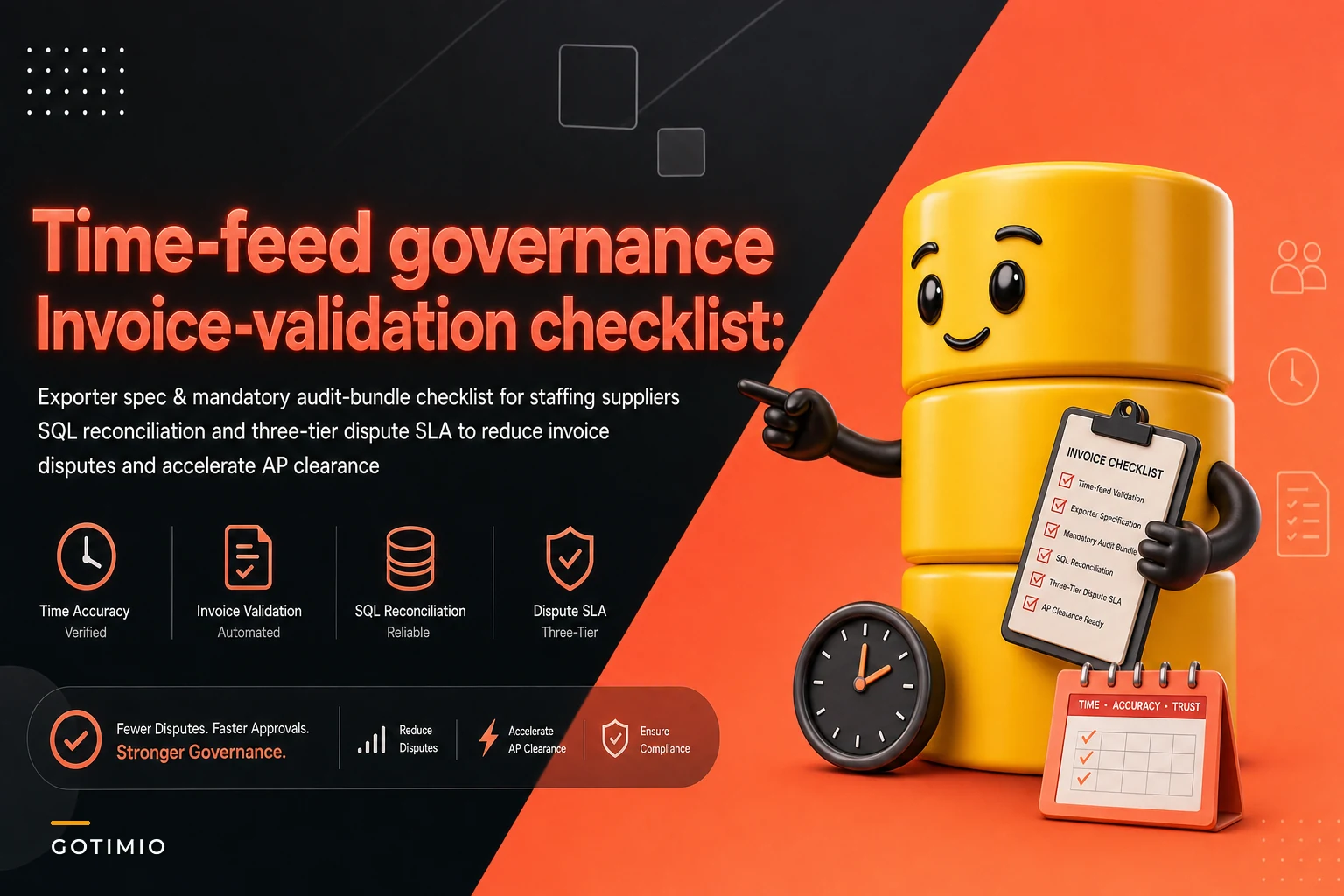
This post is about killing that pattern at the source — not with more reviewers, but with a standardized exporter spec every supplier must conform to, a required audit-bundle checklist submitted alongside the feed, reconciliation SQL you can actually run, and a three-tier dispute SLA so nothing drags for 40 days while finance holds payment.
Why agency time feeds break in the first place
The core problem is that every staffing agency exports hours in its own shape. One sends rounded daily totals. Another sends raw punches. A third sends "billable hours" with the markup already baked into a rate field you weren't expecting. When you ingest three different interpretations of "hours worked" into one system, the mismatches aren't bugs — they're baked into the inputs.
A few patterns show up repeatedly:
-
Rounding drift. The agency rounds each shift to the nearest 15 minutes on their side. Your approval system stores exact punches. Across 60 contractors, that's a few hundred dollars of difference every single week, almost always in the agency's favor.
-
Overtime interpretation. Your contract says OT after 40 weekly hours. The agency's export calculates daily OT after 8. Same worker, same week, different gross — and nobody notices until the invoice.
-
Pay-code mapping gaps. The agency uses "ONCALL," you expect "STANDBY." The feed drops those hours into a default bucket, and now your cost center is wrong before anyone disputes a single number.
-
Timing mismatches. The feed cuts off Sunday midnight agency-local-time. Your payroll cutoff is Friday 6pm your-time. Half a shift lands in the wrong week.
None of these are exotic. They're the default state when you let each supplier define its own export format. The fix isn't to argue every line — it's to stop accepting undefined inputs.
Step one: a standardized exporter spec every supplier must conform to
The highest-leverage thing you can do is publish a feed spec and make conformance a contractual onboarding requirement. If a supplier can't produce the feed in your shape, they don't go live. That sounds rigid until you price out the alternative in AP hours.
Accurate time tracking made effortless.
GoTimio empowers your team to log, monitor, and manage work hours seamlessly.
- Real-time time tracking
- Automated timesheet approvals
- Payroll and billing integration
No credit card required
Here's the minimum your exporter spec should lock down.
| Field | Requirement | Why it matters |
|---|---|---|
worker_id | Your assigned ID, not the agency's internal one | Lets you join to approvals and cost centers without a lookup table that drifts |
work_date | ISO 8601, explicit timezone offset | Kills the week-boundary and cutoff mismatches |
clockin / clockout | Raw timestamps, not rounded | You apply rounding to your own rules, once, consistently |
hoursregular / hoursot | Separate fields, OT rule stated in metadata | Removes the "daily vs weekly OT" ambiguity |
pay_code | From your controlled vocabulary only | No free-text codes that silently fall into defaults |
rate_type | Bill rate vs pay rate flagged explicitly | Stops markup-baked-in surprises |
cost_center | Your code, validated against your GL | Wrong allocations caught at ingest, not month-end |
approval_ref | Links each line to a manager approval event | This is the field that ends most disputes |
The non-obvious one is approval_ref. Most agencies send hours with no link back to who approved what. The moment you require every billable line to carry a reference to an approval your managers actually signed off on, the dispute shifts from "whose spreadsheet is right" to "show me the approval." If there's no approval, the line doesn't get paid. Full stop.
Keep the raw timestamps too. If you let agencies round on their side, you inherit their rounding logic and can never reconcile cleanly. Ingest raw, round once using your own rules, and the drift disappears because it's now deterministic on your end.
Step two: the required audit-bundle checklist
A feed by itself isn't enough. For each invoice period, the supplier should submit an audit bundle — a small package of supporting artifacts that makes the invoice independently verifiable. This is what lets you clear an invoice without a back-and-forth.
Make this a hard gate: no complete bundle, no invoice processing.
-
The conformed time feed in the exported spec format, covering the exact invoice period
-
A feed manifest — row count, sum of regular hours, sum of OT hours, total billable amount, and a checksum of the file
-
Approval evidence — the list of
approval_refvalues with approver identity and timestamp -
Rate card reference — the version of the rate card in effect for that period, so a mid-period rate change doesn't become a silent dispute
-
Exception log — any lines the agency manually adjusted, corrected, or re-submitted, with reason codes
-
Timezone/cutoff declaration — the exact period boundaries in UTC so your reconciliation joins line up
The manifest is the quiet hero here. When the supplier declares "4,812 regular hours, 206 OT hours, $142,390 total" at the top of the bundle, your reconciliation becomes a comparison against a stated number rather than an open-ended audit. If their manifest total and your calculated total disagree, you know immediately and can scope the gap before anyone picks up the phone.
The exception log matters more than people expect. Most disputes trace back to a quiet re-submission — the agency fixed something on their side and sent a new file without flagging it. If re-submissions and manual corrections have to be itemized with reason codes, the "mystery hours" category basically disappears.
Step three: reconciliation SQL you can actually run
Once feeds are conformed and bundles are complete, reconciliation stops being manual. You're comparing two datasets that share a schema: the agency's submitted feed and your own approved-hours records.
Here's the shape of the core reconciliation. Assume you've loaded the agency feed into agencyfeed and your approved internal records into approvedhours, both keyed on workerid and workdate.
-- Line-level variance between agency-billed hours and internally approved hours SELECT a.workerid, a.workdate, a.paycode, a.hoursregular AS agencyreg, i.hoursregular AS approvedreg, a.hoursregular - i.hoursregular AS regvariance, a.hoursot AS agencyot, i.hoursot AS approvedot, a.hoursot - i.hoursot AS otvariance, a.approvalref, CASE WHEN i.workerid IS NULL THEN 'NOAPPROVALMATCH' WHEN a.paycode <> i.paycode THEN 'PAYCODEMISMATCH' WHEN ABS(a.hoursregular - i.hoursregular) > 0.01 THEN 'HOURSVARIANCE' WHEN ABS(a.hoursot - i.hoursot) > 0.01 THEN 'OTVARIANCE' ELSE 'MATCH' END AS reconstatus FROM agencyfeed a LEFT JOIN approvedhours i ON a.workerid = i.workerid AND a.workdate = i.workdate WHERE a.invoiceperiod = :period ORDER BY reconstatus, a.workerid, a.work_date;
-- Does the agency manifest match our reconciled totals? SELECT SUM(a.hoursregular) AS agencytotalreg, SUM(i.hoursregular) AS approvedtotalreg, SUM(a.hoursregular) - SUM(i.hoursregular) AS reggap, SUM(a.hoursot) AS agencytotalot, SUM(i.hoursot) AS approvedtotalot, SUM(a.hoursot) - SUM(i.hoursot) AS otgap FROM agencyfeed a LEFT JOIN approvedhours i ON a.workerid = i.workerid AND a.workdate = i.workdate WHERE a.invoice_period = :period;
One practical note: don't try to resolve everything to zero variance.
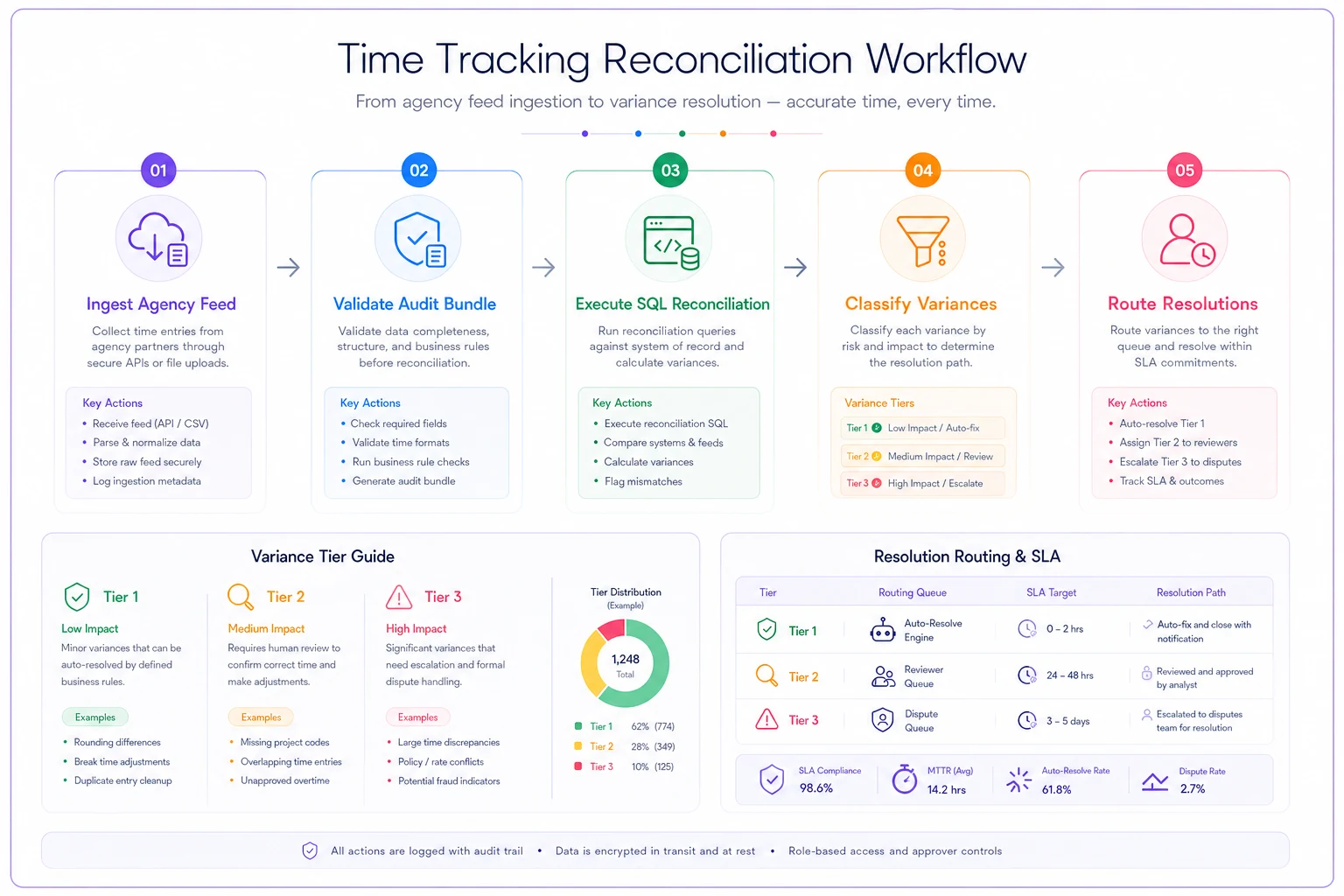
A simple ingest-to-resolution workflow.
This same discipline connects directly to catching mismatches before they ever reach an invoice. If you want the upstream version — stopping discrepancies at the project-hours stage — the pre-billing reconciliation checklist to prevent client disputes covers the controls that keep variances from entering the pipeline in the first place.
Step four: a three-tier dispute SLA
Reconciliation surfaces the problems. The SLA is what keeps them from sitting unresolved for six weeks while finance withholds an entire invoice over a 2% variance. Tier disputes by materiality and keep the clock explicit.
| Tier | Trigger | Who owns it | Resolution SLA | Payment handling |
|---|---|---|---|---|
| Tier 1 — Auto / Clerical | Variance under materiality threshold, or single-field mismatch (pay code, cost center) | AP analyst | 2 business days | Pay undisputed amount, correct the rest in next cycle |
| Tier 2 — Line Dispute | Hours/OT variance above threshold, or NOAPPROVALMATCH on specific lines | Agency account manager + your ops lead | 5 business days | Pay matched lines, hold only disputed lines |
| Tier 3 — Structural | Manifest gap exceeds period cap, systemic pay-code or rate-card failure, repeated feed non-conformance | Finance + procurement + agency leadership | 10 business days + root-cause review | Hold period, trigger contract review |
The principle that actually fixes AP cycle time: never hold a whole invoice over a partial dispute. The default behavior in most AP shops is to freeze the entire payment until everything reconciles, which punishes the agency for the matched 97% and gives them every incentive to dig in on the disputed 3%. Pay what's clean, hold what's contested, resolve on a clock. Agencies respond to this far better because their matched hours aren't held hostage.
Tier 3 is where you protect yourself long-term. If the same supplier keeps landing there because their feed never conforms or their manifests never reconcile, that's not a billing problem — that's a vendor problem, and procurement needs the data to have that conversation. Track dispute tier frequency per supplier and within a quarter you'll know which agencies actually run a disciplined time function and which ones are operating on spreadsheets and hope.
A realistic before/after
Consider a mid-sized logistics operation running roughly 70–90 contractors across three staffing agencies, invoiced weekly. Before standardizing, their AP team was spending close to two full days a week on agency reconciliation. Invoices routinely cleared at 35–45 days, and disputed amounts hovered around 4–6% of total agency spend — most of it never recovered because by the time anyone chased it, the trail had gone cold.
After publishing an exporter spec, requiring the audit bundle, and running the reconciliation SQL on ingest, things shifted noticeably. Two of the three agencies conformed within a month. The third needed a Tier 3 conversation and eventually fixed their export. Reconciliation dropped to a few hours a week because the SQL did the matching and humans only touched flagged variances. Clearance moved toward the 15–20 day range, and the disputed-but-unrecovered bucket shrank to roughly 1%, mostly immaterial rounding that auto-cleared anyway.
Nothing here was a dramatic transformation. It was the compounding effect of refusing to accept undefined inputs and putting a clock on disputes.
When this is worth it — and when it isn't
This makes sense when you're running multiple staffing suppliers, invoicing on a regular cycle, and your AP or HR team is spending real hours each period chasing mismatches. The more suppliers and the higher the contingent spend, the faster the spec pays for itself.
This is overkill when you've got a single agency, a handful of contractors, and invoices small enough that a quick manual check clears them in ten minutes. Don't build a governance framework around a problem you can eyeball.
Who should not start here: if your own internal approval data is a mess — managers approving in bulk after the fact, no reliable link between a worker and an approval event — fix that first. The reconciliation SQL is only as good as the approved_hours side of the join. Garbage on your side makes every agency look wrong, and you'll lose credibility fast when you dispute a line and the agency proves your approvals were never actually captured.
The connective tissue
Clean agency time feeds aren't only an AP problem — they feed straight into how you understand the true cost of contingent labor. Once hours are conformed, approved, and reconciled against a controlled pay-code vocabulary, you can actually allocate that spend accurately across projects and cost centers.
That's the foundation for turning those reconciled hours into something finance trusts, which is exactly the territory covered in turning tracked hours into defensible P&L.
The thread running through all of it is the same: stop treating supplier hours as a given and start treating them as inputs that have to earn their way into payroll and the ledger. Define the shape, require the evidence, reconcile deterministically, and put a tiered clock on anything that doesn't line up. The monthly scramble stops being a scramble — it becomes a short list of flagged exceptions that someone can clear before the morning's first coffee gets cold.
Ready to optimize your workforce time management?
Join 2,000+ companies using GoTimio to improve timesheet accuracy, reduce payroll errors, and boost team productivity.