

Most timesheet errors don't come from bad employees. They come from the same three or four people making the same mistake week after week because nobody ever sat them down and walked them through it. The supervisor sees the error, fixes it on their end, mutters something under their breath, and moves on. Next week the same punch is missing. Week after that, same thing.
That loop is the real problem. Not the error itself — the fact that correcting it got outsourced to the supervisor's silent cleanup instead of becoming a quick, repeatable conversation.
This post is a coaching flow built for that exact situation. Scripts you can read almost word-for-word, a way to show evidence without triggering defensiveness, a short corrective checklist, and a follow-up cadence tied to a KPI so you actually know if it worked. It's designed to run inside a normal 1:1 — not a formal write-up, not an HR escalation.
Why the "I'll just fix it myself" habit keeps errors alive
There's a quiet pattern behind most recurring timesheet problems: supervisors become the error-absorbing layer. Someone forgets to clock out, the system flags it, and the manager edits the record so payroll runs clean. Done. Except the employee never learns the punch was missing, never learns what the fix cost, and has zero reason to change.
In real operations this usually shows up as a small group of repeat offenders generating a disproportionate share of corrections. A 40-person team might have six people responsible for 70% of the first-pass edits. The supervisor "handles it" every cycle, which feels efficient in the moment but guarantees the work never ends.
The second reason these errors stick is that when correction does happen, it comes out as blame. "You forgot to clock out again" puts the person on defense immediately. They explain, they justify, maybe they apologize — and nothing about tomorrow changes. Defensiveness kills learning. If your coaching makes someone feel accused, you've already lost the behavior change you were after.
A good coaching flow removes both problems. It stops the silent-fix habit and replaces blame with evidence plus a clear next step.
The structure of a non-punitive correction
Before the scripts, the mechanics. Every one of these conversations follows the same four beats, and the order matters more than the exact wording:
Accurate time tracking made effortless.
GoTimio empowers your team to log, monitor, and manage work hours seamlessly.
- Real-time time tracking
- Automated timesheet approvals
- Payroll and billing integration
No credit card required
-
Name the pattern, not the person. You're describing a recurring data issue, not a character flaw.
-
Show the evidence neutrally. Let the record speak. You're not arguing, you're reviewing.
-
Ask what's getting in the way. The employee almost always knows the root cause better than you do.
-
Agree on one specific change and a check-in date. Vague commitments ("I'll be more careful") don't count.
Notice what's missing: no warning language, no "this is your second time," no consequences framing. That's deliberate. Consequences live in your formal policy if the pattern continues — they don't belong in a coaching conversation. The moment you mix coaching and discipline, the employee stops hearing the coaching part.
Here's a quick visual of that four-step coaching workflow.
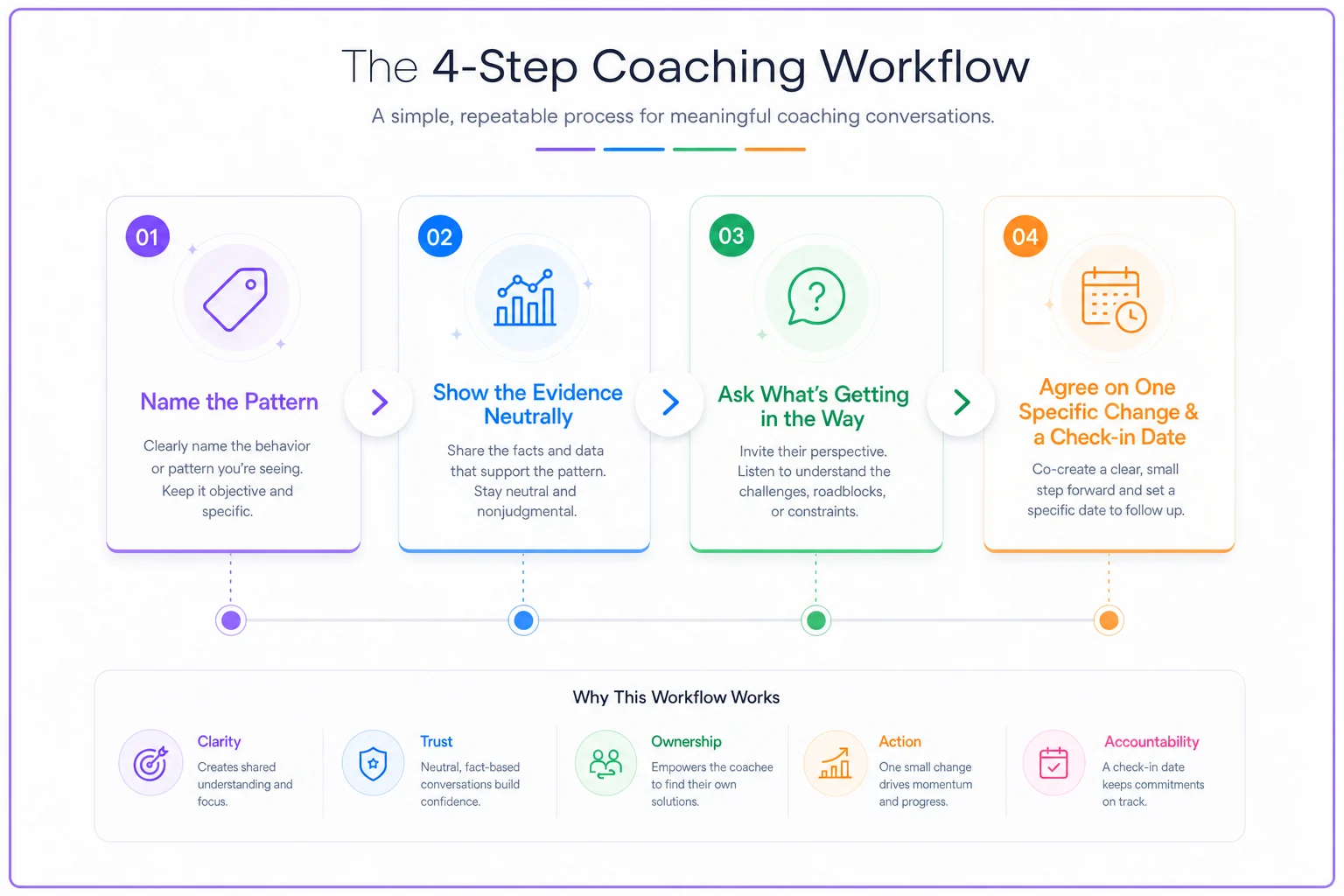
Use the visual as a reminder to run the beats in order during a short 1:1.
The scripts
These are written for the most common recurring errors. Read them close to verbatim the first few times; after a while you'll settle into your own cadence.
Missing clock-outs
> "I pulled your last three weeks and the clock-out is getting added manually on about half your shifts. I'm not worried about the hours — those are fine. I want to figure out what's happening at end of shift so you don't have to rely on me catching it. Walk me through your last hour of the day."
Then stop talking. Nine times out of ten you'll hear something concrete: they're helping a customer right up to close, the clock-out terminal is across the building, the app logs them out when signal drops. Each of those has a different fix.
Late or back-dated entries
> "Your time for last week came in on Monday instead of Friday. That lands after payroll pulls the numbers, so it creates a retro adjustment on the back end. Totally fixable, but I'd rather not run the correction every cycle. What's making end-of-week submission hard to hit?"
Rounding or estimating hours
> "A few of your entries are landing on clean half-hours — 8:00, 12:30, 4:00 — which usually means they're being estimated rather than punched live. I need actual punch times for this to hold up if payroll ever gets audited. Are you clocking in when you arrive, or writing it in later?"
The common thread across all three: you state what you see, explain the downstream cost in one plain sentence, and hand the floor to them. No lecture.
How to present the evidence without it feeling like an ambush
This is where a lot of well-meaning supervisors blow it. They pull up a screen full of red flags and the employee immediately feels cornered.
-
Show a trend, not a single incident. One missed punch is forgettable and arguable. Three weeks of the same gap is a pattern worth a calm conversation. Trends feel like data; single incidents feel like gotchas.
-
Lead with what's fine. "Your hours are accurate" or "the totals are right" before "but the punches are coming in late." People relax when they know they're not in trouble.
-
Put the number on the process, not the person. "This created four retro edits last month" is about the workflow. "You made four mistakes" is about them.
If you're already running prioritized exception views — the kind covered in this breakdown of manager dashboards that cut first-pass edits — the evidence is basically pre-assembled. You're reviewing a filtered list of that person's exceptions, not digging through raw logs mid-conversation, which keeps the whole thing feeling routine instead of investigative.
One more thing worth saying: keep this clearly separate from any fraud or integrity concern. Coaching is for honest mistakes and bad habits. If you suspect something intentional, that's a completely different track — the respectful approach is outlined in this piece on detecting timesheet fraud without demotivating staff. Don't let the two blur together. Treating an honest mistake like potential fraud will destroy trust fast.
The corrective checklist
After the conversation, before the person leaves, confirm these. This is what turns a decent chat into an actual correction:
-
[ ] The specific error pattern was named out loud and the employee acknowledged it
-
[ ] The root cause was identified — by the employee, not assumed by you
-
[ ] One concrete behavior change was agreed on, stated in their words
-
[ ] Any tooling or access barrier was logged (wrong terminal location, app logout issue, etc.)
-
[ ] A follow-up date is on both calendars
-
[ ] The KPI you'll watch is named ("next three weeks, I'm looking at your clock-out completion")
If you can't check all six, the conversation isn't finished. The most commonly skipped one is root cause — supervisors tend to prescribe a fix ("just remember to clock out") instead of surfacing why it keeps getting missed. A fix that doesn't address the actual cause is just the same conversation scheduled for next month.
The follow-up cadence that makes it stick
One conversation rarely changes a months-old habit. The follow-up is what does the work, and it needs to be tied to a specific number so you're not running on gut feel.
Pick one metric per person based on their error type, then run a decreasing-intensity check-in:
| Check-in | Timing | What you're looking at | Tone |
|---|---|---|---|
| First | 1 week after | Did the pattern break even once? | "Saw you hit your clock-outs this week — nice." |
| Second | 2 weeks after | Is it holding most days? | Quick verbal, 30 seconds |
| Third | 1 month after | Is it the new normal? | Drop it from active tracking if clean |
The decreasing cadence matters. You're reinforcing the win, not hovering. Catching someone doing it right in week one does more for the behavior than any amount of continued correction. Most supervisors never close this loop — they coach once, assume it stuck, and only revisit when the error reappears. The one-week check-in is cheap and probably the highest-leverage part of the whole flow.
The one-week check-in is cheap and probably the highest-leverage part of the whole flow.
If after the third check-in nothing has changed, that's your signal the situation has moved past coaching. At that point it's a documented pattern and it goes into your normal performance process. But most cases never get there.
A realistic example
A regional HVAC company with around 50 field and shop techs had a chronic missing-punch problem — roughly 60-some manual corrections per pay period, nearly all of it landing on two dispatch supervisors to clean up before payroll ran. Each correction only took a minute or two, but across a month it was eating most of a day of supervisor time, and the retro adjustments were making payroll close messier than it needed to be.
They didn't buy anything new or roll out a new policy. The ops manager just had each supervisor run this flow during their next round of 1:1s, starting with the five techs generating the most edits. Those conversations surfaced two root causes nobody had thought to ask about: the shop clock-out terminal was in a back room techs rarely passed on the way out, and the field app was logging people out when their phones lost signal in rural areas.
Two fixes came out of it — a tablet moved near the shop exit, and a reminder notification added for the field crew. Within about six weeks the corrections dropped to somewhere in the high teens per period. The supervisors stopped losing a day a month to cleanup and payroll close got noticeably calmer. Most of the remaining errors were from new hires who hadn't built the habit yet — exactly the people a coaching flow is good at catching early.
The interesting part: the techs weren't the problem. The terminal location and the app behavior were. They'd been informally "coached" for months with zero effect, because nobody ever asked what was actually in the way.
When this flow works — and when it doesn't
It works well when:
-
Errors are recurring and concentrated in a few people
-
The mistakes are clearly honest — forgetfulness, bad habits, tooling friction
-
Your supervisors run regular 1
1s already, so this just slots in
-
You have enough visibility to show a trend rather than a one-off
It's the wrong tool when:
-
You suspect intentional manipulation — that needs a formal, evidence-scored protocol, not coaching
-
The error is systemic (bad rounding rules, broken integration) — no amount of coaching fixes a configuration problem, and you'll frustrate people by implying it's their fault
-
The relationship is already adversarial and this would read as building a case
That middle one is worth sitting with. Supervisors sometimes try to coach their way out of a problem that's actually baked into the system — a sync that drops punches, a policy that's genuinely confusing. If three different people are making the "same" error, the odds are good it's not a people problem, and you should be fixing the process before you schedule any 1:1s.
The thing most managers get wrong
The instinct to just fix the record and keep the line moving feels responsible. It keeps payroll clean, avoids an awkward conversation, and it's faster in the moment. But it quietly guarantees the error is permanent, because the person who could change the behavior never finds out there's anything to change.
A coaching flow isn't softer than silently correcting things — it's actually more demanding up front. You have to look someone in the eye, show them a pattern, and hold a specific commitment with a date attached. The payoff is that you do it a few times instead of forever. Done right, the supervisor stops being the error-absorbing layer and the team starts producing clean records on the first pass, which is the only version of this that actually scales.
A coaching flow isn't softer than silently correcting things — it's actually more demanding up front. You have to look someone in the eye, show them a pattern, and hold a specific commitment with a date attached. The payoff is that you do it a few times instead of forever. Done right, the supervisor stops being the error-absorbing layer and the team starts producing clean records on the first pass, which is the only version of this that actually scales.
Ready to optimize your workforce time management?
Join 2,000+ companies using GoTimio to improve timesheet accuracy, reduce payroll errors, and boost team productivity.