

Most companies don't have a time-data problem. They have a time-data ownership problem. When a punch goes missing, a shift swap doesn't flow to payroll, or an exception report sits untouched for three days, the failure almost never traces back to bad software. It traces back to nobody being clearly on the hook for that specific thing at that specific point in the lifecycle.
That's the gap a time-data center of excellence is supposed to close. Not a fancy department with a mandate and a slide deck — a lightweight operating structure that defines who owns what, how mature each part of your process actually is, and what you're fixing this quarter versus what can wait.
Most maturity-model articles stop at the pretty grid and never tell you what to do on a Tuesday. This one tries to get past that.
Why the ownership vacuum forms in the first place
Here's the pattern that shows up almost everywhere once a company grows past a couple dozen employees on hourly or project-based time.
In the early days, one person — usually an office manager or an HR generalist — quietly owns the entire time-to-payroll flow in their head. They know which manager always approves late, which locations round weird, which employees to double-check. It works because the whole thing lives inside one skull.
Then you add a second location. Or a field crew. Or a payroll integration. Suddenly the knowledge that used to live in one person's head has to be split across a supervisor, an HR coordinator, a payroll admin, and maybe an IT person who owns the integration. Nobody hands off that tribal knowledge cleanly. Each person assumes someone else is watching the seam between their piece and the next.
The result is orphaned responsibilities. Who validates that GPS-flagged punches got resolved before the payroll lock? Who confirms the leave export matched the time export? Who notices when the exception queue quietly grows from 12 items to 60? In most companies, the honest answer is "whoever happens to catch it" — which is another way of saying nobody, until it breaks.
A center of excellence is really just the deliberate assignment of those seams. It doesn't need headcount. It needs clarity.
Start with a real maturity model, not a vanity grid
Maturity models get a bad reputation because people use them to feel good rather than to decide anything. A useful one is tied to observable behavior and to KPIs you can actually pull, so you can't fool yourself about which level you're at.
Accurate time tracking made effortless.
GoTimio empowers your team to log, monitor, and manage work hours seamlessly.
- Real-time time tracking
- Automated timesheet approvals
- Payroll and billing integration
No credit card required
Here's the structure I'd use for time data specifically. Each level is defined by what's measurably true, not by aspiration.
| Level | What it looks like in practice | Signature KPIs | Typical failure |
|---|---|---|---|
| 1 — Reactive | Time is collected, but corrections happen during payroll processing. No exception queue. Payroll admin is the safety net for everything. | First-pass payroll accuracy < 85%; edits discovered at run time | Late payroll, silent overpayments |
| 2 — Managed | Exceptions are visible before payroll close. Supervisors approve on a schedule. Basic audit trail exists. | Exception resolution before lock > 90%; audit-log completeness tracked | Approvals rushed at deadline |
| 3 — Defined | Roles are documented, SLAs exist for approvals and corrections, data-quality checks run automatically. | First-pass accuracy 95%+; mean time-to-resolve exceptions < 24h | Governance exists on paper, drifts in practice |
| 4 — Governed | KPIs reviewed on a cadence, root-cause analysis on recurring exceptions, changes to config are controlled. | Recurring-exception rate declining quarter over quarter; config change lead time tracked | Over-process for the actual risk |
| 5 — Optimized | Time data feeds decisions (labor cost, profitability) with trusted lineage. Problems are prevented, not caught. | Data trusted for P&L; exception volume flat or down as headcount grows | Complacency; model rot |
The mistake that comes up constantly is companies believing they're at Level 3 because they wrote down roles and SLAs. Writing them down is Level 3 documentation. Living them — where an SLA breach actually triggers something — is the real difference. If you can't name what happens when an approval SLA is missed, you're sitting at Level 2 wearing a Level 3 costume.
A quick gut check: pull last quarter's payroll and count how many corrections were made after the pay period closed. If that number isn't near-zero, you're not as mature as your process documents claim.
The RACI templates that actually prevent seam failures
RACI (Responsible, Accountable, Consulted, Informed) is overused as a corporate ritual, but for time data it's genuinely the right tool for fixing orphaned seams. The key is building it around lifecycle events, not job titles. Events are where ownership gets dropped.
Here's a starter RACI mapped to the moments that actually break.
| Lifecycle event | Responsible | Accountable | Consulted | Informed |
|---|---|---|---|---|
| Daily punch capture & missing-punch flag | Supervisor | HR Ops lead | Employee | Payroll |
| Exception queue triage (GPS/badge mismatch, long shifts) | HR coordinator | HR Ops lead | Supervisor | — |
| Shift swap / late change approval | Supervisor | Ops manager | Payroll | HR |
| Leave/PTO reconciliation vs time capture | Payroll admin | HR Ops lead | HR coordinator | Finance |
| Pre-lock validation (all exceptions cleared) | Payroll admin | Payroll manager | HR Ops lead | — |
| Payroll integration / export health | IT owner | Payroll manager | Vendor | HR Ops |
| Config or rule changes (rounding, tiers, RBAC) | IT owner | HR Ops lead | Payroll, Legal | Supervisors |
| Audit-log review & retention | HR Ops lead | Compliance | IT | Finance |
Two rules keep this from becoming wallpaper.
Give Responsible parties the permissions they need to act—otherwise they'll just escalate everything.
First, only one Accountable per row. The moment two people are accountable, nobody is. When you dig into a stalled time process, you'll almost always find rows where "HR and Payroll both own it" — which is exactly why the leave-vs-time reconciliation never happens until something's already wrong.
Second, the Responsible party needs the access to actually do the thing. This sounds obvious and gets violated constantly. You assign a supervisor to resolve exceptions but their permissions are read-only, so they escalate everything, so the queue backs up. Getting the permission model right underneath the RACI is its own project — the separation-of-duties and RBAC blueprint is worth reading alongside this, because a RACI without matching access controls just relocates the bottleneck.
The quarterly operating rhythm
A center of excellence lives or dies on cadence. Without a rhythm, all of this decays back into firefighting within a couple pay cycles. But you don't need weekly governance meetings — for time data, quarterly with a light monthly touch is the right weight for most small and mid-sized operations.
-
Month 1, week 1 — Metrics pull. HR Ops pulls the KPI set (first-pass accuracy, exception volume and age, SLA breach count, recurring-exception categories). No interpretation yet, just the numbers.
-
Month 1, week 2 — Root-cause session (60–90 min). Take the top three recurring exception categories from the quarter and ask why they keep happening. Not "who messed up" — what in the workflow or config keeps producing this.
-
Month 2 — Fix one thing. Pick a single improvement from the root-cause session. One config change, one policy clarification, one training gap. Ship it. Trying to fix five things a quarter is how nothing ships.
-
Month 3 — Measure the fix and re-baseline. Did the exception category actually shrink? Update the maturity assessment. Decide next quarter's target level for one or two dimensions.
The discipline that matters most is picking one improvement per quarter. Teams that try to jump from Level 2 to Level 4 in a single push almost always end up back at Level 2 — they change too much at once and can't tell which change helped. Slow and provable beats fast and mysterious.
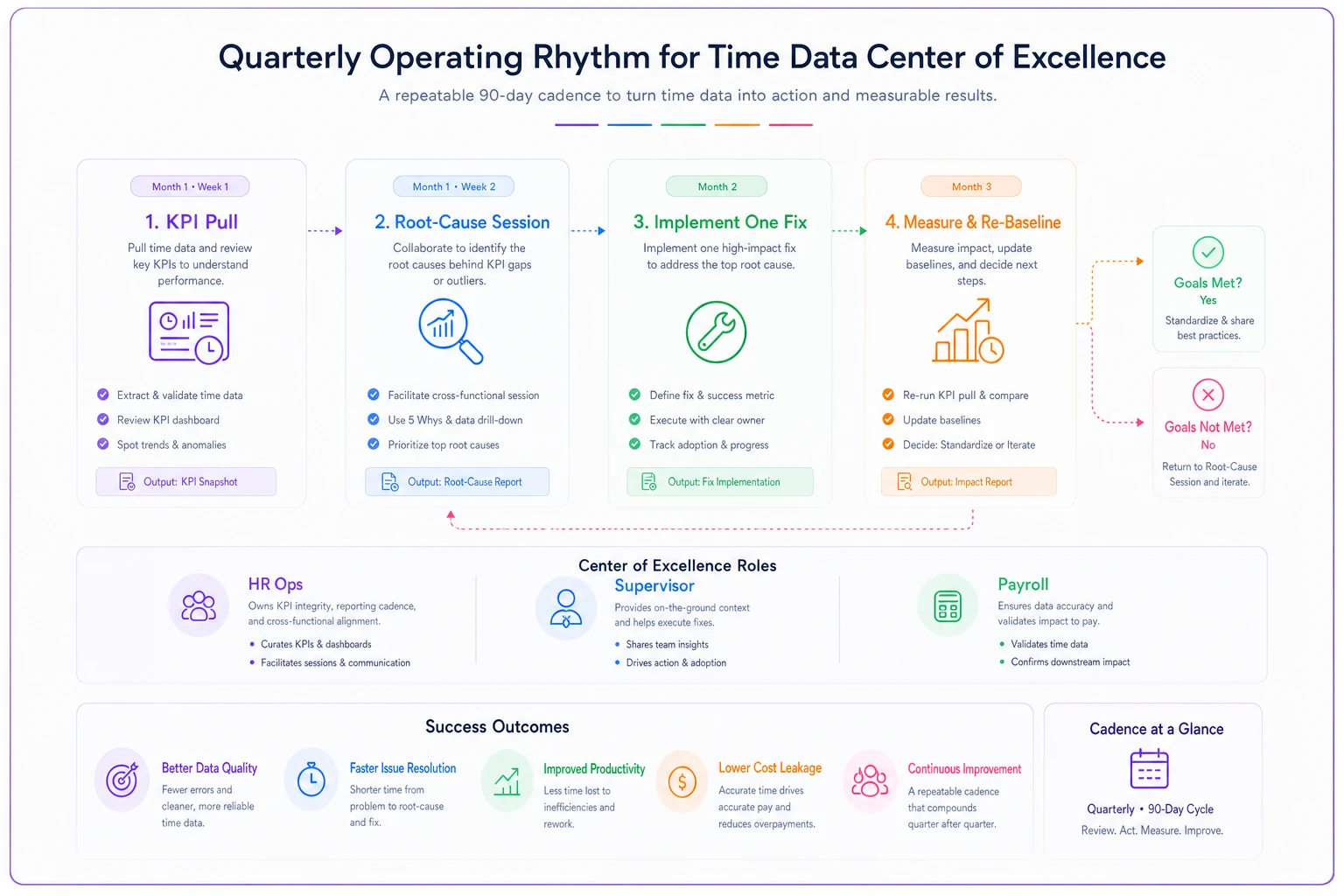
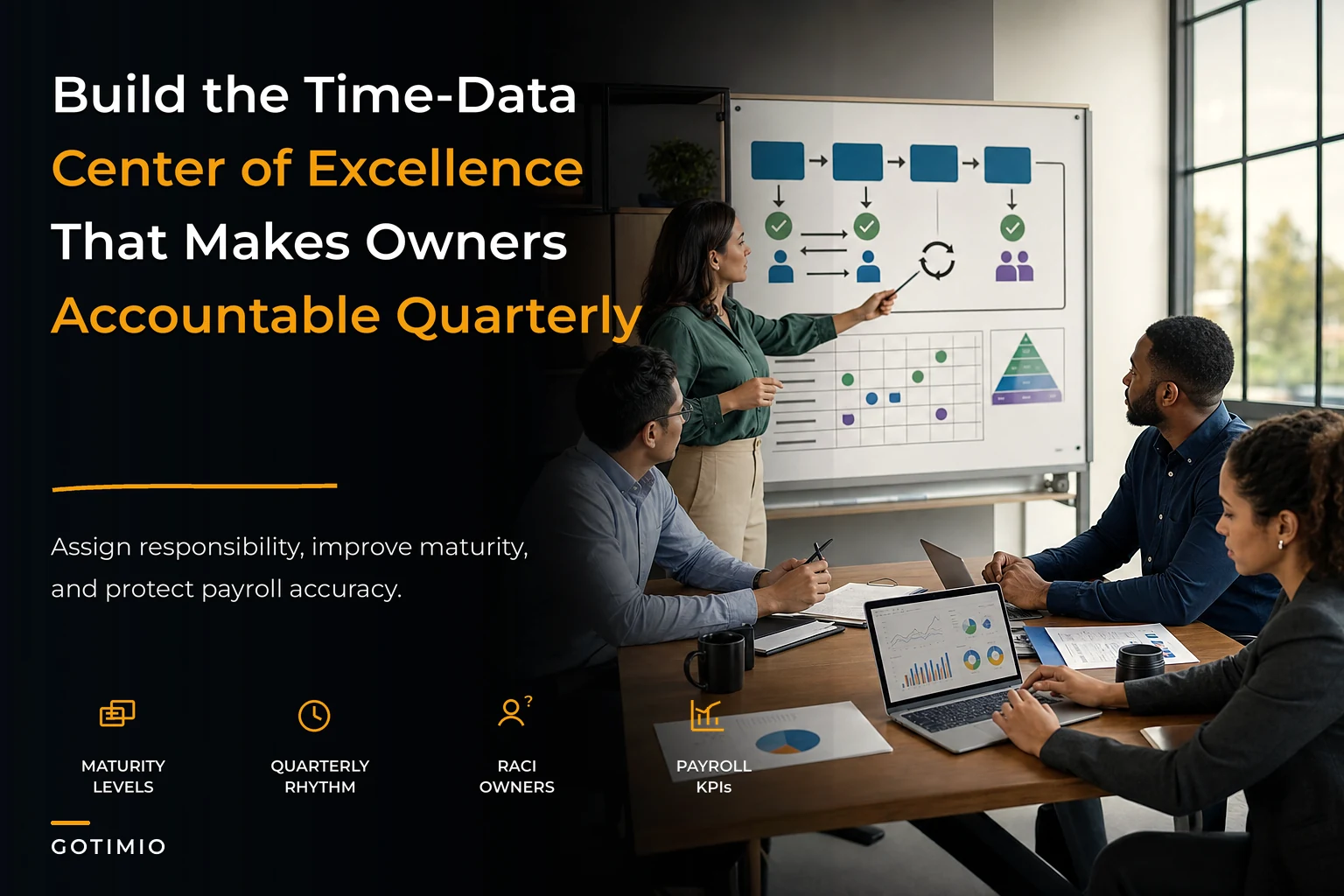
Use this visual in your quarterly review.
One more thing on rhythm: the KPI pull should be boring and automated. If someone spends two days manually assembling the quarterly numbers, the review will quietly get skipped the quarter someone's on vacation. Building repeatable data-quality checks that feed these metrics automatically is foundational — the approach in this data-quality playbook for time entries is the kind of plumbing that makes the operating rhythm sustainable instead of aspirational.
Playbooks for moving up a level
Getting from Reactive (1) to Managed (2): The single move is making exceptions visible before payroll processing, not during it. Practically, that means standing up an exception queue and defining what counts as an exception — missing punch, shift over X hours, GPS mismatch, unapproved edit. At this stage you don't need SLAs yet. You just need the queue to exist and someone to look at it before lock. The win is that payroll stops being the discovery mechanism.
Getting from Managed (2) to Defined (3): Now you add SLAs and written ownership — but the real work is enforcement. An SLA that nobody enforces is a suggestion. Define what happens on breach: an approval not done within 24 hours auto-escalates to the Accountable party. Document the RACI. Turn on automated data-quality checks so exceptions get created by the system, not by whoever happens to notice.
Getting from Defined (3) to Governed (4): The shift here is from resolving exceptions to eliminating their causes. This is where the quarterly root-cause rhythm earns its keep. If badge-vs-GPS mismatches are 30% of your queue, Governed means you fix the underlying cause — a location's poor GPS reception, an unclear policy — rather than resolving the same 40 tickets every month. You'll also want change control on config, because at this level your rules are stable enough that unmanaged changes are the main new source of noise.
Getting from Governed (4) to Optimized (5): At this point time data is trustworthy enough to drive decisions — labor cost per project, true overtime patterns, profitability. The playbook is mostly about lineage and trust: can you prove where a number came from, all the way back to the punch? Optimized isn't about more process. It's about the data being clean enough that leadership stops second-guessing it.
Here's a compact checklist for a quarterly maturity review, regardless of your level:
-
- [ ] KPI set pulled and compared to prior quarter
-
- [ ] Top 3 recurring exception categories identified
-
- [ ] Each RACI row still has exactly one Accountable owner
-
- [ ] Any SLA breaches from the quarter reviewed, with the escalation actually triggered
-
- [ ] One improvement selected, scoped, and assigned
-
- [ ] Last quarter's improvement measured for actual impact
-
- [ ] Maturity level re-assessed per dimension (don't assume it only goes up)
-
- [ ] Access/permissions still match assigned responsibilities
Working through this list quarterly takes maybe two hours. Skipping it costs you a payroll firefight you'll repeat indefinitely.
A real scenario: multi-site services company
A regional facilities-services company — roughly 180 employees across cleaning and maintenance crews, about seven job sites — was convinced they had a software problem. Every payroll run, the payroll admin spent two full days chasing corrections. GPS mismatches, missing punches from crews clocking in on spotty mobile connections, PTO that didn't line up with logged hours.
They'd assumed they needed to switch systems. What they actually had was a Level 1 ownership problem dressed up as a tooling problem. There was no exception queue. Supervisors weren't formally responsible for their crew's punches. The payroll admin was the entire safety net.
They did three things over two quarters. First, they built the RACI around lifecycle events and made each site supervisor Responsible for their crew's daily exceptions — with the access to actually resolve them. Second, they stood up an exception queue reviewed before the payroll lock, not during it. Third, they ran the quarterly root-cause session and found that a single job site with bad cell coverage was generating close to 40% of the GPS mismatches; they switched that crew to an offline-first capture flow.
The payroll admin's correction work dropped from roughly two days per cycle to a few hours. Post-close corrections went from a routine occurrence to rare. Nothing about the underlying software changed. They just assigned the seams and built a rhythm to keep improving them.
When this makes sense — and when it doesn't
When a center of excellence is worth it: You're past roughly 40–50 employees on time-tracked pay, you operate more than one location or crew, or you have a payroll integration where errors have real cost. The moment the time-to-payroll flow can't live in one person's head, you need structure.
When it's overkill: A single-location team of 15 with one manager who approves everything doesn't need a formal RACI and quarterly governance. You'd be building process for risk you don't actually have. For that team, a clean weekly review and one clear owner is the whole system. Don't cargo-cult enterprise governance onto a small operation.
Who should be careful: Companies mid-migration to a new system. Standing up a maturity program and swapping platforms at the same time splits your attention and muddies your metrics — you won't know whether an improvement came from the new tool or the new process. Stabilize the rollout first; the timekeeping adoption playbook covers sequencing so the two efforts don't collide. Then layer the governance on top of a stable base.
The real point
A time-data center of excellence isn't a title or a team. It's the decision to stop treating each missing punch, each late approval, each reconciliation gap as a surprise — and to instead name who owns each seam, measure how mature each part really is, and fix one real cause every quarter.
The companies that get this right aren't the ones with the fanciest software. They're the ones where, when something breaks in the time-to-payroll flow, there's never a moment of "wait, whose job was that?" That clarity is worth more than any feature list, and it's what most operations are actually missing when they think they have a tools problem.
A time-data center of excellence isn't a title or a team. It's the decision to stop treating each missing punch, each late approval, each reconciliation gap as a surprise — and to instead name who owns each seam, measure how mature each part really is, and fix one real cause every quarter.
Ready to optimize your workforce time management?
Join 2,000+ companies using GoTimio to improve timesheet accuracy, reduce payroll errors, and boost team productivity.