


Most time and attendance business cases die in the CFO's office for one reason: they lead with soft benefits. "Improved accuracy." "Better visibility." "Reduced administrative burden." Those phrases are poison in a finance conversation. A CFO doesn't fund vibes. They fund a model that ties a specific operational change to a specific line on the profit and loss statement, with assumptions they can stress-test without the whole thing falling apart.
This isn't a pitch. It's the actual model — the levers, the math, the sensitivity ranges, and the one-page slide structure that gets sign-off. If you're an HR manager or operations lead who has to walk into a budget meeting and defend a number, this is the framework that keeps you standing when finance starts poking holes.
Why time system ROI arguments usually fall apart
The failure pattern is pretty predictable. Someone estimates hours saved on payroll processing, multiplies by an hourly rate, and calls it savings. Finance immediately asks the killer question: "Are you eliminating those people, or are they just doing something else?" If the answer is "something else," that's not a cost saving — it's a productivity claim, and productivity claims don't show up on the P&L unless you can trace them to revenue or an actual headcount decision.
The second failure is optimism baked into a single number. A model that says "we'll recover $180k" with no range is one finance doesn't trust. What they want is a base case, a conservative case, and the assumptions that separate them. When you show the downside and it still clears the hurdle rate, you've largely won the argument before they can raise it.
The third failure is double-counting. People stack "time saved," "errors reduced," and "compliance improved" as if they're independent, when they're often the same dollar counted three different ways. A missed-punch correction that saves admin time, reduces an overpayment, and lowers audit risk is frequently one event — not three separate savings buckets.
A credible model does the opposite of all three: it isolates cash-visible impact, ranges every assumption, and refuses to count the same dollar twice.
Lever 1: Edit reduction (the one everyone underestimates and overcounts)
Timesheet edits are a quiet tax on payroll operations. Every correction is a manager approval, an HR touch, sometimes a retro adjustment, occasionally a downstream payroll rerun. The instinct is to value edits at the admin time they consume. That's real, but it's usually the smaller half of the cost.
Accurate time tracking made effortless.
GoTimio empowers your team to log, monitor, and manage work hours seamlessly.
- Real-time time tracking
- Automated timesheet approvals
- Payroll and billing integration
No credit card required
The larger half is the error rate riding along with those edits. A meaningful share of corrections aren't neutral — they shift pay. Some are legitimate underpayments being fixed; some are overpayments that would otherwise leak out the door. When first-pass accuracy improves, you're not just saving handling time, you're catching money that used to walk.
How to keep the edit-reduction number honest:
-
Count only the admin hours you'll actually reclaim or redeploy to revenue-relevant work — not theoretical minutes.
-
Separately estimate net overpayment leakage inside the edit population (this belongs partly in Lever 2, so tag it carefully to avoid overlap).
-
Value manager time at a blended loaded rate, not the HR admin rate, because most edit approvals bottleneck on supervisors.
A typical mid-size operation running 200–400 employees sees first-pass edit rates anywhere from 8% to 20% of timecards, depending on how messy the capture process is. Cutting that by even a third produces a meaningful handling-time reduction. If you want to understand the operational mechanics behind driving edits down at the source, this piece on turning tracked hours into defensible P&L pairs directly with this lever — the operational fix is what makes the financial number real.
Lever 2: Billing leakage recovery (the lever CFOs love)
This is what turns a cost-center project into a revenue conversation, and it tends to get the most attention in the room. Any business that bills clients for tracked time — agencies, professional services, field service, project shops — leaks billable hours through the gap between what was worked and what got invoiced.
Leakage shows up as:
-
Hours worked but never entered before the billing cutoff
-
Hours entered but written down during reconciliation because nobody trusts them
-
Rounding and grace behavior that quietly shaves billable time
-
Project misallocation that buries billable work in non-billable buckets
The recovery math is straightforward but you have to be conservative, or finance will discount it to zero. Take your annual billable base, estimate leakage as a percentage (2–5% is common and often understated), then assume you recover only a portion of it — because no system captures 100%.
A realistic example: a professional services firm billing roughly $6M a year in tracked hours, with an estimated 3% leakage rate, is bleeding around $180k. A conservative case might assume you recover only 40% of that — about $72k — because some leakage is behavioral and won't fully close with better software alone. Present the $72k, not the $180k. When you low-ball the recovery rate and it still funds the project, the CFO stops arguing.
The pre-billing discipline that captures this recovery is operational, not magical. It comes from tightening the reconciliation step before invoices go out, which is why leakage recovery only materializes when the capture-to-billing workflow is actually clean end to end.
Lever 3: Compliance fines avoided (probability-weighted, always)
This is the lever most people either ignore or wildly overstate. The honest way to model it is expected value: potential exposure multiplied by the probability of it hitting in a given year. A $500k wage-and-hour exposure with a 10% annual likelihood is a $50k expected cost — that's what belongs in the model, not the scary headline figure.
Where compliance exposure actually accumulates:
-
Rounding and grace-period practices that drift out of legal bounds
-
Break and meal-period tracking gaps
-
Overtime miscalculation across jurisdictions
-
Retroactive rate changes applied without a clean audit trail
-
Missing or inconsistent records when an auditor comes looking
The mistake is treating this as binary — "we might get sued." Finance thinks in distributions. Give them the expected value plus the tail risk as context: "Base case models $40k in probability-weighted exposure reduction; worst-case single-event exposure is north of $400k." That framing respects how they actually think about risk.
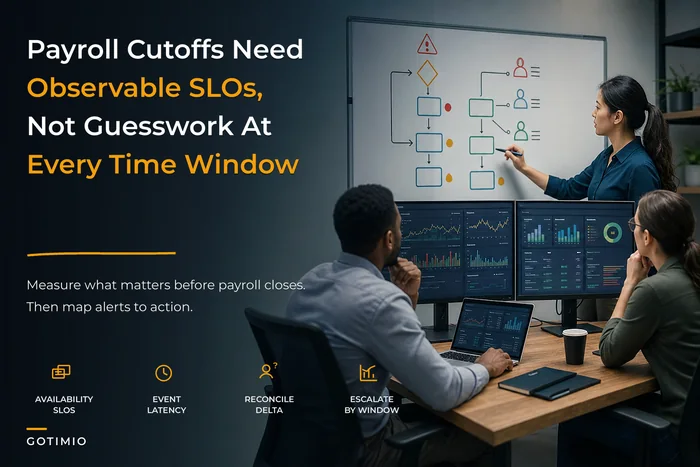
There's a coordination angle here too. Compliance exposure isn't reduced by a feature — it's reduced by the system reliably producing defensible records over time. If the time feed breaks silently or records go stale, your compliance posture degrades without anyone noticing. Treating time data reliability as an operational discipline — the way you'd approach payroll-aware service levels and observability for time systems — is what makes the fines-avoided number credible rather than aspirational.
Lever 4: Churn reduction (the softest lever — handle with care)
Late paychecks, wrong paychecks, and repeated pay disputes drive turnover, especially in hourly and shift-heavy workforces. Payroll errors are one of the more reliable ways to lose a good frontline employee. But this is the lever finance discounts hardest, so you model it with the most restraint.
Anchor it to a real, measurable cost of turnover — recruiting, onboarding, ramp time, lost productivity. Then attribute only a small fraction of turnover to pay-experience problems, because most turnover has nothing to do with payroll. If your annual replacement cost per hourly worker sits somewhere in the $3k–$5k range and you're replacing dozens of people a year, even shaving a handful of pay-driven departures produces a defensible number.
Keep this lever small on purpose. A CFO who sees a modest, believable churn number next to a large billing-recovery number trusts the whole model more. Over-inflate the softest lever and you contaminate the credibility of your hardest ones.
Putting the levers into a sensitivity table
Every lever gets a conservative, base, and optimistic case, and you present all three. The base case is what you're asking them to fund against; the conservative case is your defense.
| Lever | Conservative | Base | Optimistic | Notes / key assumption |
|---|---|---|---|---|
| Edit reduction (admin + net overpay) | $18k | $34k | $52k | Reclaimed handling time redeployed; overpay tagged to avoid overlap |
| Billing leakage recovery | $48k | $72k | $120k | Recovery rate 30–60% of estimated 3% leakage |
| Compliance fines avoided (EV) | $20k | $40k | $70k | Probability-weighted, not headline exposure |
| Churn reduction | $9k | $16k | $28k | Small attribution to pay-experience only |
| Total annual benefit | $95k | $162k | $270k | — |
The power of this table is that it argues against itself. When finance asks "what if you're wrong," you point at the conservative column that already assumed they were.
The payback calculation finance actually wants
Total benefit is only half the story. The CFO needs payback period and, ideally, a simple return figure. Keep the cost side complete — people routinely forget implementation labor and the internal time cost of rollout, which is where a lot of business cases quietly lose credibility.
PAYBACK CALCULATION WORKFLOW [Sum all first-year costs] Subscription + Implementation + Integration + Internal rollout labor | v [Separate ongoing annual costs for Y2 and Y3] Implementation drops off — model this separately or payback looks wrong | v [Use conservative benefit case only] Not base case — conservative. This is your defense number. | v [Simple payback] First-year net cost ÷ Conservative annual benefit = Months to break even | v [Build 3-year cumulative view] One-time implementation cost vs. compounding recurring benefit
This workflow shows the payback calculation steps.
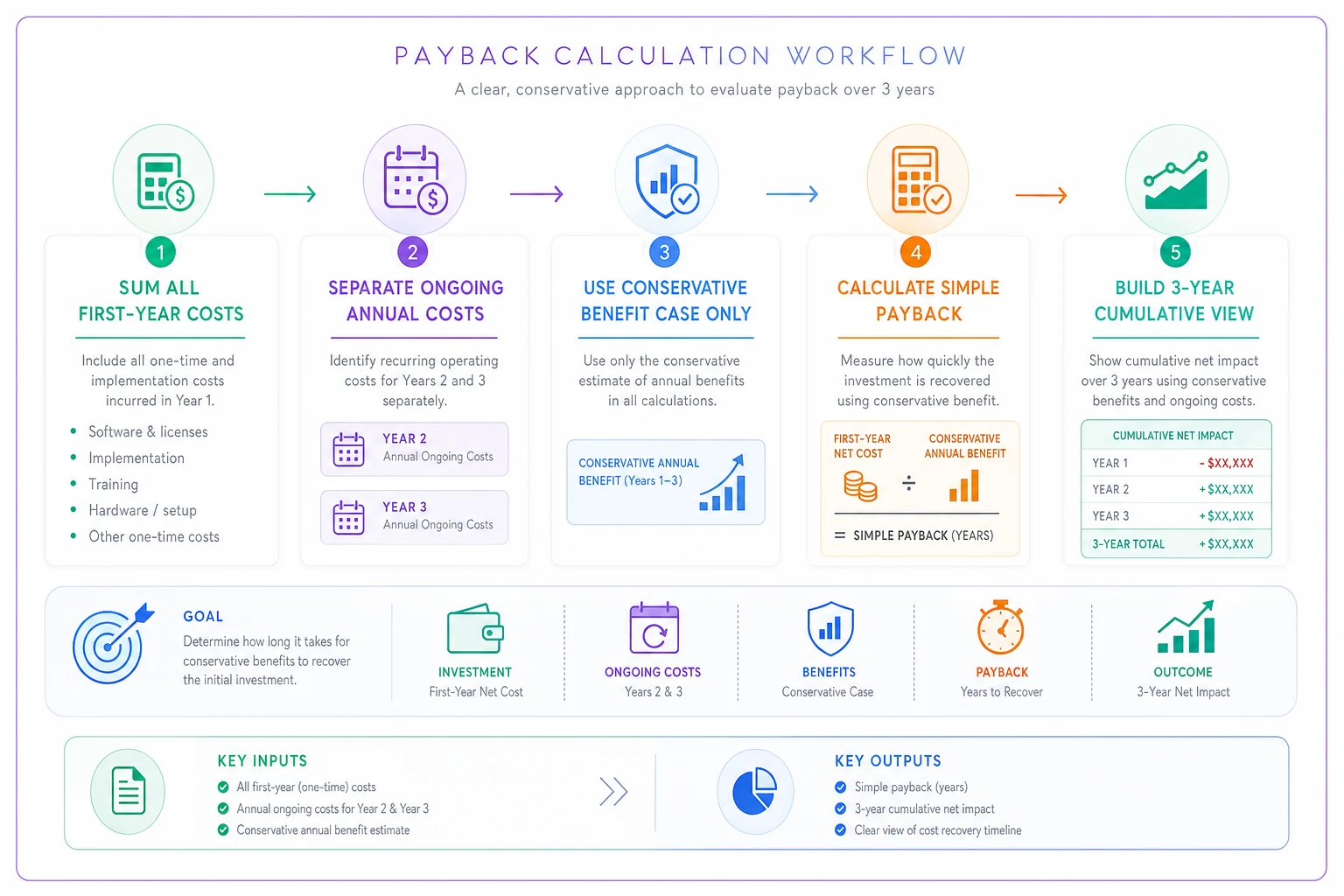
Plan deployment timelines conservatively to avoid slipping payback.
A common outcome: all-in first-year costs somewhere around $60k–$80k against a conservative benefit near $95k produces payback inside the first year even on the pessimistic case. That's the sentence you want the CFO to repeat back to you: "It pays back in under a year even if you're wrong."
One thing that quietly wrecks payback assumptions is a chaotic rollout that delays benefits by a quarter or two. If implementation drags, your payback slips and the model looks dishonest in hindsight. Planning the deployment carefully — along the lines of rolling out a new timekeeping system without payroll chaos — is what protects the timeline your ROI model promised.
The one-page exec slide (templated)
Executives don't read the model. They read one page. Build it in this order, top to bottom:
-
Headline outcome "Payback in under 12 months; conservative annual benefit ~$95k."
-
The four levers, one line each, with the base-case dollar figure.
-
The sensitivity band conservative / base / optimistic totals as a single row.
-
Total cost line first-year all-in, then ongoing annual.
-
Payback + 3-year cumulative in a single small chart or two numbers.
-
One risk + one mitigation name the biggest assumption and how you're de-risking it.
That's it. If it doesn't fit on one page, it's a reference document — and reference documents don't get funded in the meeting.
Sector variants (because the levers weigh differently)
The four levers exist in most businesses, but their relative size shifts hard by industry. Rebalancing them for the sector is what makes your case feel tailored instead of templated.
-
Professional services / agencies Billing leakage recovery is the dominant lever, often 50–70% of total benefit. Lead the slide with it. Compliance is secondary.
-
Manufacturing / warehousing Edit reduction and compliance dominate, especially with shift complexity and overtime rules. Billing leakage may be near zero. Churn matters more here than in most other sectors.
-
Healthcare Compliance and churn lead — high regulatory exposure plus expensive, hard-to-replace staff. Billing leakage exists where you bill for clinical time.
-
Field service / construction Billing leakage and edit reduction both run high because capture happens in messy, offline conditions. Compliance varies by jurisdiction exposure.
If you drop a generic model into a sector where the wrong lever leads, an experienced CFO notices immediately. A manufacturing CFO seeing "billing leakage recovery" as your top line will assume you copied a template — and you'll lose trust on everything else in the room.
When this business case actually makes sense — and when it doesn't
It makes sense when you have real billable-time leakage, a genuine compliance exposure, or a payroll error rate high enough that turnover and rework are visibly costing money. In those cases the model practically writes itself and the payback is short.
It's a weak case when you're a small salaried workforce with clean payroll, no billable time, and low regulatory exposure. If three of your four levers round to near-zero, don't force it. A thin model with padded numbers is worse than no model — it burns your credibility for the next ask.
Who should not lead with ROI at all: organizations where the real driver is risk or control rather than dollars. In those cases, lead with the exposure narrative and let the ROI model play a supporting role. Forcing a soft situation into a hard-dollar frame makes you look like you're reaching.
A short real scenario
A regional services firm — roughly 260 employees, mix of billable consultants and hourly support staff — was running a payroll process drowning in corrections. First-pass edit rate hovered around 15%, and the billing team routinely wrote down consultant hours before invoicing because nobody trusted the tracked numbers.
The model came in with a conservative first-year benefit near $110k: about $30k from edit and rework reduction, roughly $60k from recovering a fraction of billing leakage, and modest compliance and churn figures. All-in first-year cost landed around $70k. Payback cleared inside the first year on the conservative case, and by month nine the finance team could actually see the billing recovery showing up — invoiced hours crept up a few percent without anyone working more, because fewer hours were getting written down before invoices went out.
The number that sold it wasn't the biggest one. It was the conservative total surviving every question finance threw at it.
Bringing it together
A time system business case wins or loses on discipline, not enthusiasm. Isolate the four levers. Range every assumption. Refuse to count the same dollar twice. Present the conservative case as your primary defense and let it clear the hurdle on its own. Then compress the whole thing onto one page and rebalance the levers for the sector in front of you.
Do that, and the conversation shifts from "can we justify this cost" to "why haven't we recovered this money already." That's the position you want going into the budget meeting — with a model that argues its own downside and still comes out ahead.
Do that, and the conversation shifts from "can we justify this cost" to "why haven't we recovered this money already." That's the position you want going into the budget meeting — with a model that argues its own downside and still comes out ahead.
Ready to optimize your workforce time management?
Join 2,000+ companies using GoTimio to improve timesheet accuracy, reduce payroll errors, and boost team productivity.