

Most payroll rule engines don't break because someone wrote bad logic. They break because someone changed the logic on a Tuesday afternoon, told nobody, and the change didn't surface until the following payroll run when 40 people got shorted overtime. The engineering was fine. The governance was missing.
That's the gap this charter is built to close. A payroll rule engine — overtime tiers, shift differentials, rounding logic, meal-penalty triggers, blended rates — is one of the few systems in a company that can silently move real money into or out of employee bank accounts. And yet in most small and mid-sized businesses, the process for changing those rules looks nothing like the process for, say, changing a customer's credit terms. One requires three approvals. The other requires a person with admin access and a free hour.
The point of automation governance for payroll rule engines isn't to slow anyone down. It's to make sure that every rule change carries proof of why it was made, who signed off, what evidence backed it, and how you'll know afterward whether it worked. That's the difference between "we deployed a config change" and "we made a governed payroll decision."
Why rule changes escape governance in the first place
Time-and-attendance platforms are usually configured by an ops-savvy HR person or an admin who's genuinely good at the tool. They can change a rounding threshold or add a new overtime tier in a few clicks. And because they can, the change stops looking like a policy decision and starts looking like a settings tweak.
Compare that to how the same company handles a general-ledger change. Nobody in finance edits a GL mapping without a ticket, a reviewer, and a note explaining the business reason. Payroll rule engines deserve the same treatment, but they rarely get it because the interface feels lightweight. A dropdown doesn't feel like a $200k-a-year decision. It often is.
-
The number of jurisdictions goes up, so rules multiply — California meal penalties, different overtime thresholds, union rules, local sick-leave accrual.
-
More people get admin-adjacent access, so the "one person who knows everything" bottleneck turns into "several people who each know a piece."
-
Nobody remembers why a rule was set a certain way two years ago, so changes get made on top of logic no one fully understands.
The first serious payroll incident is almost never a big dramatic bug. It's a small, plausible-looking change — someone "fixed" a rounding rule to be more generous, and three months later finance notices labor cost crept up 2–3% with no headcount change. By then it's blended across dozens of pay periods and painful to unwind.
What a governance charter actually needs to define
A charter is not a policy document that lives in a shared drive and gets read once. It's the connective tissue between the board's (or owner's) appetite for risk and the person clicking buttons in the timekeeping system. If it works, it does four things at once:
Accurate time tracking made effortless.
GoTimio empowers your team to log, monitor, and manage work hours seamlessly.
- Real-time time tracking
- Automated timesheet approvals
- Payroll and billing integration
No credit card required
-
Sets risk tolerances — how much payroll exposure is acceptable before a change needs heavier scrutiny.
-
Ties those tolerances to approval gates — who has to sign off, based on the size of the risk.
-
Requires evidence — proof that the change was tested, reconciled, and reviewed.
-
Defines assurance — the recurring checks that confirm the rule is still behaving after it goes live.
All four have to sit in one document because they fail as a chain, not individually. Strong approvals with no post-change assurance means you catch bad decisions but never verify good ones stayed good. Great evidence requirements with no risk tolerance means you drown a $50 rounding fix in the same paperwork as a company-wide overtime restructure.
The risk-tiered approval matrix
The core of the charter is a matrix that maps how much a rule change can move to how many people have to agree to it. Payroll impact is the cleanest way to tier this — estimated dollar exposure per pay period, plus a compliance-risk flag for anything touching a regulated area (overtime, meal/rest, minimum wage, tax withholding logic).
Below is a working version you can adapt. The dollar bands should scale to your payroll size; a 300-person company and a 3,000-person company shouldn't use the same thresholds.
| Risk tier | Trigger | Approval gate | Evidence required | Rollback plan |
|---|---|---|---|---|
| Tier 0 – Cosmetic | No pay impact (labels, display, report formatting) | HR admin self-approve, logged | Change note + screenshot | Not required |
| Tier 1 – Low | Est. impact under ~$2k/period, no compliance flag | HR admin + payroll lead | Test-case results, before/after sample of 5+ employees | Config snapshot |
| Tier 2 – Moderate | ~$2k–$15k/period, or touches overtime/rounding logic | Payroll lead + HR manager + finance reviewer | Parallel-run reconciliation, jurisdiction check, sample of 20+ | Documented rollback + verified snapshot |
| Tier 3 – High | Over ~$15k/period, or any compliance-regulated rule | Add CFO/owner sign-off | Full parallel run, legal/compliance review, audit-log export | Tested rollback with restore verification |
| Tier 4 – Structural | Cross-jurisdiction, union, or company-wide rate logic | Executive committee + written sign-off artifact | Everything in Tier 3 + phased rollout plan + assurance schedule | Staged rollback per rollout phase |
One thing people consistently miss: the tier is decided by the estimated impact, and estimating that impact is itself part of the discipline. If someone can't estimate what a rule change will do to payroll, that's not a reason to skip the tiering — it's a reason to bump it up a tier. Uncertainty is risk.
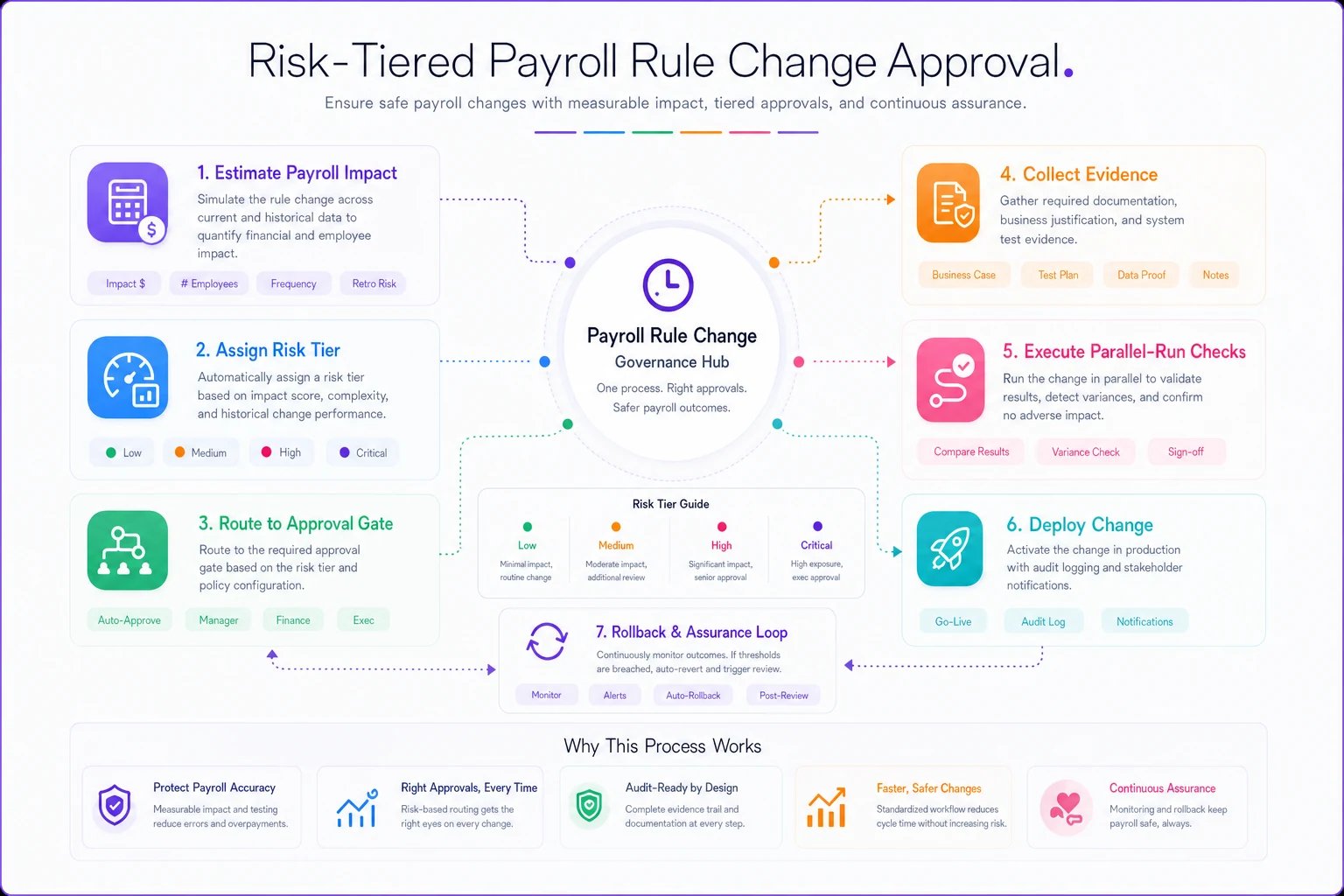
Below is a visual workflow of how a risk-tiered approval process routes a rule change from estimation through approval, evidence collection, deployment, and rollback.
A quick note on compliance flags overriding dollar bands: a change that only affects three employees but touches meal-penalty logic in California is a Tier 2 or 3 regardless of the small dollar amount, because the regulatory exposure and potential class-action math don't care about your per-period number.
Evidence requirements: what "proof" means
Evidence is where a real charter separates from a checkbox exercise. The standard isn't "we tested it." It's "we can hand an auditor, or an angry employee, or a wage-and-hour investigator a folder that shows exactly what changed, why, and what we verified."
For most Tier 2+ changes, the evidence bundle should include:
-
The business reason, in plain language — not "updated OT rule" but "new state law effective Jan 1 requires daily OT above 8 hours; previous config only applied weekly OT above 40."
-
Before/after configuration snapshot so the exact prior state is recoverable.
-
A parallel-run reconciliation — run the old rule and new rule against the same real time data and diff the results. This turns "we think it works" into "here are the 14 employees whose pay changes and by how much."
-
A jurisdiction check confirming the change is correct for every location it applies to.
-
The audit-log export showing who made the change and when.
-
Sign-off records from each required approver.
That parallel-run step deserves emphasis. A typical example: a company updates a shift-differential rule and runs it against the last full pay period of real punches. The diff shows 22 employees affected, total delta of about $1,900, all in the expected direction. Nobody unexpected shows up — clean signal to proceed. When the diff instead shows 60 employees affected, including salaried staff who shouldn't be touched at all, that's the change catching a bug before payday instead of after.
Getting evidence right also depends on the underlying access model. If you can't reliably prove who had the ability to make a change, your audit log is only half the story. This is where a clean policy-to-configuration RBAC setup with separation of duties does a lot of quiet work — the person who requests a rule change shouldn't be the same person who approves and deploys it.
KPIs that make assurance measurable
Approvals and evidence handle the decision. KPIs handle the aftermath — and this is where most governance efforts quietly die. Everyone's diligent about the change itself, then nobody watches whether the rule kept behaving three months later.
The KPIs worth tracking fall into a few buckets:
-
Change accuracy
percentage of rule changes that required a follow-up correction within two pay cycles. If this climbs above single digits, your evidence requirements aren't tight enough.
-
Off-cycle correction volume and dollar value
how much money you're moving after payroll runs to fix things. This is the clearest downstream signal that a rule change went wrong.
-
Approval cycle time
how long changes sit waiting for sign-off. Governance that takes three weeks gets bypassed, so this is a health metric for the process itself.
-
Unauthorized-change count
rule changes that appear in the audit log without a matching approval record. This number should be zero. Anything above zero is a live incident.
-
Assurance coverage
percentage of high-tier changes that got their scheduled post-deployment review on time.
The metric that predicts trouble earliest is usually approval cycle time, not accuracy. When cycle time spikes, people start routing around the gates — self-approving, batching changes to avoid scrutiny, or making changes "temporarily" that never get formalized. The accuracy problems show up a quarter later. Watching cycle time gives you a head start.
For teams that already run payroll-aware SLOs and operational observability, these governance KPIs slot in as their own dashboard rather than something separate — the same escalation logic that watches for late time feeds can watch for a rule change with no approval artifact.
The quarterly assurance cadence
Assurance is the recurring rhythm that keeps the charter honest. Treating it as an annual audit is a mistake — payroll rules drift too fast. Laws change, someone makes a quick fix, a jurisdiction gets added. Quarterly is the right beat for most mid-sized operations.
A practical quarterly cycle looks like this:
-
Pull every rule change from the last quarter and match each one to its approval record and evidence bundle. Any change without a complete bundle gets flagged.
-
Re-run a sample of live rules against real time data to confirm they still produce expected results. Rules can break not because they changed, but because the data feeding them changed.
-
Review the KPI trend, not just the current number. A correction rate of 4% isn't alarming on its own — a correction rate that went 1% → 2% → 4% over three quarters is.
-
Review who has change access and whether that still matches their role. Access accumulates; people change teams and keep old permissions.
-
Produce an executive sign-off artifact — a short, dated summary of what was reviewed, what was found, and what's being remediated, signed by whoever owns payroll risk.
That last artifact matters more than it looks. In a dispute or audit, it's the thing that proves governance was operating, not just documented. There's a real difference between "we have a policy" and "here are four consecutive quarterly reviews showing we followed it."
Policy template: the minimum viable charter
You don't need a fifty-page document. A working charter can fit on a few pages and still hold up. The structure:
-
Scope — which systems and rule types this covers (time capture, overtime, rounding, differentials, accruals, rate blending).
-
Risk appetite statement — one or two sentences on how much payroll exposure the business will tolerate before mandatory executive review. This is the board/owner's contribution, and it's what everything else hangs off.
-
The tier matrix — approvals, evidence, rollback by tier.
-
Evidence standards — what a complete bundle contains for each tier.
-
Roles — who requests, who approves, who deploys, who assures. Keep these separated.
-
KPI definitions — how each metric is calculated and its threshold.
-
Assurance cadence — quarterly steps and the sign-off artifact format.
-
Exception handling — how genuine emergencies (a legal deadline, a critical bug) get an expedited path without skipping evidence entirely.
That exception clause is where charters either stay realistic or become theater. Real operations have emergencies. If your charter has no fast lane, people will invent one — and it'll have no controls. A reasonable expedited path might allow a single senior approver plus mandatory retroactive evidence within 48 hours. Faster, but never invisible.
A real scenario
A regional home-services company, roughly 220 field employees across two states, kept having small payroll disputes — a few employees each cycle claiming overtime was off. Each dispute was minor, maybe $30–$80, but there were 6–10 every pay period and each one ate manager time to research.
When they finally traced it, the cause wasn't fraud or a big bug. It was three separate overtime rule changes made over about eight months, none documented, each made by a different admin trying to fix a complaint. The changes partially contradicted each other. One added daily OT for one location; another adjusted the weekly threshold globally; a third tweaked rounding. Stacked together, they produced edge cases nobody could explain.
They introduced a lightweight version of the charter above — a two-tier matrix, a mandatory parallel-run for anything touching OT, and a quarterly review. The rebuild took about six weeks, mostly spent reconstructing why rules were the way they were. After the cleanup, off-cycle corrections dropped from that steady 6–10 per period down to one or two, and the ones that remained were legitimate edge cases with clear paper trails.
The bigger win was quieter: the next time a state law changed, the update took one governed afternoon instead of a month of guessing.
When this level of governance makes sense — and when it doesn't
When it's clearly worth it: you operate in more than one jurisdiction, you have union or complex overtime rules, more than one person can change payroll logic, or you've already had an off-cycle correction that made someone nervous. Any of those and the charter pays for itself the first time it catches a bad change before payday.
When it's overkill: a very small single-location business with one person who owns payroll end to end, simple hourly-plus-overtime logic, and rules that essentially never change. For them, a lightweight change log and a habit of reconciling one sample before each run is enough. Building a five-tier matrix would be governance for its own sake.
Who should be careful: fast-growing companies that are about to cross into multi-state or higher headcount. The trap is waiting until after an incident. Governance is far cheaper to build when you have 15 rules than when you have 90 and can't remember why half of them exist.
Where this connects to everything else
A rule-engine charter doesn't stand alone. It leans on your access controls, your observability, and — importantly — on the privacy and consent framework governing the underlying time data, since rule changes often affect what gets calculated from sensitive employee records. If you haven't formalized that layer, the employee time-data governance framework for privacy and consent is the natural companion piece; the two charters share the same DNA of approvals, evidence, and recurring review.
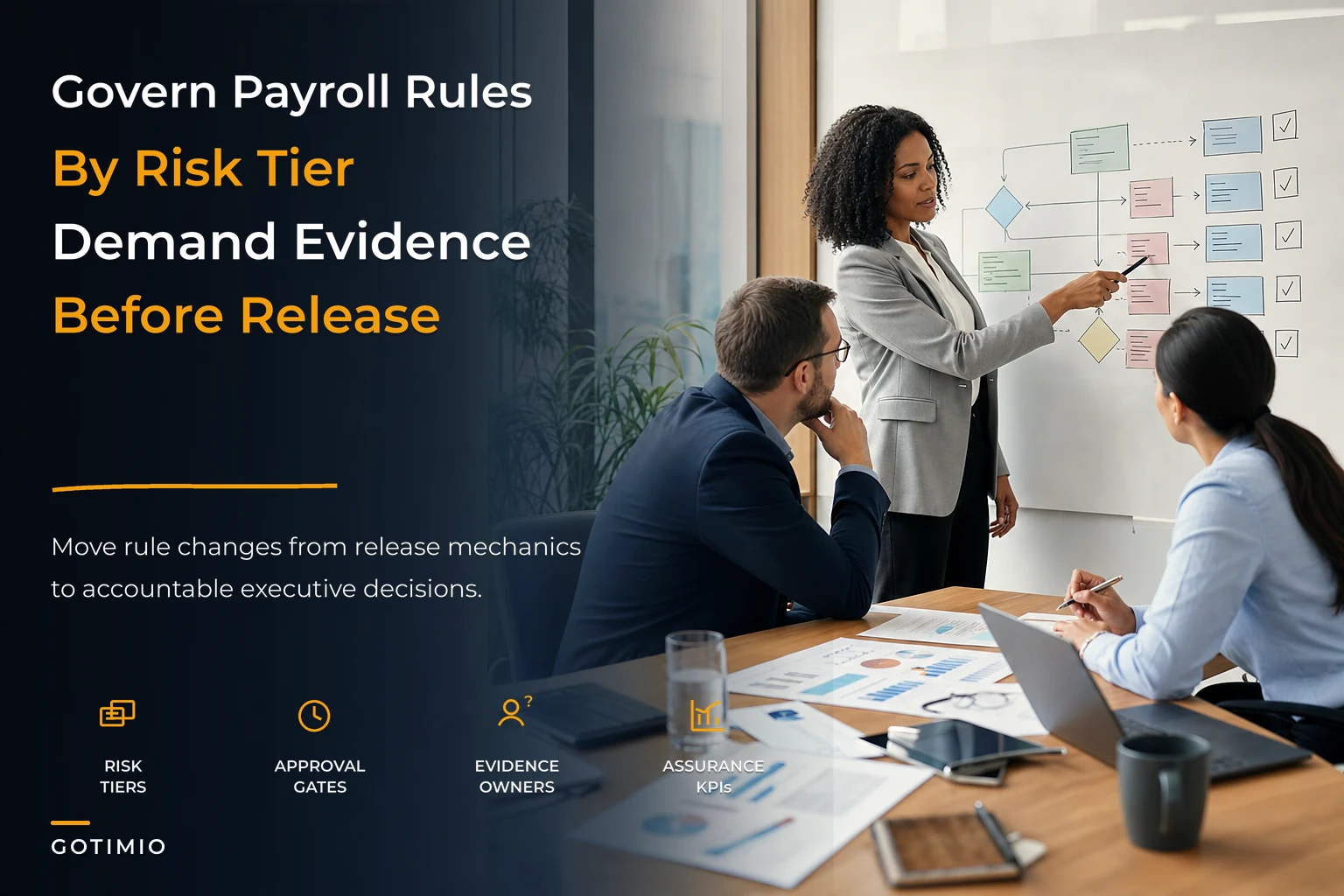
The larger shift here is one of framing. Most teams treat a payroll rule change as a release-mechanics problem — something that lives in the deployment process, alongside every other config tweak. The whole argument of this charter is that it's a decision, one that moves money and carries legal weight, and decisions deserve gates, proof, and follow-up.
Automation makes the change easy to execute. Governance is what makes it safe to execute at scale. The businesses that get this right aren't the ones with the fanciest rule engines — they're the ones who can tell you, for any rule, exactly who decided it, why, and how they know it still works.
Ready to optimize your workforce time management?
Join 2,000+ companies using GoTimio to improve timesheet accuracy, reduce payroll errors, and boost team productivity.