

Most companies treat workforce analytics models like a dashboard feature. Someone builds a scheduling optimizer or an overtime predictor, it gets wired into the payroll flow, and then nobody owns it. The data science team thinks HR owns the outputs. HR assumes finance validated the numbers. Finance has no idea a model even touches payroll until a bad pay run surfaces at month-end close.
That gap is where real money leaks. A forecasting model that quietly drifts can over-schedule a department by 6–8% for weeks before anyone notices — and by then you've already paid for it. A schedule-change automation that fires without a human gate can push hundreds of shift edits into payroll that nobody signed off on. These aren't exotic failures. They're governance failures. The model works fine technically, but nobody connected its behavior to the P&L line it affects.
This is a playbook for closing that gap. Not model theory. The boring, defensible plumbing that connects model governance workforce analytics work to payroll controls, finance sign-off, and legal exposure — with artefacts you can actually hand to a CFO.
The core problem: models touch payroll, but payroll controls ignore models
Payroll already has mature controls. Approval matrices, reconciliation steps, separation of duties, audit logs. Finance built those over decades because payroll errors are expensive and legally dangerous.
Workforce analytics models bypass almost all of it.
When a forecasting model recommends staffing levels, or a swap-optimizer reshuffles shifts, or an anomaly detector flags (or fails to flag) a pay exception, it's influencing payroll outcomes — but it sits completely outside the control environment payroll finance teams actually trust. There's no sign-off on the model. No reconciliation of its predictions against actuals. No defined owner when it misbehaves.
-
A model's output gets treated as ground truth and flows straight into scheduling or pay with no human checkpoint.
-
The model slowly drifts as the business changes — new locations, new shift patterns, a seasonal spike — and accuracy degrades without triggering anything.
-
When something breaks, nobody can reconstruct which version of the model made which decision on which pay period. The audit trail stops at the payroll system and never reaches the model.
The fix isn't more sophisticated modeling. It's wrapping the model in the same kind of controls payroll already has, and making those controls legible to the people who own financial risk.
Payroll-linked model cards: the artefact finance can actually read
Standard model cards are written for data scientists. They document training data, features, performance metrics. Useful internally, but a CFO or payroll manager can't do anything with "F1 score 0.87."
Accurate time tracking made effortless.
GoTimio empowers your team to log, monitor, and manage work hours seamlessly.
- Real-time time tracking
- Automated timesheet approvals
- Payroll and billing integration
No credit card required
A payroll-linked model card reframes the same model around the money and the controls. Same document, different audience.
Here's the structure that actually gets used:
| Section | Standard model card | Payroll-linked model card |
|---|---|---|
| Purpose | "Predicts weekly staffing demand" | "Drives schedule recommendations affecting ~1,200 weekly shift-hours and ~$X in weekly labor cost" |
| Inputs | Feature list | Which payroll/time systems feed it, and what breaks if those feeds are late or malformed |
| Performance | Accuracy metrics | Accuracy expressed as payroll impact — e.g. "a 5% over-forecast = roughly $4k–$6k extra weekly labor" |
| Failure modes | Technical edge cases | What a wrong output does to pay, compliance, and P&L |
| Control gates | Usually absent | Where humans approve, what gets auto-applied, what's blocked |
| Owner | Model author | Named business owner + escalation path |
The key shift is expressing model performance in payroll units, not statistical ones. When your forecasting model is 92% accurate, nobody in finance knows if that's good or not. When you tell them "the 8% error band translates to roughly $5k of weekly labor variance per site," they can decide whether that's acceptable risk. That translation is the whole job.
One pattern worth borrowing: tie each model card directly to the time-data feeding it. If your forecasting model depends on clean capacity signals, the card should reference those upstream assumptions — this connects naturally to a broader workforce forecasting framework for operational capacity planning, because a model is only as governable as the data pipeline underneath it.
Drift thresholds mapped to payroll KPIs, not model metrics
Most drift monitoring watches statistical distributions — feature drift, prediction drift, that sort of thing. The problem is that a statistically "drifting" model might have zero payroll impact, while a statistically "stable" model can quietly cost you money because the business changed around it.
Map drift thresholds to payroll KPIs instead.
A practical setup: pick the payroll outcomes the model is supposed to influence and define thresholds in those terms.
-
Forecast-to-actual labor variance. If predicted labor hours diverge from actuals by more than, say, 7% for two consecutive weeks at any site, the model gets flagged — regardless of what the internal metrics say.
-
Overtime surprise rate. If the share of overtime the model failed to anticipate climbs past a threshold, that's drift that costs real money.
-
Schedule-change volume. If an optimizer starts generating substantially more edits than its baseline, something shifted — either the data or the model's behavior.
-
Exception rate at payroll close. If model-driven pay items generate more manual corrections than usual, the model is degrading in a way that directly loads work onto payroll.
Drift that doesn't move a payroll KPI isn't worth paging anyone about. Drift that does move one is worth escalating even if the model metrics look fine. Thresholds expressed in dollars and hours survive contact with finance. Thresholds expressed in KL-divergence do not.
This is also where observability discipline pays off. The same escalation rigor you'd apply to a late time feed should apply to a drifting model — both are failures that corrupt payroll if nobody catches them. If you've already built payroll-aware SLOs for your time systems, extend that catalogue to cover model-driven outputs as first-class signals, not separate dashboards nobody checks.
Human-in-the-loop approval gates for automated schedule changes
The single most dangerous pattern is letting a model apply schedule changes straight into the payroll-feeding system with no gate. It feels efficient. It's a liability.
That said, not every change needs a human — gate everything and you've just rebuilt manual scheduling with extra steps. The trick is tiering the gates by payroll impact.
A tiered approval model that works in practice:
-
Auto-apply, logged. Low-impact changes — a swap between two equally-paid employees on the same shift tier, no overtime implication, no premium pay trigger. The model applies it, logs it with full lineage, no human needed. These are the majority.
-
Auto-apply with notification + reversal window. Moderate changes that stay within budget but touch something sensitive — reshuffling within a department near a threshold. Applied automatically, but a supervisor gets notified and has a defined window to reverse before it hits the pay calculation.
-
Hold for approval. Anything that creates overtime, crosses a premium-pay boundary, pushes a site over its labor budget, or affects a flagged employee. The change sits in a queue. A named approver signs off or rejects. Nothing flows to payroll until they do.
-
Hard block. Changes that would violate compliance rules — rest-period breaches, maximum-hours limits, consent constraints. The model cannot apply these, full stop, with no override without a documented exception.
Gate the write, not the suggestion.
Each gated decision needs a few required fields logged: model version, input snapshot, the recommendation, who approved or rejected, timestamp, and the resulting payroll delta. That's what makes the whole thing defensible later. And because these gates touch employee schedules directly, they need to respect the consent and privacy boundaries you've already defined — a time-data governance framework for privacy and consent should constrain what a model is even allowed to act on before you start worrying about approval tiers.
A CFO-friendly risk matrix: model failures mapped to P&L and legal outcomes
This is the artefact that actually gets executives to fund the work. Not a technical risk register — a matrix that maps each model failure mode to its financial and legal consequence, in language a CFO cares about.
| Failure mode | What happens operationally | P&L impact | Legal/compliance exposure | Likelihood | Control |
|---|---|---|---|---|---|
| Over-forecast staffing | Too many people scheduled | Direct labor overspend, weekly | Low | Medium | Drift threshold on labor variance |
| Under-forecast staffing | Understaffing, reactive overtime | OT premium costs, service failures | Low–Med | Medium | Overtime-surprise KPI gate |
| Silent drift after business change | Degrading accuracy, no alert | Compounding variance over weeks | Low | Med–High | KPI-mapped drift monitoring |
| Auto-applied bad schedule change | Unapproved pay-affecting edits | Overpayment / clawback cost | Med–High | Medium | Human-in-the-loop write gate |
| Compliance-violating recommendation | Rest/hours rule breach | Fines, back-pay, litigation | High | Low–Med | Hard-block gate |
| Lost model-decision lineage | Can't explain a pay outcome | Audit findings, dispute cost | Med | Medium | Logged decision artefacts |
The value of this matrix is that it forces a conversation finance can actually lead. They can look at "compliance-violating recommendation → fines and litigation" and immediately understand why the hard-block gate isn't optional. They can look at "silent drift → compounding variance" and decide how tight the threshold should be. You've translated model risk into the only two dimensions executives actually govern by: money and legal exposure.
One honest note — don't over-quantify the likelihood column. Precise probabilities on model failures are mostly fiction. Low/Medium/High bands that the team agrees on are more useful than a false-precision percentage nobody believes anyway.
Runnable tests and sign-off artefacts
Governance that lives in a slide deck decays immediately. What makes it stick is tests that run on a schedule and sign-off artefacts that gate deployment.
The tests you actually want running before any model version touches payroll:
-
Payroll-impact regression. Run the candidate model against the last few closed pay periods. Does it reproduce outcomes within tolerance? A new version that would have changed last month's labor cost by more than the threshold doesn't ship without review.
-
Threshold-breach simulation. Feed it inputs designed to trip each gate. Confirm overtime recommendations actually get held, compliance violations actually get blocked. Test the gates, not just the model.
-
Lineage completeness. For a sample of decisions, confirm every required audit field is captured. A decision you can't reconstruct is a decision you can't defend.
-
Feed-failure behavior. Simulate a late or malformed time feed. Does the model fail safe (hold, don't auto-apply) or fail open (apply garbage)? It must fail safe.
The sign-off artefact ties it together. Before a model version goes live, a short record gets signed:
-
Model version and card reviewed — data/analytics owner
-
Payroll-impact tests passed within tolerance — payroll lead
-
Risk matrix reviewed, no new high-exposure modes — finance
-
Compliance gates verified — HR/compliance
-
Approved for production, with effective pay period — accountable executive
That five-signature record is unglamorous and it's exactly what an auditor or a disputing employee's lawyer will ask for. "Who approved the model that generated this pay outcome, and on what basis?" If you can answer that with a signed artefact in under five minutes, you're in good shape.
Audit export templates that actually reconstruct a decision
When a dispute or audit lands, the question is always specific: why did this employee's schedule change on this date, and what did it do to their pay? Your export has to answer that end-to-end.
A usable audit export for a single pay-affecting decision contains: the pay period, the employee(s) affected, the model version and card reference, the input snapshot that drove the decision, the recommendation, which gate tier it hit, who approved or rejected it with timestamp, and the resulting payroll delta. One row, one reconstructable story.
The common mistake is exporting model logs and payroll logs separately and expecting someone to join them under pressure. They won't match cleanly, the timestamps will be off, and you'll spend three days reconstructing something that should have been one query. Build the join at decision time — stamp the model version and decision ID onto the payroll record as it's written. The lineage has to be born connected, not reassembled later.
A sample approval workflow HR and payroll can run
Here's how the pieces fit into an actual weekly rhythm.
The model generates its scheduling recommendations mid-week for the upcoming period. Low-impact changes auto-apply and log. Moderate ones apply with supervisor notification and a reversal window. Anything hitting overtime, premium pay, budget overage, or a flagged employee drops into an approval queue.
A payroll or HR approver works the queue daily — not as a bottleneck, but as a filter. Each item shows the recommendation, the estimated payroll delta, and the reason it was held. Approve, reject, or modify. Each action is logged with the required fields automatically.
In parallel, drift monitors run against the payroll KPIs. If labor variance or overtime-surprise crosses threshold, the model owner gets notified and the model can be dialed back to recommendation-only mode — it suggests, but nothing auto-applies — until it's re-validated.
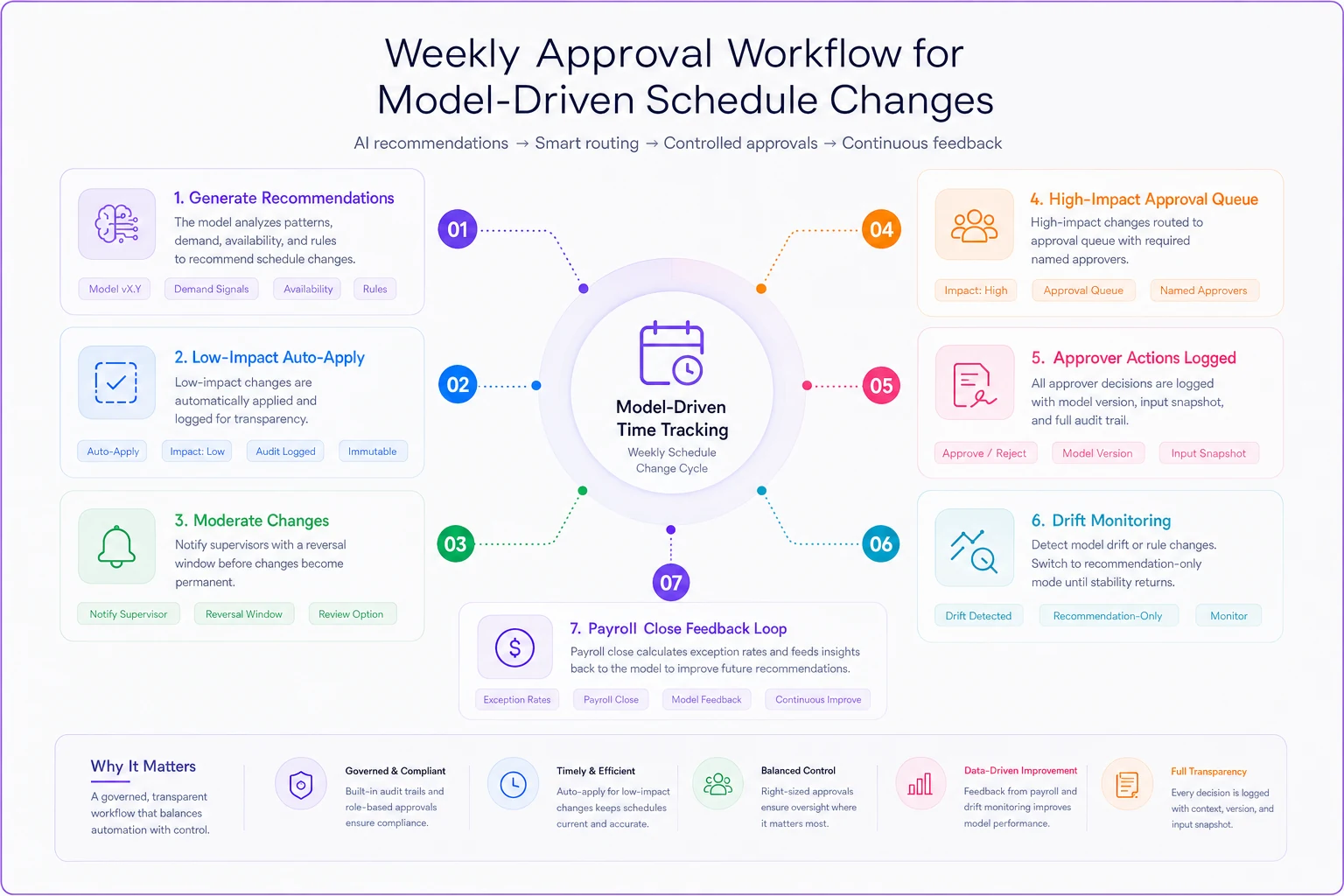
This diagram shows the weekly rhythm and who acts at each gate.
At payroll close, the exception rate from model-driven items feeds back into the drift signal. A spike in corrections on model-touched pay is itself evidence the model is degrading, and it closes the loop between operations and governance.
When this level of governance makes sense — and when it's overkill
This makes sense when: models are directly influencing pay-affecting decisions, you're operating across multiple sites or jurisdictions, labor is a large share of cost, or you're in a regulated environment where a bad schedule can become a legal problem. Once a model can move real money without a human in the loop, you need the controls.
This is overkill when: your "model" is really a simple rule that a person reviews anyway, your headcount is small enough that every pay run already gets eyeballed, and the worst-case error is a few hours of labor you'd catch at close. Don't build a five-signature sign-off process for a spreadsheet forecast two people check by hand.
Who should not do this yet: teams that haven't gotten their underlying time data clean and reconciled. Governing a model that runs on unreliable inputs is governing the wrong layer. Fix the feed and the reconciliation first — a well-documented wrong answer is still wrong.
A short real scenario
A regional services company — around 14 sites, close to 600 hourly staff — rolled out a scheduling optimizer tied into their time and payroll flow. It worked well for a quarter. Then they opened three new locations with different shift patterns, and the model's assumptions quietly stopped matching reality.
Nothing alarmed. The model metrics still looked healthy. But forecast-to-actual labor variance crept up, and because changes were auto-applying, the drift flowed straight into pay runs. By the time a manager noticed the overspend, they were roughly 6–7% over labor budget across the new sites for about five weeks — somewhere in the low tens of thousands before anyone connected it to the model.
The fix wasn't a better model. They added a KPI-mapped drift threshold on labor variance, moved overtime-generating and new-site changes behind an approval gate, and started stamping model version onto payroll records. When the next seasonal shift hit, the variance threshold tripped in week one, the model dropped to recommendation-only, and a human caught it before it reached a single pay run. Same model. The difference was the governance wrapped around it.
Bringing it together
Workforce analytics models don't fail because the math is wrong. They fail because they sit outside the control environment that payroll and finance already trust — so when they misbehave, there's no gate to catch them, no threshold to flag them, and no artefact to explain them afterward.
The work here is connective, not technical. Translate model performance into payroll units. Map drift to the KPIs that cost money. Gate the writes that affect pay, not just the suggestions. Give finance a risk matrix in their own language, and give auditors a decision they can reconstruct in one query. Do that, and your models become something the CFO can actually govern — instead of a black box quietly editing payroll until the next bad close reveals it.
The work here is connective, not technical. Translate model performance into payroll units. Map drift to the KPIs that cost money. Gate the writes that affect pay, not just the suggestions. Give finance a risk matrix in their own language, and give auditors a decision they can reconstruct in one query. Do that, and your models become something the CFO can actually govern — instead of a black box quietly editing payroll until the next bad close reveals it.
Ready to optimize your workforce time management?
Join 2,000+ companies using GoTimio to improve timesheet accuracy, reduce payroll errors, and boost team productivity.