

Most CoE plans die in the gap between the org chart and the invoice. Someone builds a maturity model, presents a slick RACI, and then finance asks the only question that matters: "So how many people, and what does this cost?" The answer comes back as some version of "we'll figure it out as we go" — which is exactly how you end up with one overworked analyst holding together a system that three departments depend on.
The staffing side of a time-data Center of Excellence is where good intentions go to die, because it forces you to be honest. You can't fake headcount. You either have someone owning reconciliation SLAs or you don't. You either budgeted for a data-quality engineer or your analyst is doing it at 11pm before payroll cutoff. This piece is about turning maturity into an org design that survives a budget review — costed job families, a hiring order that matches how work actually accumulates, throughput math per FTE, and a 12-month plan that ties promotions to metrics instead of tenure.
If you haven't yet set up the underlying operating structure, the maturity model and RACI templates for a time-data CoE are the natural prerequisite. This article assumes you know where you sit on that curve and now need to staff it.
Start from throughput, not from an org chart
The mistake almost everyone makes is designing the team around roles they've seen elsewhere — "we need a manager, two analysts, and an engineer" — before they've counted the work. That's backwards. The CoE exists to move a specific volume of time-data work through a specific set of SLAs. Headcount is downstream of that volume.
-
Exceptions resolved per pay period (missed punches, badge/GPS mismatches, retro edits)
-
Reconciliation cycles closed within SLA (per client, per department, per region)
-
Configuration changes deployed (rounding rules, pay policies, jurisdiction updates)
-
Data-quality checks maintained and triaged
What you find across a lot of operations is that exception volume, not employee count, drives staffing. Two companies with 800 employees each can have wildly different workloads — one running clean badge capture in a single jurisdiction, another juggling field crews, offline mobile capture, and four state overtime rules. The second company might need double the analyst hours even though headcount is identical.
Before you cost anything, pull three months of actual exception and reconciliation volume. If you don't have that data, you're not ready to staff — you're ready to instrument. That instrumentation work becomes your first hire's opening project.
The job families, costed
A time-data CoE settles into five job families once it matures past the "one person does everything" stage. Here's how they break down, with rough fully-loaded cost ranges (salary plus benefits and overhead, US mid-market — adjust for your region).
Accurate time tracking made effortless.
GoTimio empowers your team to log, monitor, and manage work hours seamlessly.
- Real-time time tracking
- Automated timesheet approvals
- Payroll and billing integration
No credit card required
| Job family | Core responsibility | Throughput they protect | Rough loaded cost |
|---|---|---|---|
| Time-Data Analyst | Exception resolution, reconciliation cycles, first-pass edits | Exceptions/period, SLA close rate | ~$62k–$82k |
| Data-Quality / Integration Engineer | SQL checks, connector reliability, idempotency, schema | Feed uptime, defect escape rate | ~$95k–$135k |
| Payroll-Systems Configuration Specialist | Pay rules, rounding, jurisdiction config, RBAC | Config accuracy, audit-pass rate | ~$78k–$105k |
| CoE Lead / Governance Owner | SLAs, prioritization, stakeholder coordination, roadmap | Overall SLA attainment, cost/unit | ~$120k–$160k |
| Analytics / Reporting Partner | Productivity & profitability metrics, forecasting inputs | Decision-ready metric delivery | ~$85k–$115k |
A few things worth flagging about this table.
The analyst family is where volume lives, and it's the family you'll scale in whole numbers as exception load grows. The others tend to scale in fractions — you might need 0.5 of an engineer's time for a year before the workload justifies a full seat.
The configuration specialist is the role most companies skip, and it's the most expensive omission. When there's no dedicated owner for pay rules and jurisdiction config, that work gets smeared across the analyst and the engineer, both of whom do it slower and with more errors because it isn't their primary muscle. A misconfigured rounding rule that survives two pay cycles can cost more in retro corrections and goodwill than the specialist's quarterly salary.
The CoE Lead should not be a working analyst wearing a title. If your "lead" is closing 30% of exceptions themselves, you don't have a lead — you have a senior analyst and no governance layer. Prioritization and SLA defense end up happening by reflex instead of design.
Throughput per FTE — the math that sizes the team
This is the part budget conversations actually need. You size analyst headcount off exception throughput, and the calculation is simpler than people make it.
-
Available productive hours per period. Start with roughly 150 productive hours per month (not 173 — meetings, context-switching, and PTO are real). Over a two-week pay period that's around 70 usable hours.
-
Average handle time per exception. Measure it. A clean missed-punch might take 4 minutes; a badge/GPS mismatch investigation or a retro rate change can eat 25–40. Blend your actual mix.
-
Divide. If your blended handle time is around 9 minutes and you've got 70 hours, that's roughly 460 exceptions per analyst per pay period at full tilt.
-
Apply a load ceiling. Never staff to 100%. Plan for 70–75% utilization so a bad week or a system outage doesn't blow your SLA. That drops the realistic number to somewhere in the 320–345 range per analyst per period.
Pro-tip: sample handle times across multiple analysts and pay periods to build a reliable blended average rather than relying on a single estimate.
So if your three-month pull shows around 1,000 exceptions per pay period, you're looking at roughly three analysts to hold SLA — not two, even though two technically covers the raw volume. The difference between two and three analysts is the difference between hitting your reconciliation SLA and quietly missing it every time flu season or a config change spikes volume.
This is also where the payroll-aware SLOs and observability catalogue becomes your budgeting evidence. When you can show finance the actual SLA attainment curve against volume, the "we need a third analyst" ask stops being a feeling and becomes a line on a chart.
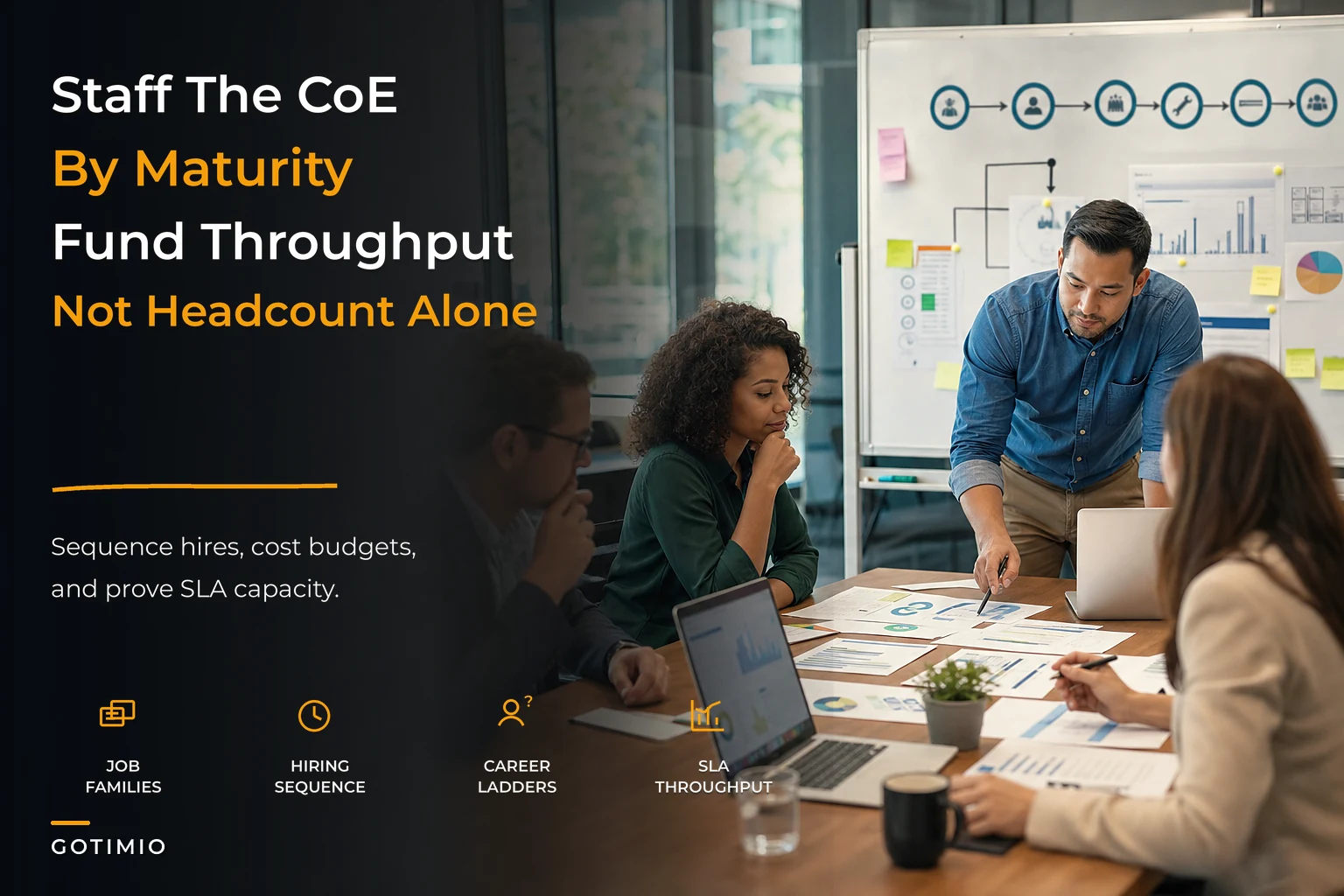
The hiring sequence — order matters more than the roster
Two teams with the same five roles can perform completely differently depending on the order they hired. Hire in the wrong sequence and you spend six months with a team that can't function because a foundational capability is missing.
-
CoE Lead first — but a builder, not a bureaucrat. Your first hire has to instrument the workload, set the initial SLAs, and make the case for hires two through five. If you hire an analyst first, they'll drown in reactive work and never build the system that makes the CoE a CoE.
-
First analyst second. This is your volume relief and your process documenter. Everything they resolve, they should be codifying into a runbook so the next analyst ramps in days, not months.
-
Data-quality / integration engineer third. Once you have two people resolving exceptions manually, the pattern of why exceptions happen becomes visible. That's when the engineer earns their cost — by killing the upstream causes instead of resolving symptoms forever.
-
Configuration specialist fourth, timed to your first real jurisdiction or pay-rule complexity. If you operate in one clean jurisdiction, this can stay fractional or contracted longer.
-
Analytics partner last, once the data is clean enough to trust. Building reporting on dirty time data just industrializes wrong decisions. The analytics partner should arrive after the engineer has stabilized quality, not before.
The pattern worth internalizing: you hire to remove the current bottleneck, not to complete the org chart. A half-built team with the right sequence outperforms a full team hired in the wrong order every time.
Visualizing the sequence makes it easier to explain to finance and stakeholders why order matters.
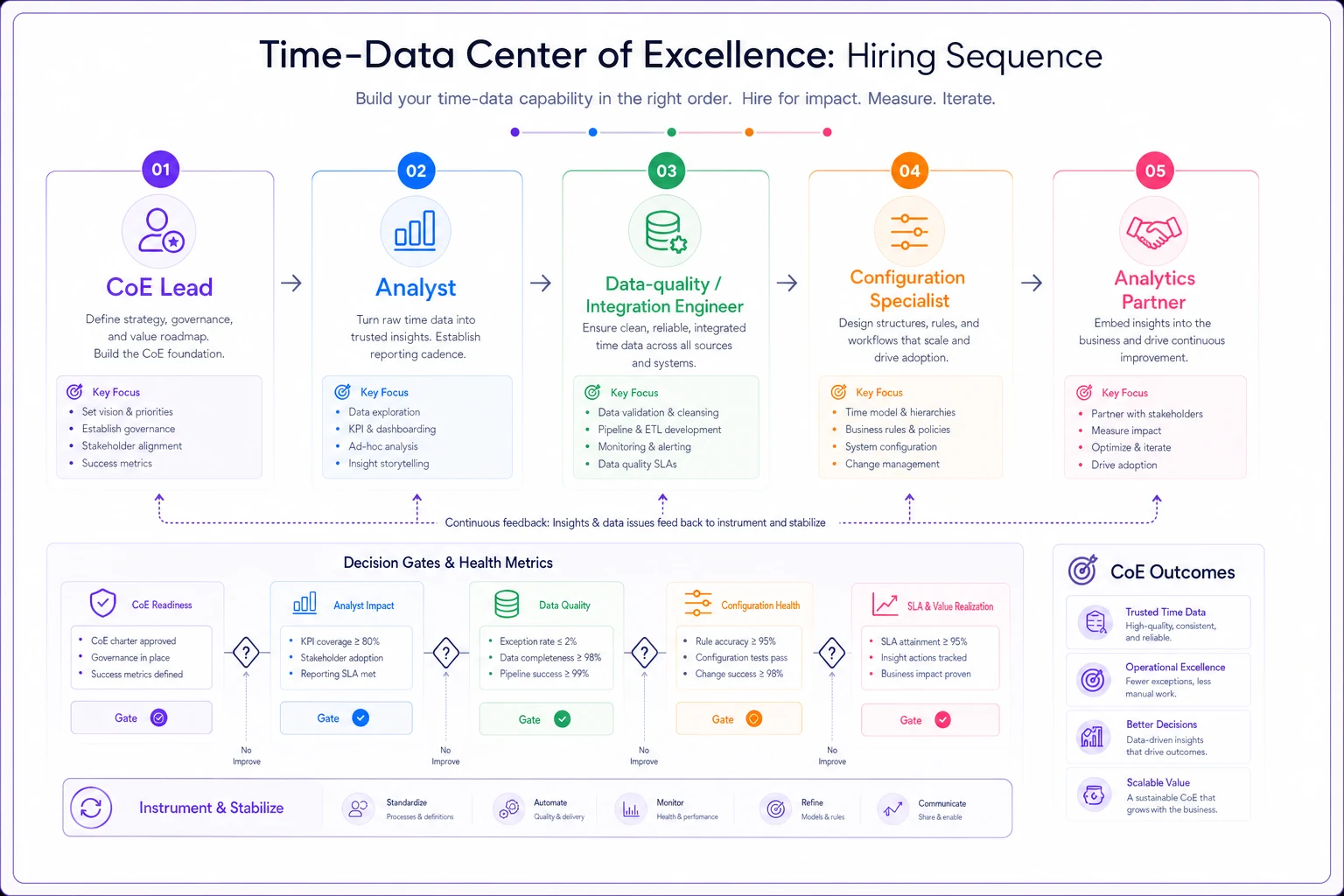
Keeping hires tied to removing bottlenecks rather than filling org-chart slots is what preserves budget flexibility and proves impact.
A 12-month operating plan tied to metrics
Budgets get approved in quarters, so the plan should read in quarters — each with a hire trigger and a measurable exit condition.
Q1 — Instrument and stabilize. Lead plus first analyst. Baseline exception volume, define SLAs, stand up the reconciliation cycle. Exit condition: you can report exception volume and SLA attainment weekly with real numbers.
Q2 — Attack root causes. Add the engineer (or fractional to start). Target the top three exception categories driving 60%+ of volume. Exit condition: measurable decline in the highest-volume exception type and a documented data-quality check suite running on a schedule.
Q3 — Formalize configuration. Bring in the config specialist as jurisdiction and pay complexity warrants. Move pay-rule changes from ad-hoc to a controlled, audited process. Exit condition: config changes deploy with a tested rollback and an audit trail, and audit-pass rate is tracked.
Q4 — Turn data into decisions. Add the analytics partner. Wire clean time data into productivity and profitability views, and into capacity planning. This is where the CoE stops being a cost center and starts feeding the workforce forecasting framework that operations uses to plan headcount and schedules. Exit condition: at least one operational decision — staffing, scheduling, or client profitability — made off CoE-produced metrics.
Each hire in this plan is gated by a metric, not a calendar date. If Q2's root-cause work drops exception volume enough that a third analyst becomes unnecessary, you redeploy that budget — and you'll have the data to defend that choice.
Career ladders keyed to maturity, not tenure
The reason CoE teams lose their best analyst around month 18 is that there's no visible path. They mastered exception resolution, there's nowhere to go, and a recruiter offers them $12k more somewhere else. A ladder tied to CoE maturity metrics fixes this by making advancement about capability the team actually needs.
-
Analyst I — resolves standard exceptions within SLA, follows runbooks. Metric: individual SLA attainment.
-
Analyst II — handles complex investigations (mismatches, retro changes), writes runbooks. Metric: first-pass accuracy plus runbook contributions.
-
Senior Analyst — owns a reconciliation domain, mentors, triages prioritization. Metric: domain SLA plus defect escape rate.
-
Specialist track split — at this point people branch toward configuration, data quality, or analytics based on where they're strongest and where the CoE has gaps.
Tie promotion criteria to the same maturity metrics the CoE reports upward. When the metric that gets someone promoted is the same metric the CoE is judged on, incentives line up — people grow by making the whole system better, not by politicking.
When this full build makes sense — and when it doesn't
Do the full five-family build when: you're past roughly 500 employees with real jurisdictional or capture complexity, time data feeds payroll and client billing and profitability reporting, and exception volume is consistently in the hundreds per pay period. At that scale the cost of not having a CoE — retro corrections, disputed invoices, missed payroll cutoffs — dwarfs the salary line.
Don't build this when: you're a single clean jurisdiction, under a few hundred employees, with badge capture that just works. A fractional config-savvy analyst plus solid tooling covers it. Forcing enterprise org design onto a business that doesn't have enterprise complexity is one of the more expensive vanity moves in ops.
Who should specifically hold off: businesses still fighting basic data-quality fires. If your time data isn't trustworthy yet, hiring an analytics partner or a governance lead just puts polished reporting on top of a broken foundation. Fix capture and quality first, then staff the CoE.
A real scenario
A regional field-services company — roughly 640 employees across three states, a mix of office badge and mobile crew capture — was running its entire time operation on one senior analyst and a lot of spreadsheet heroics. Exception volume was around 900 per pay period. Payroll was late to close about one cycle in three, and they'd eaten two client billing disputes in a quarter over tracked project hours.
They staffed properly over about nine months: promoted the existing analyst to lead, hired two analysts, and brought in an integration engineer at roughly half time to attack the mobile-capture exceptions that were generating close to 40% of the volume.
The numbers moved the right direction. SLA close rate went from missing about a third of cycles to hitting SLA on nearly all of them. The engineer's work on offline capture reconciliation cut the recurring mismatch exceptions by more than half within two quarters — which meant the analyst headcount they'd budgeted for month 12 got deferred. The root-cause work removed the volume that would have justified it. Fully loaded, the team cost somewhere in the low-to-mid $300ks annually, and it paid for itself between the recovered billing accuracy and no longer paying people to reconcile the same problems every fortnight.
The part worth noticing isn't the SLA number. It's that the sequence — lead, analysts, then engineer targeting root cause — is what let them avoid an unnecessary fifth hire. Hire the engineer first with no volume baseline and you can't prove the impact. Hire the fifth analyst before the engineer and you've locked in a permanent cost to manage a problem you could have deleted.
Bringing it together
Staffing a time-data Center of Excellence isn't an HR exercise bolted onto a technical function — it's the point where your maturity model has to survive contact with a budget. The teams that get it right count the work before they draw the org chart, size headcount off throughput math instead of gut feel, hire in an order that removes bottlenecks rather than fills seats, and gate every hire against a metric someone in finance can see.
Get the sequence and the throughput math right and the budget conversation stops being a negotiation. You're not asking for people — you're showing that a specific volume of work, at a specific SLA, requires a specific team, and here's the number. That's the version of the staffing plan that actually gets funded, and more importantly, the version that holds together when the volume spikes and the pay cutoff doesn't move.
Staffing a time-data Center of Excellence isn't an HR exercise bolted onto a technical function — it's the point where your maturity model has to survive contact with a budget. The teams that get it right count the work before they draw the org chart, size headcount off throughput math instead of gut feel, hire in an order that removes bottlenecks rather than fills seats, and gate every hire against a metric someone in finance can see.
Get the sequence and the throughput math right and the budget conversation stops being a negotiation. You're not asking for people — you're showing that a specific volume of work, at a specific SLA, requires a specific team, and here's the number. That's the version of the staffing plan that actually gets funded, and more importantly, the version that holds together when the volume spikes and the pay cutoff doesn't move.
Ready to optimize your workforce time management?
Join 2,000+ companies using GoTimio to improve timesheet accuracy, reduce payroll errors, and boost team productivity.