

Most time-data programs don't fail because the technology is bad. They fail because nobody agreed, in writing, who owns the data, who pays for the systems that move it, and what happens when a late feed breaks payroll or a project margin comes out wrong. The tooling can be excellent and the program still stalls, because the operating model underneath it is a handshake agreement between Payroll, Finance, HR, and whatever operations team happens to generate the hours.
This is the gap this article is about. Not "how to track time" — you already do that. The question is how to wire the money and the accountability so that the time-data function behaves like a real operating unit with budget, service commitments, and consequences. When a Center of Excellence or a shared services team owns this, the difference between a funded, enforceable model and a vague one shows up fast — usually around month-end, usually as finger-pointing.
Below is how these models actually get structured, where they break, and how to decide between chargeback and central funding without turning the whole thing into a budgeting war.
The structural problem: time-data sits between four teams and belongs to none of them
Operations and line managers generate raw time events. HR owns policy — rounding, overtime rules, PTO interaction. Payroll consumes the data and has the hardest deadline in the company. Finance wants the cost allocation and project margins out the other end. IT or a platform team keeps the integrations alive.
Five stakeholders, one stream of data, and in most mid-market companies, zero clear owner of the stream itself. What you get instead is a diffuse responsibility model where everyone owns a slice and nobody owns the throughput.
The practical consequence: when something breaks, the cost lands wherever the deadline is hardest — usually Payroll — but the control to fix it sits somewhere else, usually in the operations team that generated the bad punches. Payroll gets blamed for a problem they can't structurally solve. That mismatch between accountability and authority is the most common reason these programs feel chronically under-resourced.
A funded operating model fixes this by doing three unglamorous things:
-
Naming a single owner for the time-data stream (not the policy, not the payroll run — the stream)
-
Deciding how that owner's budget gets funded
-
Tying service commitments to measurable throughput, with consequences attached
Each of those is a decision, and the order matters. You can't negotiate SLAs before you've settled funding, because whoever pays will always try to dictate the service levels.
Chargeback vs central budget: the decision that sets everything downstream
Either the time-data function is funded from a central budget (a cost center that absorbs the spend), or its costs are charged back to the business units that consume the service — each department pays for the hours it processes, the integrations it uses, the exceptions it generates.
Accurate time tracking made effortless.
GoTimio empowers your team to log, monitor, and manage work hours seamlessly.
- Real-time time tracking
- Automated timesheet approvals
- Payroll and billing integration
No credit card required
| Dimension | Central budget | Chargeback |
|---|---|---|
| Who pays | One cost center absorbs all spend | Consuming business units pay proportionally |
| Behavioral effect | Teams treat time-data as "free," demand grows unchecked | Teams feel the cost of their own messiness |
| Best when | Early maturity, small org, need adoption | Scaled org, mature usage, cost discipline needed |
| Biggest risk | Unlimited demand, no accountability for exceptions | Teams underinvest, dispute every invoice, game usage |
| Admin overhead | Low | High — needs metering, allocation rules, dispute process |
| SLA leverage | Weak (payer is the provider) | Strong (payer can hold provider accountable) |
The pattern worth internalizing: central funding drives adoption but destroys cost discipline. Chargeback drives discipline but creates friction and gaming. Neither is "better." They're appropriate at different stages.
When central budget actually makes sense
Early on, when you're still getting people to use the system correctly, chargeback is poison. If a department gets invoiced every time they submit a messy timesheet, they'll quietly route around the system — spreadsheets, side agreements, delayed submissions — and data quality collapses before the program has a chance to prove itself.
Central funding during the adoption phase removes that friction. You want demand up in the first year. You want every team pulling reports, flagging exceptions, asking for integrations. A cost center absorbs that and you worry about discipline later.
Central budget also makes sense when the org is small enough that the metering overhead of chargeback would cost more than the behavior it corrects. If you're allocating $400k of spend across four departments, building a usage-metering apparatus to split it is a waste of everyone's quarter.
When chargeback starts earning its keep
Chargeback becomes the right call when two things are true: usage is mature, and someone's abusing the "free" nature of a central model. The classic trigger is one business unit generating a wildly disproportionate share of exceptions — late submissions, retroactive edits, badge mismatches — while contributing the same flat share of a central budget as everyone else. They have no reason to clean up their act because their mess is subsidized.
A well-designed chargeback model makes that visible and expensive. The operations unit that generates 60% of the manual corrections should pay for roughly 60% of the correction effort. Suddenly their manager has a reason to care about first-pass accuracy, because it hits their cost line.
The other reason to move to chargeback: it gives the payer real SLA leverage. Under central funding, the time-data team is both provider and (effectively) payer, so service commitments are toothless. Under chargeback, the business unit is a customer, and customers can enforce SLAs with credits, disputes, and escalation. That's what makes accountability real instead of aspirational.
The hybrid most mature orgs actually land on
In practice, the stable end-state is usually a split. Core platform and baseline capacity get funded centrally — the integrations, the data warehouse, the standing team. Marginal consumption gets charged back — excess exception handling, custom reports, premium integrations, out-of-cycle corrections.
This gives you adoption at the base layer and discipline at the margin. Nobody disputes the existence of the core platform; they dispute (and therefore manage) their own incremental messiness. It's more complex to administer, which is why it's an end-state and not a starting point.
The throughput economics: FTE math that justifies the whole thing
Funding arguments die without unit economics. You need to be able to say what one FTE on this team processes and what a correction costs, or the budget conversation becomes a feelings debate.
A typical mid-market time-data analyst can process and assure time data for somewhere around 800–1,200 employees per pay period, depending on exception rates and how much the upstream capture is cleaned up. That's not a precise constant — it swings heavily with data quality — but it's a planning anchor.
The exception rate is the real cost driver. A clean operation might see 2–4% of timesheets requiring manual intervention. A messy one runs 12–18%. Each manual correction — the investigation, the approval chase, the edit, the audit note — eats somewhere between 6 and 15 minutes of fully-loaded analyst time once you account for back-and-forth.
Run the math on a 2,000-employee org:
-
At a 4% exception rate
roughly 80 corrections per period, maybe 15–20 hours of handling
-
At a 15% exception rate
roughly 300 corrections per period, closer to 60–75 hours of handling
That's the difference between part of one FTE and nearly two full FTEs — for the same headcount, driven entirely by upstream data quality. This is exactly the number that justifies investing in capture quality and, in a chargeback model, exactly the number you allocate back to whoever's generating the exceptions.
Track corrections per FTE each period to justify staffing and demonstrate the cost impact of exception-rate improvements.
When you build the staffing and funding case, the throughput-per-FTE figure and the exception-driven cost multiplier are the two numbers that make the whole budget defensible. The staffing and budget blueprint for a time-data Center of Excellence goes deeper into how those roles and ratios scale, and it's worth lining that up against whichever funding model you choose.
SLAs that tie to throughput, not vibes
Most "SLAs" in time-data programs are decorative. They say things like "data will be accurate and timely," which is unenforceable because it's unmeasurable. A real SLA commits to a number, attaches a consequence, and names the owner on both sides.
The accountability matrix is where this lives. For every commitment, you want four columns: the metric, the threshold, the owner who delivers it, and the consequence when it's missed. Without all four, it's not an SLA — it's a wish.
| Commitment | Threshold | Owner | Consequence on breach |
|---|---|---|---|
| Time feed delivered to payroll | By T-2 before cutoff, 99% of periods | Time-data team | Escalation + root-cause within 48h |
| First-pass timesheet accuracy | ≥ 92% clean on submission | Line managers | Exception cost charged to unit |
| Exception resolution | 95% resolved within 1 business day | Time-data team | Payroll credit / escalation |
| Retroactive edits closed | 100% approved + logged before close | HR + Payroll | Close blocked, flagged to finance |
| Integration uptime | 99.5% during pay-processing window | Platform team | Incident review + remediation plan |
Notice the ownership isn't all on the time-data team. First-pass accuracy is a line manager commitment, because they control the upstream capture. That's the point — the SLA matrix distributes accountability to wherever the control actually sits, which is the exact thing broken in the default diffuse model.
For uptime and feed-timeliness commitments, you need observability behind them or the numbers are just claims. The operational grounding for the integration and feed SLAs — what to measure, how to alert, where to escalate — is covered in the payroll-aware SLOs for time systems catalogue, and I'd treat that as a prerequisite before publishing any uptime SLA you intend to enforce.
Enforcement patterns: SLAs without teeth are just documentation
A commitment with no enforcement mechanism decays within two quarters. People test whether the threshold matters, discover it doesn't, and drift. So the enforcement pattern matters as much as the threshold.
There are a handful of enforcement mechanisms that actually work:
-
Financial credits. Under chargeback, a missed SLA generates a credit against the consuming unit's invoice — or, flipped, the unit that generates excess exceptions pays a surcharge. Money is the most reliable behavior modifier.
-
Close blocking. A hard control where the month-end close cannot proceed with unresolved retroactive edits or unreconciled exceptions above threshold. Aggressive, but effective — it makes the problem everyone's problem on a deadline.
-
Escalation ladders. A breach auto-escalates — first to the owning manager, then to the function head, then to the CoE steering committee — on a defined timeline. The visibility itself drives resolution.
-
Scorecard exposure. Unit-level SLA performance published to leadership quarterly. No department head wants to be the red cell in a deck the CFO reads.
The enforcement pattern you can actually sustain depends heavily on your funding model. Chargeback orgs lean on financial credits because the invoicing machinery already exists. Centrally-funded orgs lean on close-blocking and scorecard exposure because they don't have an invoice to adjust. Pick enforcement that fits your funding plumbing, or it won't stick.
Where enforcement usually goes wrong
The common failure is enforcing against the wrong owner. A late payroll feed gets pinned on the time-data team, when the actual root cause was a line manager who approved 40 timesheets at 4:58pm on cutoff day. The SLA breach was real; the accountability was misrouted. If your matrix doesn't cleanly separate "who delivers the feed" from "who delivers clean upstream data," you'll punish the team that's downstream of the actual problem — and they'll stop trusting the whole system.
Org charts: three models that actually appear in the wild
How you structure the org follows directly from your funding model.
Centralized CoE model. A single time-data team reports to Shared Services or Finance, owns the stream end-to-end, and serves all business units. Funded centrally or via chargeback. This is the cleanest ownership model and the one that scales best past roughly 2,500 employees. The risk is distance from the floor — the central team can lose touch with how operations actually captures time.
Federated model. A small central team sets standards, owns the platform, and runs assurance, while embedded analysts sit inside large business units. The embedded people report dotted-line to the CoE for standards, solid-line to their unit. This works when business units are genuinely different — a manufacturing floor and a professional services arm capture time in fundamentally different ways. The risk is standards drift across the federation.
Payroll-anchored model. The time-data function lives inside Payroll. Common in smaller orgs. It's efficient because Payroll has the most skin in the game, but it creates a conflict: Payroll both produces the assurance and consumes the output, which weakens independence. Fine at small scale, problematic once you need defensible, independent data quality attestation.
The org chart isn't a cosmetic choice — it determines whether your SLAs are enforceable. A payroll-anchored team can't credibly hold an SLA against payroll. A centralized CoE can. If you're building toward enforceable accountability, the structure has to create enough independence for the SLA to mean something. The maturity progression across these structures — along with the RACI and operating-rhythm templates that go with each stage — is laid out in the time-data Center of Excellence maturity model, which pairs naturally with the funding decisions here.
A chargeback template you can actually run
If you go the chargeback route, the allocation logic has to be transparent or every invoice becomes a dispute. A workable structure splits the charge into a base component and a usage component:
-
Base allocation — split by headcount processed. Covers platform, baseline capacity, standing team. Predictable, hard to argue with.
-
Exception allocation — split by exceptions generated by each unit. This is the behavioral lever. Units that run clean pay less.
-
Premium services — direct-charged. Custom reports, bespoke integrations, out-of-cycle runs. Billed to the requester.
A simplified quarterly chargeback line for a business unit might read:
-
Base (420 employees × base rate)
the bulk, steady every quarter
-
Exception handling (unit generated roughly 18% of total exceptions)
their proportional share of correction cost
-
Premium (two custom margin reports, one off-cycle correction run)
direct charges
The exception line is what changes behavior. Once a unit sees that their 18% share of exceptions translates into a line item their own cost center absorbs, the conversation inside that unit shifts from "Payroll keeps nagging us" to "why are we generating so many corrections?" That's the entire point of chargeback — moving the cost of messiness to the people who can actually fix it.
A quarterly assurance cadence that keeps the model honest
A funding and SLA model isn't set-and-forget. It drifts. Exception rates creep, business units renegotiate quietly, SLAs stop being enforced. A quarterly assurance rhythm keeps it alive:
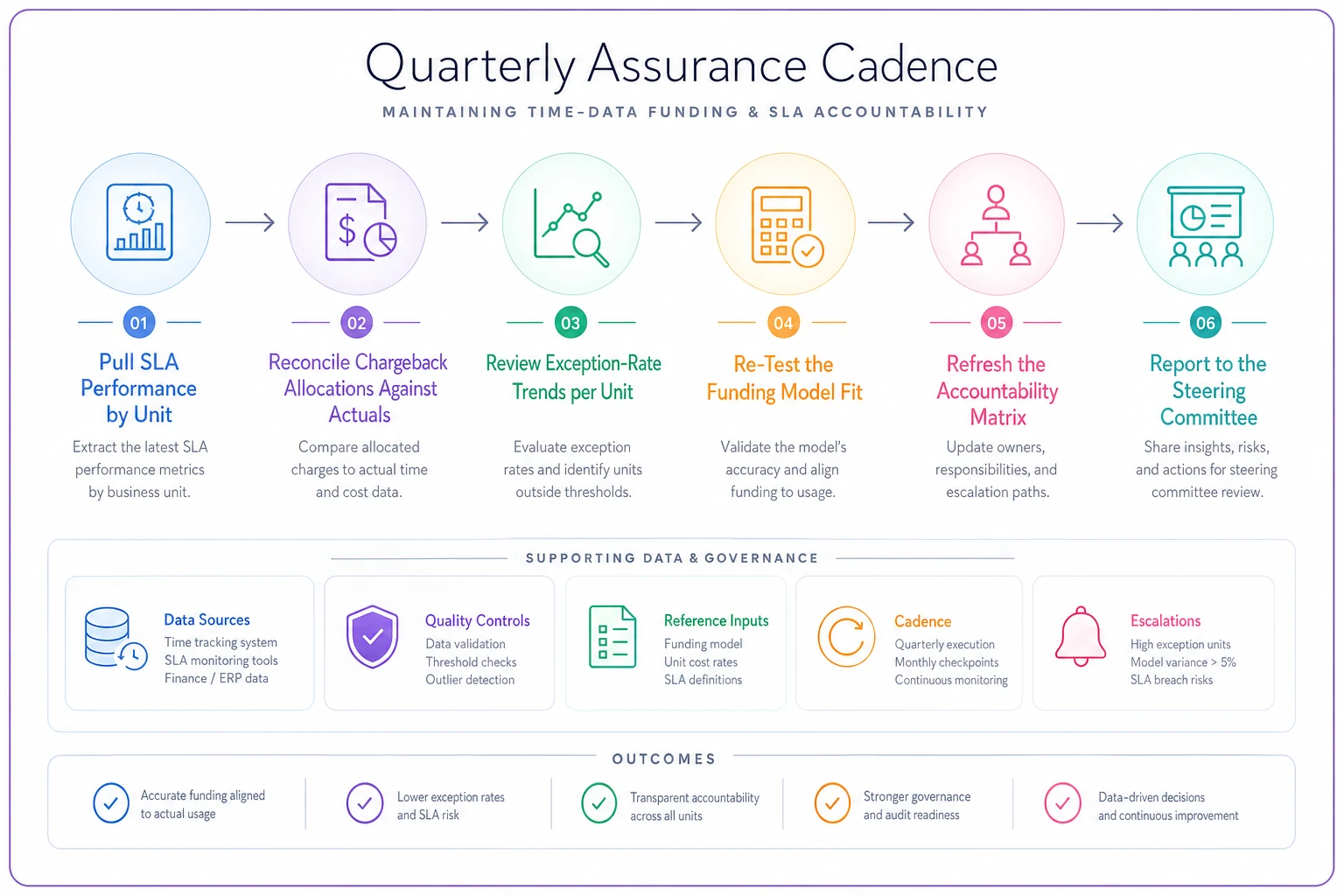
A simple visual like this helps stakeholders see the recurring steps and who owns each checkpoint.
-
Pull SLA performance by unit and by commitment. Not aggregate — disaggregated, so you can see which unit and which metric drifted.
-
Reconcile chargeback allocations against actuals. Did the metered usage match what you invoiced? Dispute patterns tell you where the allocation logic is weak.
-
Review exception-rate trends per unit. A rising exception rate in one unit is a leading indicator of a future cost spike and a future payroll incident.
-
Re-test the funding model fit. Has any unit outgrown central funding? Is chargeback friction costing more than the discipline it buys? The right model at 800 employees is often wrong at 3,000.
-
Refresh the accountability matrix. Owners change, thresholds need tightening as data quality improves, new integrations need new SLAs.
-
Report to the steering committee. Red cells, cost trends, and any proposed model changes go up to leadership with a recommendation, not just data.
The step most teams skip is #4. They lock in a funding model during the adoption phase and never revisit it, so central funding keeps subsidizing messy units long after the org could support chargeback. The quarterly re-test is what prevents that from calcifying.
A real scenario: moving from diffuse to funded
A regional field-services company, roughly 1,400 employees across six branches, had the classic diffuse setup. Time data was "handled" by two payroll clerks who also ran payroll. No defined owner of the stream, no SLAs, central funding by default — it was just absorbed in the payroll cost center.
The symptom that forced change: month-end close was slipping two to three days nearly every month, and one branch was generating an outsized share of retroactive edits — somewhere north of half the total corrections despite being under a quarter of total headcount. Under central funding, that branch had zero reason to care. Their mess was invisible to them.
They restructured. Created a small central time-data function (carved out of payroll, two people, independent of the payroll run itself). Put a base-plus-exception chargeback model in place. Published a six-row SLA matrix with first-pass accuracy owned by branch managers, not the central team.
The exception allocation did the work. Once the problem branch saw a quarterly line item reflecting their share of correction cost, their manager actually dug into the root cause — turned out to be a scheduling process that generated late approvals every single cycle. Within two quarters their exception contribution dropped by more than half, total corrections across the company fell noticeably, and close stabilized to within the window most months. Nothing exotic happened technologically. The incentive changed, and behavior followed.
How to decide what's right for you
If you're setting this up or fixing a drifting one, the sequence matters more than any single choice:
-
Settle ownership first. Name one owner of the stream before anything else. Diffuse ownership is the root problem.
-
Match funding to maturity. Early adoption → central. Mature usage with discipline problems → chargeback or hybrid. Don't charge back before people trust the system.
-
Build the FTE-throughput model so your funding case rests on unit economics, not opinion.
-
Write SLAs with all four columns — metric, threshold, owner, consequence — and route accountability to where control actually sits.
-
Pick enforcement that fits your funding plumbing. Financial credits for chargeback, close-blocking and scorecards for central.
-
Run the quarterly assurance cadence, and actually re-test the funding model each quarter instead of locking it in forever.
When this is a bad idea
Don't build a formal chargeback apparatus for an org that's too small to need it — the metering overhead will cost more than the behavior it corrects. Don't impose hard close-blocking enforcement before your data quality is good enough to survive it, or you'll block close on noise and everyone will route around the control. And don't anchor the time-data function inside Payroll if you need defensible, independent data-quality attestation — the conflict of interest is real, and auditors notice.
The thread running through all of it: time-data funding and accountability is a systems design problem, not a tooling problem. Who owns the stream, who pays for it, and what happens when it drifts — those three decisions shape every downstream behavior. Get the incentives right and the hours clean themselves up. Get them wrong, and no amount of technology will stop the finger-pointing at month-end.
The thread running through all of it: time-data funding and accountability is a systems design problem, not a tooling problem. Who owns the stream, who pays for it, and what happens when it drifts — those three decisions shape every downstream behavior. Get the incentives right and the hours clean themselves up. Get them wrong, and no amount of technology will stop the finger-pointing at month-end.
Ready to optimize your workforce time management?
Join 2,000+ companies using GoTimio to improve timesheet accuracy, reduce payroll errors, and boost team productivity.